

One possible sign of the times is the fallout of the hedge fund Situational Awareness (with its 4x leverage). Will we look back at this as the first cracks in the AI bubbble? Leopold Aschenbrenner’s hedge fund, Situational Awareness, dropped from about $45 billion to $10 billion in under a month, tied to the AI selloff we’ve been tracking in the newsletter (the Nasdaq correction, Meta’s cash flow hit, momentum-to-value rotation). here are a couple of Youtube videos if you’re interested: The Biggest Hedge Fund Blow-Up of 2026 EXPLAINED , Situational Awareness: How a 25-Year-Old’s Hedge Fund Exposed the Entire AI Bubble
Too Busy? Got Better Things to Do? Read the Summary…
Cat got your tongue Mr Warsh?: Fed Chair Kevin Warsh held rates at 3.5 to 3.75% on Wednesday but gave almost nothing away in his press conference, echoing his stated preference for opacity. Markets punished the silence: yields steepened sharply, the Nasdaq 100 slid over 10% from its peak, and three regional Fed presidents dissented in favor of a hike, an unusually large split. Bond markets read the non-answer as dovish and are now pricing a higher risk that inflation forces a bigger hike later, making this the classic “market tests the new chair” moment every incoming Fed head seems to face.
Maxing out?: Microsoft and Meta’s earnings became a referendum on AI capital spending. Microsoft surged 15.5%, its largest single-day value gain ever, after Azure revenue topped $100 billion and it trimmed 2026 capex guidance to $175 billion. Meta fell as much as 10% after free cash flow dropped to $784 million, its lowest in nearly four years, even as it raised its capex floor to $130 billion. The split underscores investor anxiety that AI spending may be outrunning proven returns.
Ai Eish?: Market leadership is rotating away from the Magnificent Seven narrative that has dominated since ChatGPT’s 2022 launch. The equal-weighted S&P 500 hit an all-time high while the Nasdaq 100 flirted with correction territory, and momentum stocks have badly lagged value this month. The 25 best first-half performers (mostly AI infrastructure names) are down an average of 36% in July, while the 25 worst are up 14%, suggesting the market is regrouping around a new story rather than abandoning AI altogether.
IPO announcement, time to sell?: SpaceX’s record IPO coincided almost exactly with the Nasdaq peak, reviving the idea that insider share sales signal insiders think valuations have topped. Hyperscalers increasingly prefer raising equity over debt to fund capex given their rich multiples, and 2026 could be the first year in decades that equity supply rises broadly. Appetite for OpenAI and Anthropic IPOs is reportedly cooling as a result.
US Housing dilemma: Housing has stopped acting as a reliable growth engine, with elevated 30-year mortgage rates near 6.7% (a one-year high) locking in low pandemic-era borrowers and squeezing builder margins. Affordability, per the NAR index, is barely better than just before the 2008 crash, though this is described as a soft market rather than a repeat crisis. Whether housing recovers or reveals deeper economic weakness may hinge on what happens once the AI spending boom cools.
Investment focus, REITs: SA listed property has swung from a strong 2011 to 2017 run through a brutal 2018 to 2020 collapse (Resilient governance scandal, then COVID discounts to NAV of up to 55%) to back-to-back standout years in 2024 and 2025, each near 30% returns, driven by rate cuts and GNU-driven confidence. Fairvest and Hyprop stood out as 2025’s top performers, and the sector’s Regulation 28 status as a distinct equity-boosting category is regaining relevance.Hermès loses its Birkin: Hermès grew half-year revenue 6.1% at constant currency but warned of high single-digit rather than double-digit growth ahead, triggering a selloff that took shares down as much as 13% and roughly 63% below their 2025 peak. Weak Asia-ex-Japan growth (2.4%, tied to China’s property hangover) and slowing ready-to-wear sales point to a thinning marginal buyer base, raising the question of whether even best-in-class luxury names can sustain 35 times earnings valuations.





By common consent, the gold standard for an uncommunicative interview belongs to the late Dr. Hastings Banda, for decades the president of Malawi. In 1962, when the campaign for independence from Britain was at its height, he gave a one-minute interview to the BBC in which he answered nearly every question with a version of: “I won’t tell you that.” Followed closely by Dr Fauci in the last week with his 50 invocations of the 5th amendment (despite being pardoned by Biden – shows how much he trusts Toxic Trump 2.0 who has already floated reversing pardons more than once.) Trump famously invoked the 5th 450 times during his Senate hearings on the Jan 6th enquiry.
Kevin Warsh’s performance during his 45-minute press conference on Wednesday was far more charming. But his bottom line was much the same, and the market wasn’t buying it.
Warsh is actually considering doing away with press conferences — a policy that Banda would probably have approved — and it might have saved everyone some time if he’d cut the niceties and simply done a Banda.
Paradoxically, his second outing as chair of the Federal Open Market Committee should have been a non-event. Rates didn’t change. Neither did the accompanying official statement. There were no dot plots or projections, and Warsh ducked questions about future intentions and reaction functions.
Yet a non-event it was not. Markets rewarded him with the sharpest steepening of the yield curve in a year, and a late selloff for stocks that brought the Nasdaq 100 more than 10% below its peak. Explaining quite what happened and why is tricky.
The statement was short enough to reprint in full, again. It was also essentially unchanged from the last meeting in June. The only alteration is underlined, (which did nothing more than update a tense).
The Committee decided to maintain the target range for the federal funds rate at 3-1/2 to 3-3/4 percent, in support of the Federal Reserve’s dual mandate. The Committee is continuing [reaffirmed] its policy of maintaining ample reserves in the banking system. Economic activity is expanding at a solid pace despite elevated uncertainty that owes, in part, to the conflict in the Middle East. Productivity growth and capital investment are strong. Job gains have kept pace with the workforce, and the unemployment rate has changed little. Inflation remains elevated relative to the Committee’s 2 percent goal, in part reflecting supply shocks that have driven price increases in certain sectors, including energy. The Committee will deliver price stability.
That’s pretty disrespectful, frankly. At least run it through your favourite chatbot (probably Grok) and reword it…
After all, it’s been an eventful six weeks, with the oil price falling and then resurging as the Middle East conflict spun out of control again, while both inflation and employment data in the US were surprisingly moderate, yet one of these merited a change to the statement?
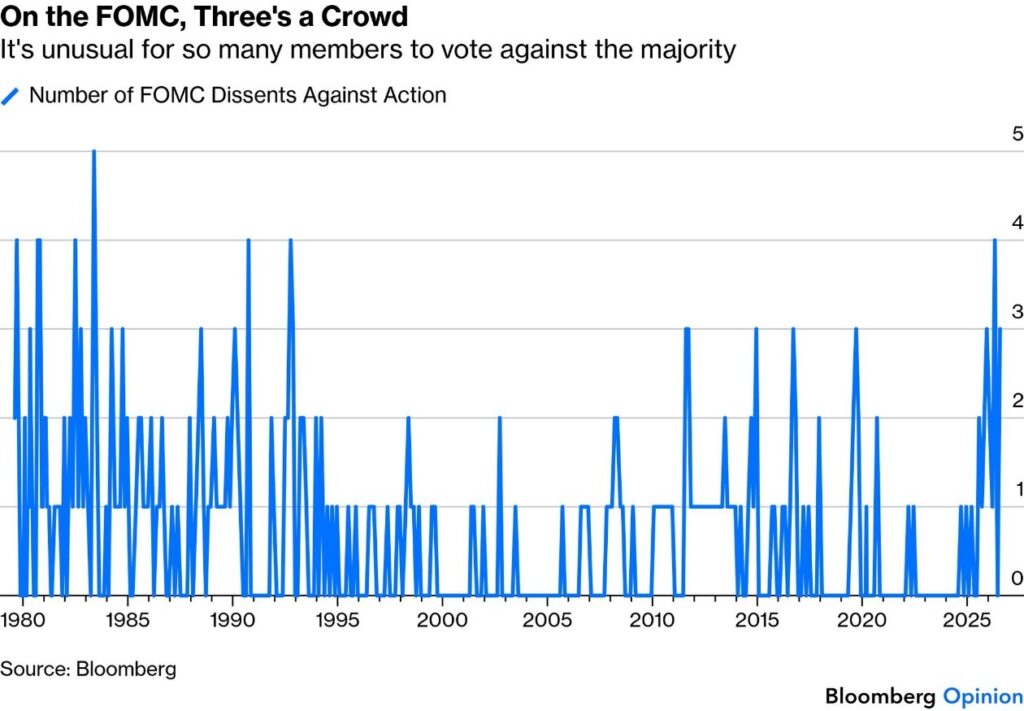
But even though inflation had dropped between the meetings, three governors of regional Feds voted to hike rates this time, in contrast to the unanimity in June to stay on hold. That was only the sixth time in the last 30 years that as many as three FOMC members dissented:
Despite the statement of intent, fed funds futures responded by trimming their implied path for the future. There had been a non-trivial chance of a hike, and that dominated the action. But overall, it’s noticeable that the market’s projections really haven’t changed much so far under Warsh.
Then came the press conference. There, Warsh could explain the dissents, justify the decision to overrule them, and reassert his hawkish credentials. He did none of these. Warsh is known to favour doing away with press conferences altogether, and was expected to speak somewhat opaquely, as Alan Greenspan used to do. The stock market’s reaction showed the “Banda” approach didn’t go down well:
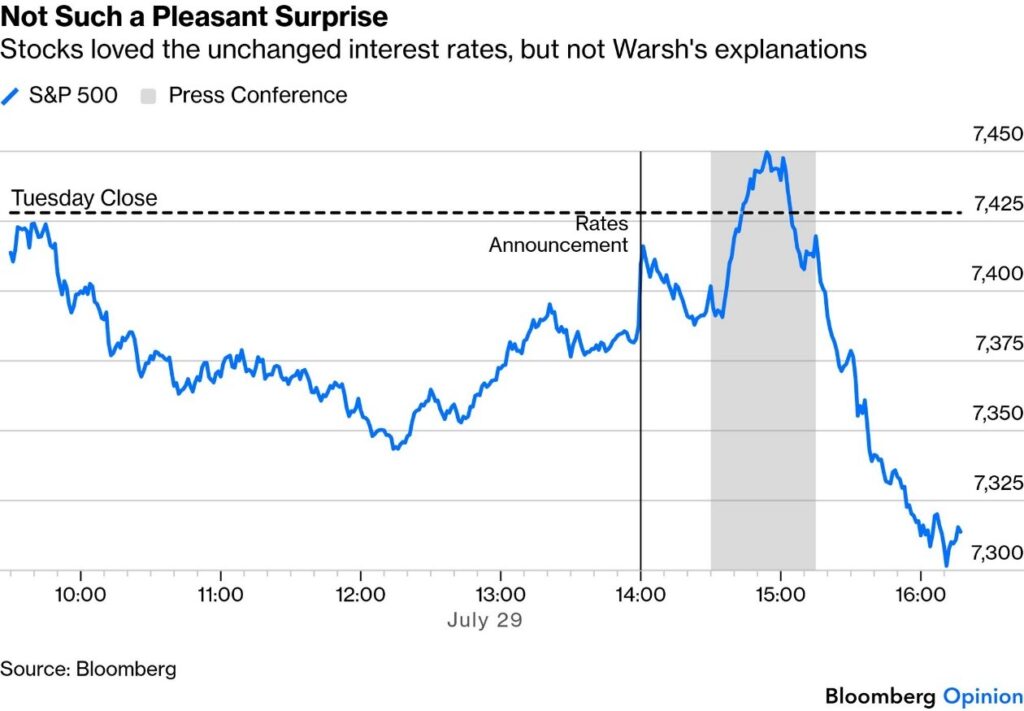
Stocks found the performance unconvincing, and retreated from initial glee that a hike had been avoided. The critical verdict came from bonds.
You wouldn’t guess Warsh had said almost nothing from the way bond yields moved as he was speaking; they clearly did not approve. (Interestingly, bonds are usually bought and sold by ‘professional’ investors – the asset managers and institutions who don’t usually operate on a whim. The fall in the two-year yield suggests that traders think he revealed himself as a dove.
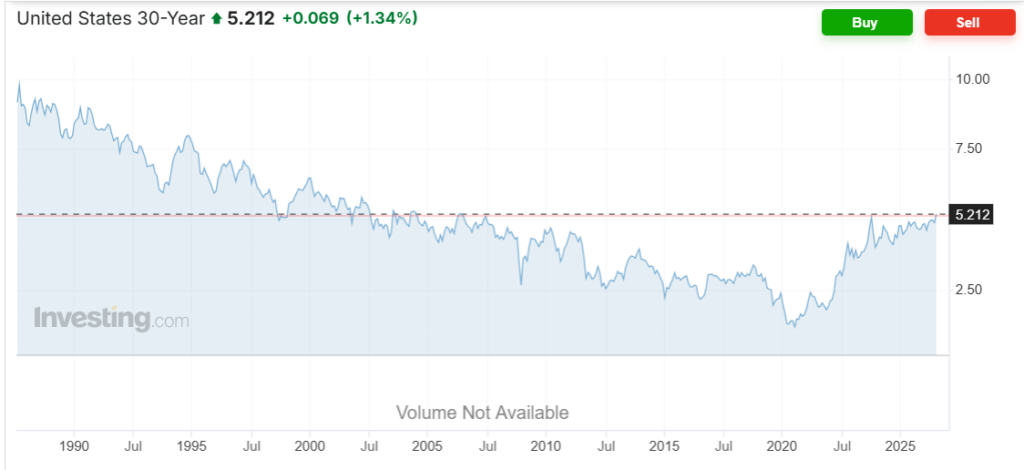
The rise in the 30-year yield, which touched its highest since 2007, shows traders think this will prove to be a mistake, bringing higher inflation and forcing the Fed to hike more in the longer term. That’s quite a vote of no-confidence. (US consumers are not going to be happy either, as their mortgage rates are linked to the long-term Treasury bond yield.)
The predominant emotion was confusion, plain and simple, as both ends of the yield curve retraced a lot of their moves after the conference ended.
What went wrong?
Those dissents can best be interpreted as the governors registering their belief that rates were going to go up at this meeting, in line with the hawkish stance Warsh had outlined in June. If you’re going to be a hawk, at some point you need to bare your talons and pounce. The dissenters — in line, apparently, with the market — didn’t find complete inactivity this month to be credible.
You don’t make monetary policy ‘boring’ by saying nothing – boring comes from increased certainty going forward. The fact that 3 of the governors are not in alignment is very telling.
Warsh seems to be taking a leaf out of his boss’s tattered book of spin – talk up the economy long enough and loud enough and everyone will believe you. In this case, clearly not.
The persistently high Treasury rates have made it much more difficult for Warsh to roll over debt that is falling due, even the 2 year rate , the fall-back position so that they can roll over short-term and wait for the long-term bonds to fall to a more palatable level, has been coming unstuck for a while.
The net result is that it will grow much harder to resist a hike next time, just to offer belated proof of his hawkish bona fides. One rule of central banking is confirmed. When a new chair arrives at the Fed, the market tests them. Inevitably, they make a mistake that investors leap on. Jerome Powell said he could reduce the balance sheet “on autopilot”; Ben Bernanke thought he could kvetch to Maria Bartiromo off the record; and now Warsh believes he needn’t explain why he wasn’t raising rates when inflation was too high. Powell and Bernanke lived and learned. Warsh must do the same.

Investors in the AI trade couldn’t wait for the earnings of Microsoft Corp. and Meta Platforms Inc. – two hyperscalers worth a combined $4.5 trillion. With the Nasdaq 100 slipping into correction before the release, unease about artificial intelligence had been fueled by shrinking free cash flow that raised the question of whether the industry was spending too much.
And indeed for both companies, their announcements on cash, and what they intended to do with it in future, overshadowed everything else. Meta didn’t dispel those concerns, with its shares tumbling by as much as 10% in after-hours trading after it revealed that free cash flow in the second quarter fell to $784 million, its lowest level in almost four years.
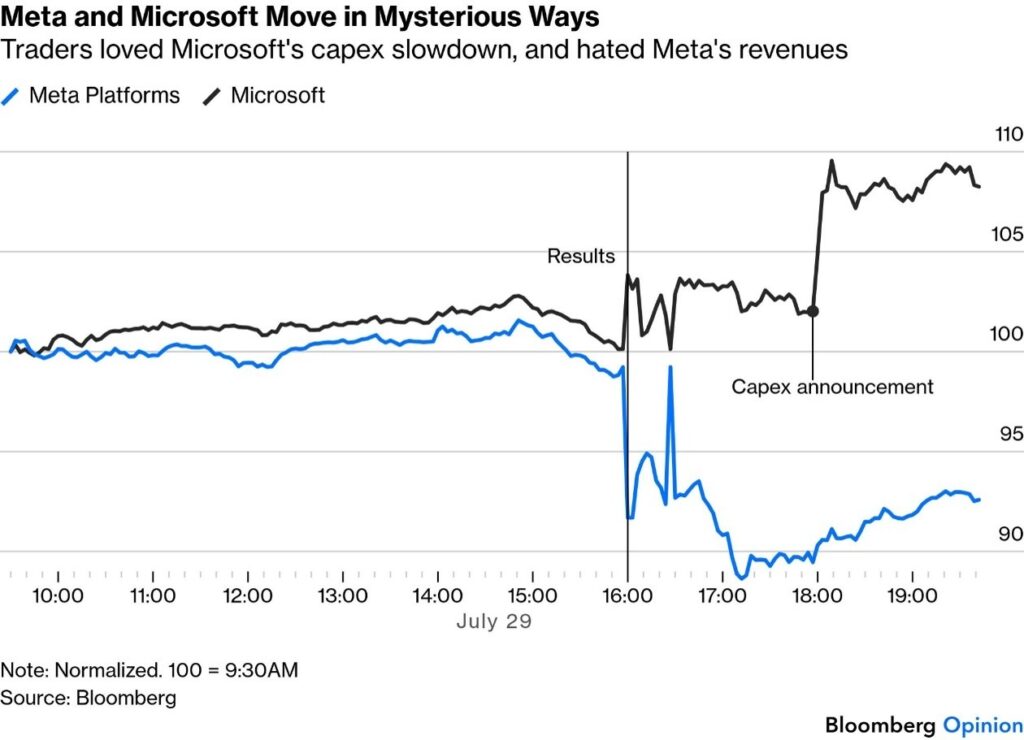
This was hardcore evidence that Mark Zuckerberg’s AI investment is exacting a heavy toll. Meanwhile, Microsoft’s shares surged, particularly after it cut estimates for this year’s capital expenditures to $175 billion from $190 billion:
Meta compounded concerns by raising the lower end of its full-year capital expenditure forecast to $130 billion from $125 billion (the upper end remained at $145 billion). Zuckerberg’s assertion that there is “nowhere near enough compute for all the demand” amounts to a justification for even greater capital spending at a time when investors are still looking for evidence that previous AI commitments are generating adequate returns. This is far from the reassurance desired after similar cost growth at Alphabet Inc. and Tesla Inc.
Every dollar of AI capex rests on the proposition that demand for computing power will keep accelerating. This assumes a limitless demand stemming from endless inference workloads, autonomous agents and new models that reinforce each other. Frankly, nothing is limitless…
The risk is that efficiency gains, model commoditization, or slower-than-expected enterprise adoption cause demand to plateau well below the capacity now being built, leaving the industry with a glut of expensive, rapidly depreciating infrastructure. Investors remain open to evidence that AI is paying off. Even before the capex announcement, the fastest revenue growth in four years at Microsoft’s Azure cloud unit sent its shares surging. The 43% leap pushed Azure’s annual sales above $100 billion for the first time. If Chief Financial Officer Amy Hood’s forecast for 45% Azure growth next quarter materialises, Microsoft may have made its case for more AI spending.

Markets run on narratives. Hundreds of thousands of investors, big and small, turning their ‘guesses’ into share picks. It grows ever clearer the longer you cover the workings of finance, and it’s impossible to explain what is happening now without talking in tales.
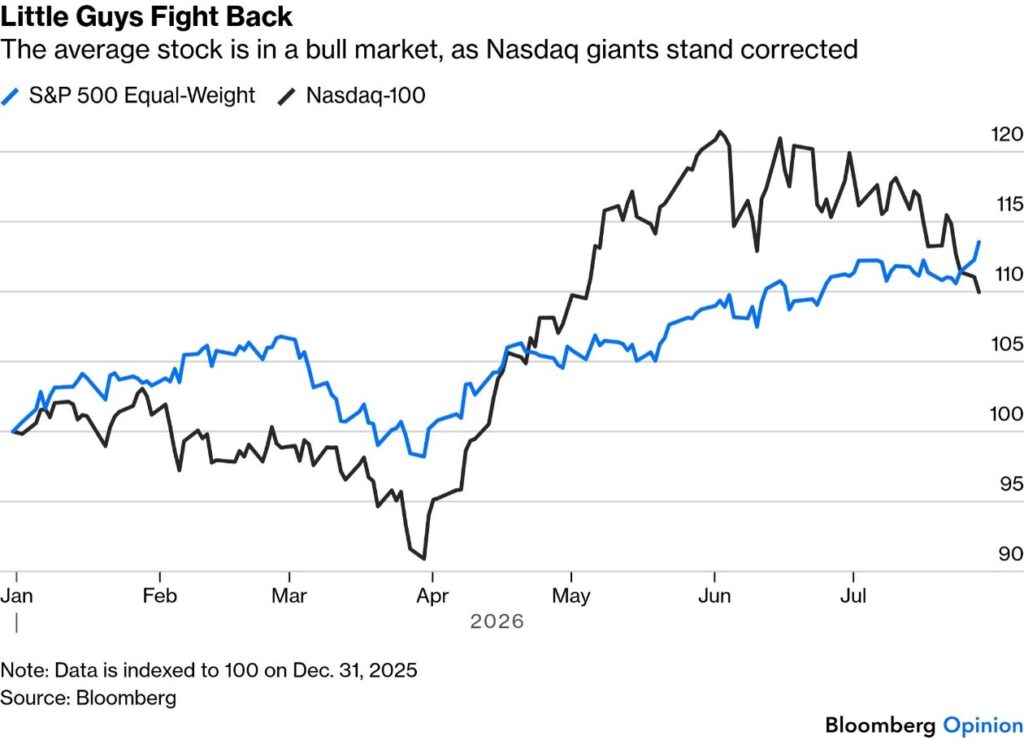
We have often talked about the problem of ‘share concentration’ in markets, the US, RSA and across the globe (the most extreme example is probably S Korea). This can distort the bog-standard trackers and ETFs, perhaps a better measure of the health of the markets is to look at ‘equally weighted’ indices, trackers and ETFs. The equal-weighted version of the S&P 500, a measure of the “average stock” in which each member is weighted at 0.2%, has rallied to an all-time high. It’s now overtaken the Nasdaq 100, where the most exciting large-cap stocks reside and which is only a hair away from a 10% fall from its recent peak — the popular arbitrary definition of a “correction”.
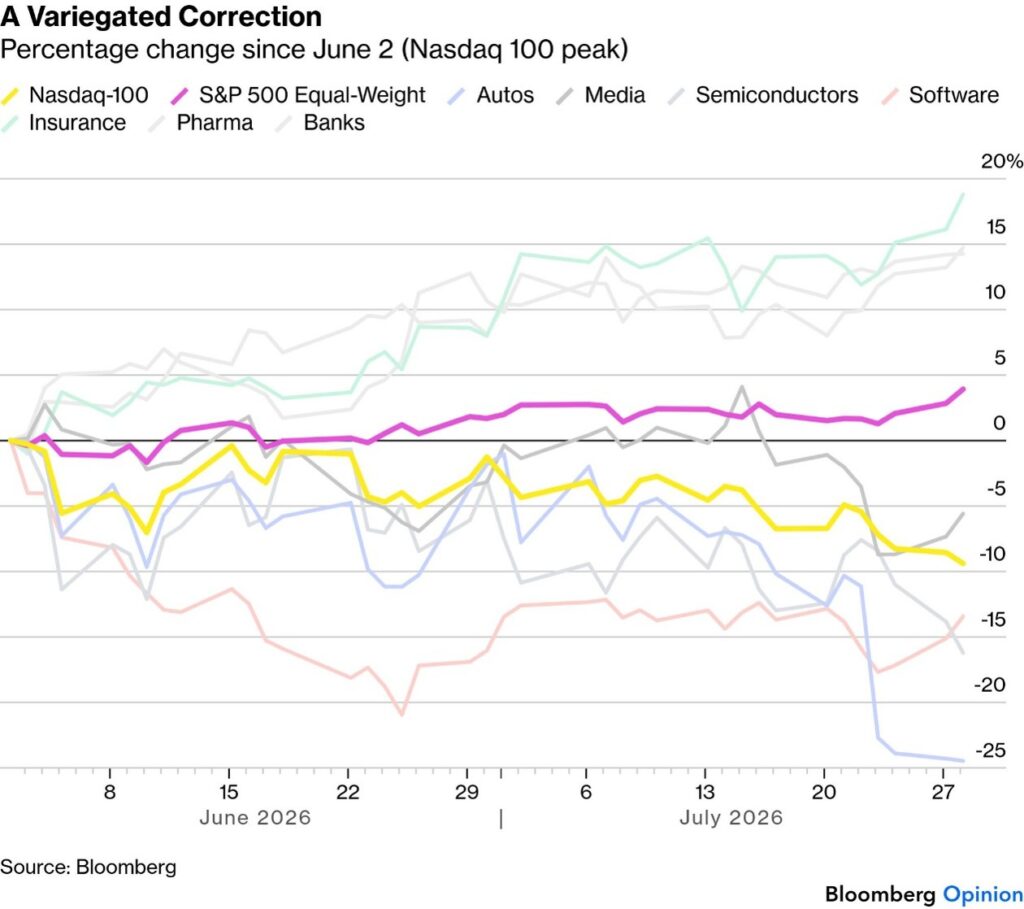
Dispersion since the Nasdaq’s peak on June 2 has been dramatic. Big selloffs for the S&P 500’s autos sector (dominated by Tesla Inc.) and tech groups have been balanced by a fantastic run for sectors such as insurance, banking and pharmaceuticals, which can’t promise so much growth but do offer consistent income:
In the US, momentum — the practice of buying recent winning stocks while betting against recent losers — has lagged value (buying the cheapest stocks compared to their fundamentals while shorting the most expensive) by 10 percentage points this month.
The turnaround, on no obvious big corporate news in the last three weeks, is dizzying.
Take the 25 best-performing Russell 1,000 stocks in the first half (mostly made up of semis and other AI infrastructure stocks). All 25 are down at least 14% this month for an average decline of more than 36%! On the flip side, the 25 worst performers in the first half are up an average of 14% in July.
Look at the battle between momentum and value over the longer term, and the power of narratives is clear. Momentum works most of the time, with sudden reversals when it has taken things too far and investors no longer trust the story driving the market. There follows a period of confusion as we look for a new narrative.
Since the Global Financial Crisis, there have been two long momentum waves. The first, from 2017 to the pandemic, centered on the “FANGs” — an acronym coined by Jim Cramer of CNBC, which stood for Facebook, Amazon.com Inc., Netflix Inc. and Google. It later became FAANG with the addition of Apple Inc., and aimed to include companies that dominated their corners of the internet and had become licenses to print money.
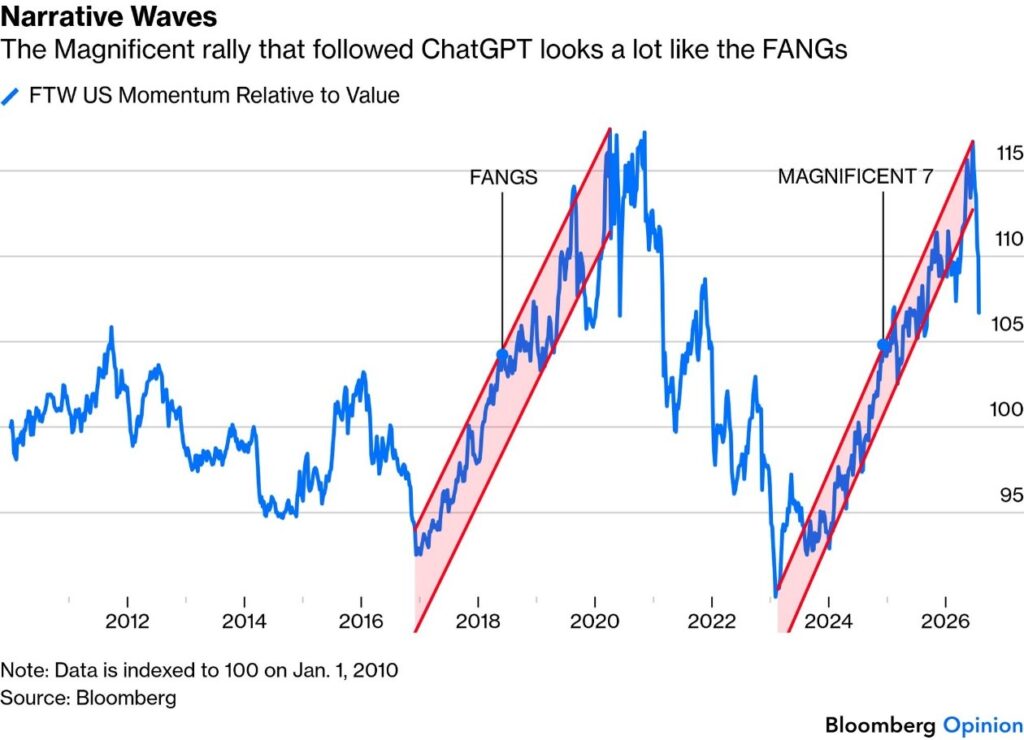
After Covid, the 2022 launch of ChatGPT set off the Magnificent Seven hyperscalers — Apple, Amazon, Alphabet Inc., Meta Platforms Inc., Microsoft Corp., Nvidia Corp. and Tesla. Others, notably Broadcom Inc. or Oracle Corp., are sometimes added. The new story is that AI will conquer the world, and established tech giants can use their scale to dominate it.
The grip of the Magnificent Seven over the media’s imagination is plainly loosening. The same is true of its hold over market traders. Since 2020, Bloomberg’s index of the Magnificent Seven is still way ahead of the index for the other 493 largest stocks, but it is no further ahead now than it was two years ago.
This certainly doesn’t mean that the big companies involved in artificial intelligence are going to go out of business. It probably does mean that there will be a protracted period to regroup before a new narrative is settled on to take things forward — much as the Magnificent Seven had a big overlap with the FANGs, but needed ChatGPT and a new label and narrative to set momentum going again. It’s also important to note that the Magnificents were never homogeneous. Apple, widely criticised for not establishing a strong foothold in AI, nevertheless reached $5 trillion in market cap last Tuesday, overtaking Nvidia as the biggest company once more.

IPO announcement – time to sell?
A more technical explanation of the momentum reversal that we spoke about above concerns attempts to raise equity, which, all else equal, pushes share prices down. It also supports the narrative that the Magnificents have taken things too far. The Nasdaq peak overlapped almost perfectly with the IPO by Elon Musk’s Space Exploration Technologies Inc., the biggest in history. As bright as the home-grown boyjie might be, his business successes have been somewhat tainted of late.
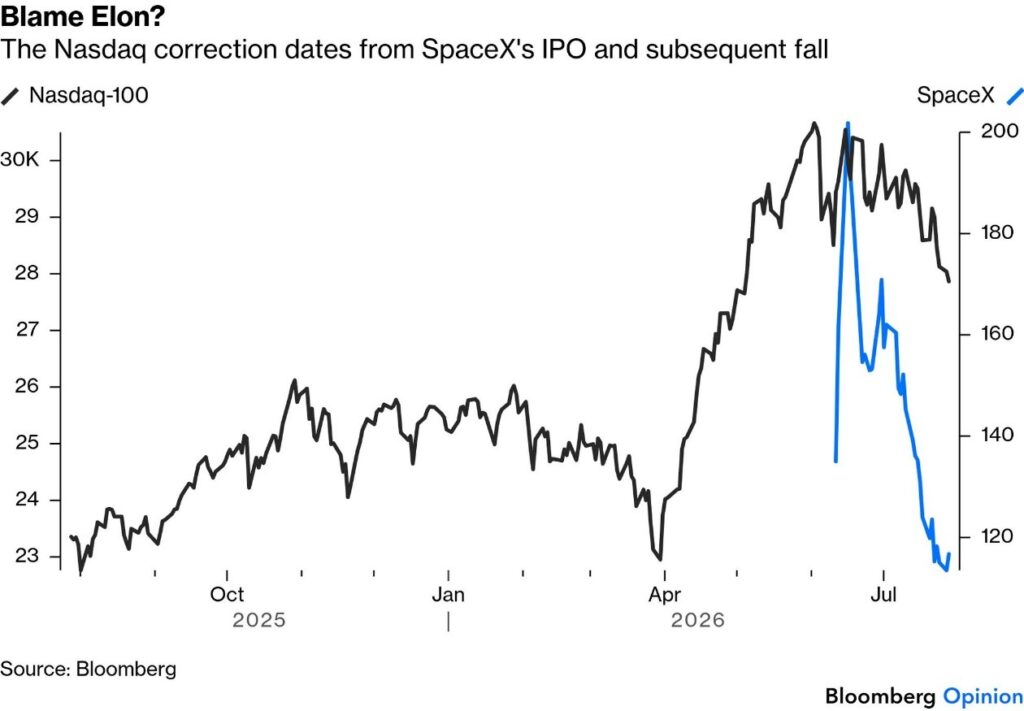
When companies go public, the fear is that the insiders have reason to believe it’s time to sell.
By raising the supply of equity, they will tend to bring down share prices. Companies have steadily “de-equitized,” buying back stock, and conducting mergers and acquisitions with cash. That has buoyed the stock market. But 2026 could be the first year in decades when equity supply rises.
The hyperscalers need money to fund their capital expenditures and the generous multiples at which their stocks trade make it cheaper to get their financing by raising equity, not debt. When current owners sell their shares, it should send the message loud and clear – they want to lock in their profits because they know, better than anyone out there, what is coming down the pipe. Sure, it is dressed up as ‘raising capital’ or ‘sharing the bonanza’ – but is it really?
Cold feet are manifest. More IPOs were expected this year, notably from OpenAI (creators of ChatGPT) and Anthropic PBC (Claude). Now traders are losing their appetite, which could prompt the companies to wait longer to go public. Prediction market bettors don’t think OpenAI will do so this year, while the chances for Anthropic have been cut back.
The Magnificent story appears to have reached its final chapter early this year, as investors latched on to the exciting subplot that huge capital expenditures would be lavished on a few lean-and-mean chip manufacturers, who could more or less name their price. It was exciting to introduce some new and exotic characters — but it was always contingent on the overarching saga that a few great companies with bottomless pockets would spend whatever it took to dominate the thrilling new technology. Investors seem ready to return that book to the shelf. While searching for a new narrative, they can enjoy hunting through the stocks they’d overlooked. It’s profitable, and makes for healthy allocation of capital.

US housing has been a reliable economic engine over the years; it’s mostly unrecognisable as that today, and is no longer generating gains in household wealth.
Prices are reverting to the mean after growing very elevated during COVID. Higher rates since 2022 combined with a diminishing pool of qualified entry-level buyers to reduce demand. Homebuilder stocks, a proxy for construction activity, remain subdued.
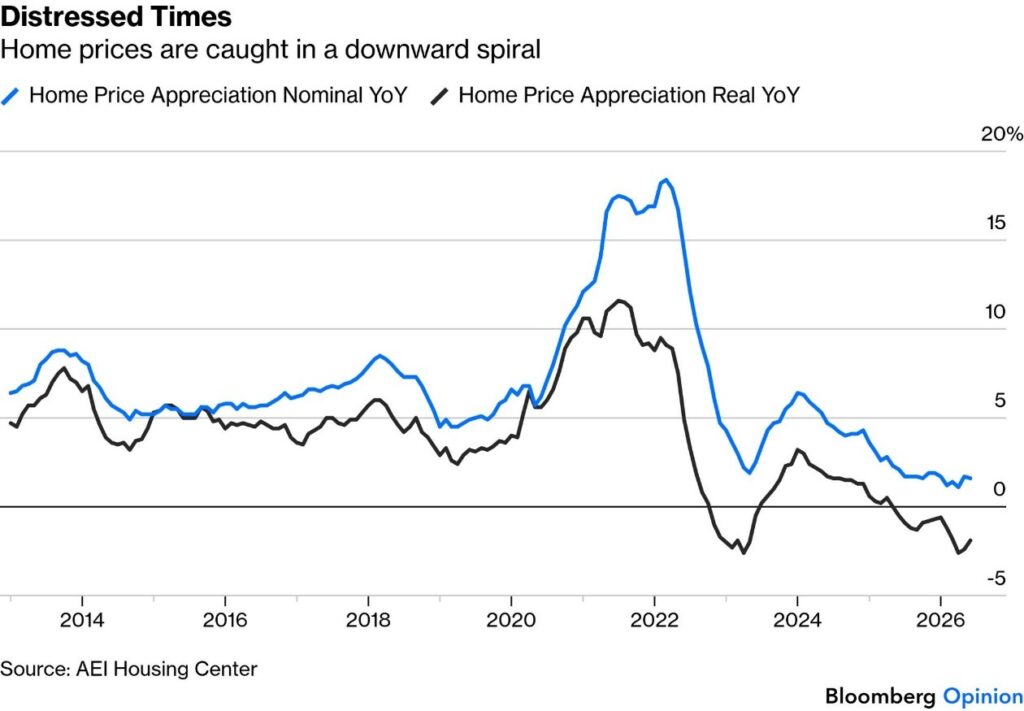
Other indicators, such as mortgage lending and affordability, aren’t performing any better. Rates are yet to return to pre-pandemic levels, with the 30-year Bankrate.com mortgage rate now back up to 6.7%, its highest in a year.
People can’t afford to trade in their ultra-low pandemic-era mortgage for a new one at today’s rates. Meanwhile, builders cannot sell finished homes at their initial asking price.
This is not 2008 all over again, but it is a soft housing market that is not supporting GDP growth. We saw that in the recent GDP figures. Falling or flat house prices in a midterm election year also could be a political football. Advocates of cutting interest rates will find support in these results.
The National Association of Realtors’ Housing Affordability Index, which measures whether a family earning the median income can afford a median-priced existing home using conventional financing, shows that homes are barely any more affordable than on the eve of the housing crash 20 years ago. It’s too soon to say that the housing market has permanently lost its role as a cyclical driver. The key test will come when the AI-driven boom fades, and housing either resumes being a meaningful engine of economic growth — or reveals that AI has masked deeper structural weakness in the economy.

Investment focus: REITs
Over the last 15 years (roughly 2011 to 2026), SA listed property has been a tale of two eras split almost exactly in half by 2018.
From 2011 through 2017, the sector was one of the JSE’s strongest performers, delivering double-digit annualised total returns most years on the back of low rates, dividend growth, and a wave of new REIT listings; a widely cited industry figure put the sector’s return at roughly 22.5% per annum for 1999 to mid-2016, well ahead of equities and bonds over that stretch.
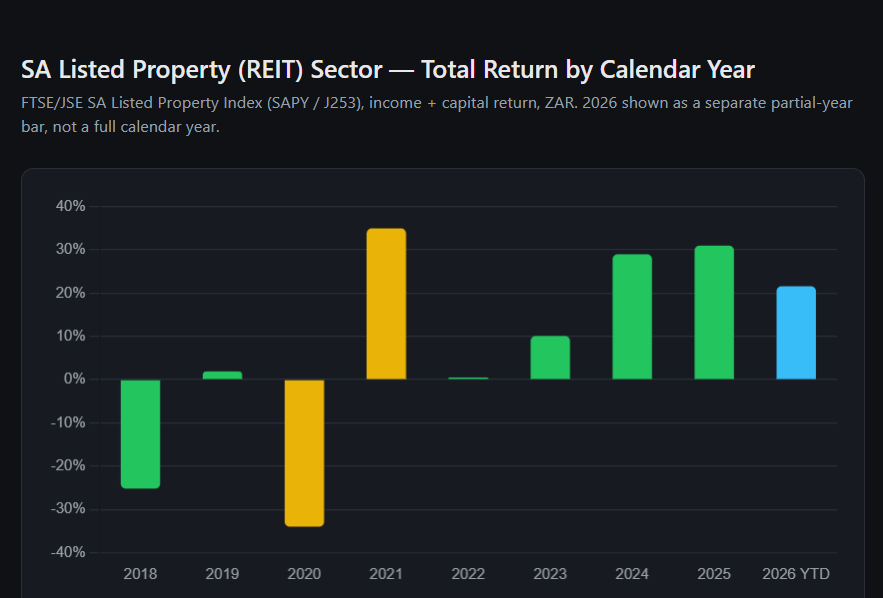
That run ended abruptly in 2018 (the Resilient-group governance scandal triggered a sector-wide de-rating, with SAPY down about 25%, its worst calendar year since the index’s 1993 inception), and the sector then endured its worst three-year stretch on record through 2020, as COVID lockdowns pushed discounts to net asset value as high as 55% and the index traded roughly 45% below its 2018 peak.
Bottom performers (5 years to Sept 2023, the window dominated by the 2018 crash + COVID):
Recovery was slow and choppy from 2021 to 2023 as high interest rates and load shedding kept a lid on earnings, before a sharp turnaround from 2022’s near-zero return into back-to-back standout years in 2024 (around +29%) and 2025 (around +31%), fuelled by rate cuts, GNU-driven investor confidence, and a narrowing NAV discount that made the sector the JSE’s top-performing asset class for three consecutive years.
Best performer last year was Fairvest (B shares) — over +60% total return, the township/rural mall owner topped the whole sector for 2025. (market cap R15bn).
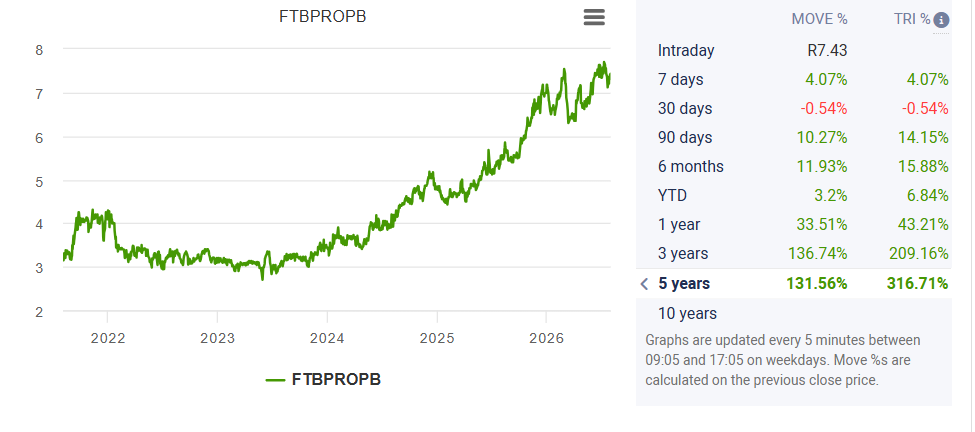
Hyprop (R25bn) wasn’t too shabby
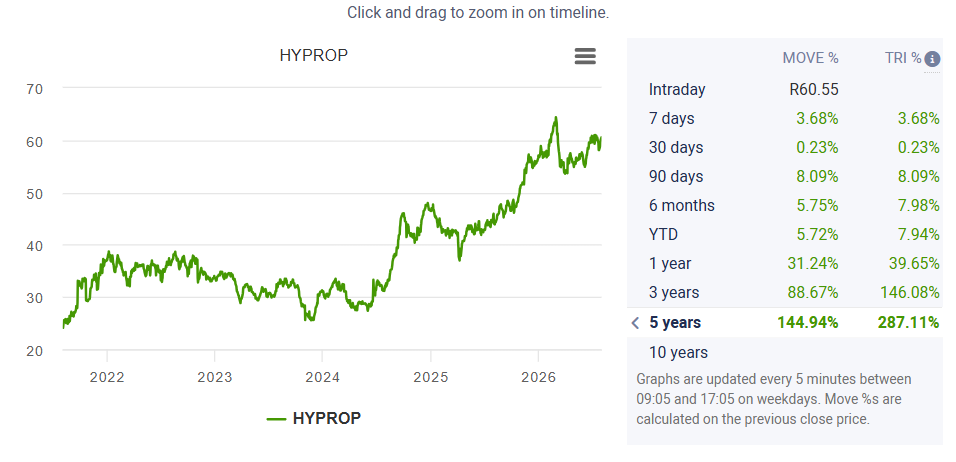
Remember that property is treated as a separate category for Regulation 28, so can be used to increase the ‘equity’ component of an investment – but hasn’t been very popular for a few years, but is having its time in the sun again.
Author: Dawn Ridler
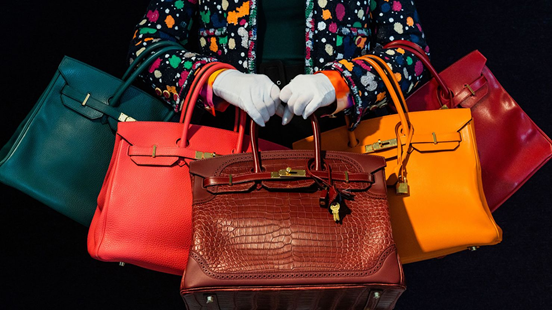
Hermès last week ended up growing Revenue by 1.6% and at constant currency exchange rates by 6.1% as compared to the same period last year. These are half-year results and show that the operating margin of 41% is still intact and that net cash in the business has grown by 14.8% to EUR 12.3 billion.
Management did warn that they see their business growing at high single digits rather than the double digits which forced the valuation of the company to over 60x earnings in 2025 (see below). This puts this business on par with valuations we see for some technology companies today.
Hermes P/E ratio
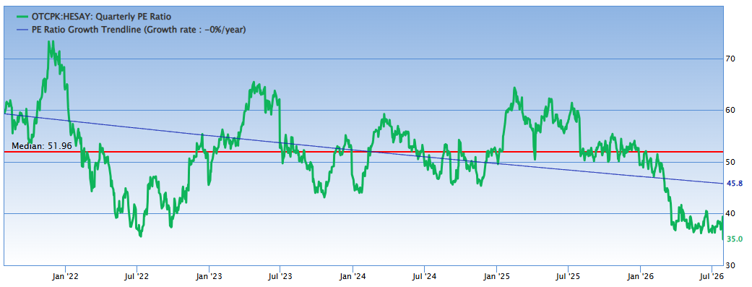
Alas, to sustain high valuations requires ongoing growth, which is difficult for most mature companies. Inevitably, the market overprices the opportunity and this causes a mean reversion to occur. If it can happen at the likes of Hermes, which is arguably one of the best listed luxury companies, it can happen as easily in tech land as well. Investors should ask if current prices are cheap enough.
The last time at the current valuation was back in 2022, which was during Covid. Here, luxury took a hit but greatly benefited from global liquidity, as this drove excess spending.
This time round Hermès isn’t the beneficiary of a central bank liquidity dump into the markets but has to contend with a more frugal Federal Reserve under Kevin Warsh.
Asia is a powerhouse for Hermès. They derive 53% of their Revenue from Asia and then 43% from Asian territories outside Japan. This is China at its best and at the half year mark revenue only grew at 2.4% whereas Japan grew at 11%. This has spooked the market, and no doubt if this had grown at a faster pace, top-line revenue would have lifted, and the stock could possibly justify its valuation. But China isn’t growing at the clip it once was and the hangover from misspent capital in their property market is still weighing heavily on this economy. There are signs that the Chinese government will commence their liquidity programme again and this would not only lift the economy but would lift sales in this segment for Hermes as well. A turnaround in China is going to be important to maintain the current valuation.
France, the home country of Hermes, only grew revenue by 1.8% at half-year, whereas at the end of 2025 full-year sales in France grew by 8.9%. It’s not a big component of total revenue, but is this symptomatic of a larger issue in France? Europe excluding France grew sales by 8.8%. Sales in the Americas were up by 15.3%, adding nicely to Revenue as it makes up 19% of total Revenue. This arguably is what management is hoping for across the group. In case you were wondering, the average price for a Kelly or Birkin is in the $10,000 – $15,000 range, with rare and exotics garnering over $300,000. They sell for even more on the second-hand market, with owners who have patiently waited and built up their spend at Hermes managing to ‘score’ a bag, and will literally flip it for a profit the same day.
In Thursday’s trading session, Hermes was down -13% at some point, falling to $ 171.53 in the American market. This is for a stock which was priced at $280 in 2025. That is a 63% slump from its all-time high. The other question investors need to ask is whether this is a temporary issue in the luxury goods market or a structural change in the market.
Let’s face it, Hermes sells very expensive handbags as their flagship product with waiting lists across the world to boot. Leather goods and saddlery make up 44% of sales and grew by 9.8% at half-year after growing at 13% y-o-y in 2025. Ready-to-wear accessories grew by a disappointing 2% after growing by 6.1% in 2025. This sector isn’t exclusive but makes up 28% of overall sales. You can see the picture emerging. The consumer is under pressure, and even though the high-end buyer still buys premium handbags, the marginal buyer who enters their stores to buy accessories seems to have dwindled. Hermès is a great business and has a lot of cash on hand to weather any storm. But they do need the marginal buyer to prop up revenue, especially when analysts are trying to justify a company trading at 35x earnings.
Author: Cobie Le Grange
EXCHANGE RATES and other Indices
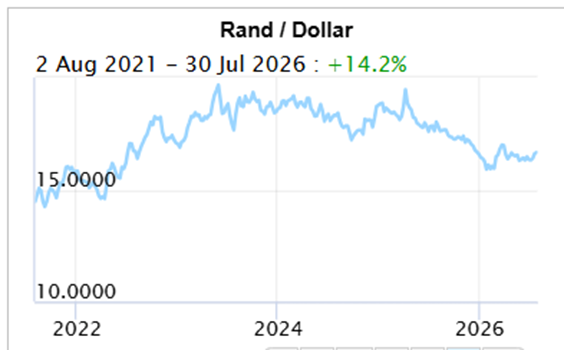
The Rand/Dollar closed at R16.55 (R16.47, R16.31, R16.22, R16.40, R16.39, R16.27, R16.55, R16.23, R16.46, R16.68, R16.39, R16.63, R16.29, R16.41, R17.07, R17.06, R16.89, R16.55, R15.93, R16.01, R15.96, R16,03, R16.15, R16.10, R16.50, …R16.91, R17.13, R17.36, R17.13,16.52 )
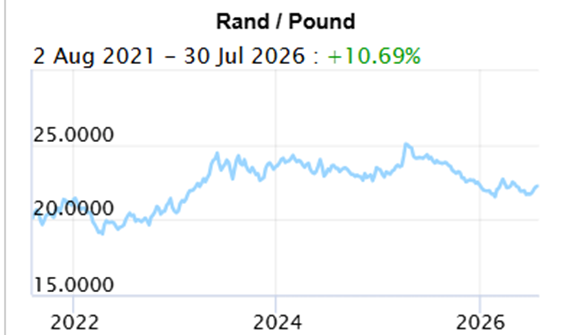
The Rand/Pound closed at R22.31 (R22.16, R21.86, R21.64, R21.64, R21.67, R21.80, R22.06, R21.80, R22.09, R22.21, R22.30, R22.56, R22.35, R22.02, R22.09, R22.77, R22.76, R22.35, R22.20, R21.48, R21.59, R21.78, R21,82, R22.11, R21.97, R22.13, …R22.57, R22.68, R22.74, R22.56,
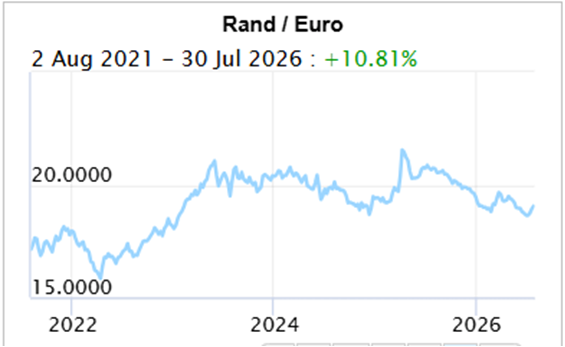
The Rand/Euro closed the week at R19.09 (R18.84, R18.62, R18.52, R18.66,R18.89, R19.16, R19.08, R18.91, R19.11, R19.38, R19.29, R19.48, R19.37, R19.17, R19.24, R19.70, R19.77, R19.33, R19.23, R18.80, R18.87, R18.94, R18.93, R19.14, R19.04, R19.20)
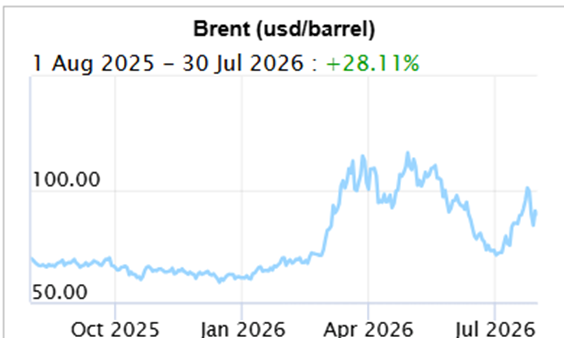
Brent Crude: Closed the week $87.93 ($88.10, $76.01, $72.10, $71.99, $80.59, $87.33, $93.09, $91.12, $104,24, $109.26, $101.29, $108.83, $105.33, $90.38, $95.20, $107.88, $112.36, $103.14, $92.88, $73.19, $71.76, $67.75, $68,05, $69.32, $65.88, $63.34, …$63.71, $63.19, )
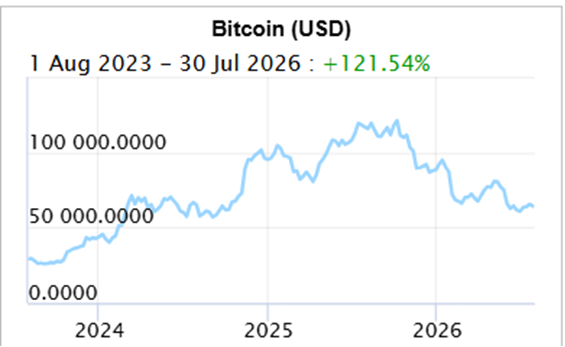
Bitcoin closed at $63,143 ($64,718, $63,815, $62864, $60,063, $64,029, $64,131,$60,762, $73,788, $74,559, $77,879, $80,733, $78,204, $78,049.98, $75,519, $70,904, $68,691 , $68,586, $70,869, $67,310, $63,534, $68,04, $69,649, $68,553, $81,301, $89,295, $90,585,)
Articles and Blogs:
Investment series part 1 (NEW)
Investment series part 2 (NEW)
Legacy Series Part 4
Legacy Series part 3
Legacy Series Part 2
Legacy Series Part 1
Holiday checklist
Next year – Action Plan
Next year – Vision, Mission etc
Medical Risk Mitigation
Next Year – Consolidation
Abdication or diversification?
Carbo-loading your retirement Spoiled for choice
Who needs a plan anyway
8 questions you need to ask about retirement
What to do when interest rates drop
How to survive volatility in your investments
What to do when interest rates drop
Difficult Financial Conversations
Financial Implications of Longevity
Kick Start Your Own Retirement Plan
You matter more than your kids in retirement
To catch a falling knife
Income at retirement
2025 Budget
Apportioning blame for your financial state
Tempering fear and greed
New Year’s resolutions over? Try a Wealth Bingo Card instead.
Wills and Estate Planning (comprehensive 3 in one post)
Pre-retirement – The make-or-break moments
Some unconventional thoughts on wealth and risk management
Wealth creation is a balancing act over time
Wealth traps waiting for unsuspecting entrepreneurs
Two Pot pension system demystified