

Too Busy? Got Better Things to Do? Read the Summary…
Central Bank conundrums: US headline and core inflation both came in exactly as forecast for once, with headline CPI easing to 3.4% and core to 2.5%, but every underlying inflation gauge has stayed above 2.5% since Covid. New Fed chair Kevin Warsh has a conundrum strong labour data argues for a hike, yet benign enough numbers let him keep delaying one, at least until after the next meeting.
Copper: Copper has rallied for six straight weeks to fresh all-time highs, with the demand story shifting away from China toward AI data centre buildout and the energy transition (EVs, renewables, grid infrastructure). Demand is projected to rise about 50% by 2040 while supply falls short by as much as 10 million tonnes, and US tariff moves on copper products are adding further upward price pressure, benefiting producer economies like Chile and Peru.
US Mid-terms, so what?: November’s midterms would historically favour a Democratic sweep given the party in power usually loses seats, but the path is narrower than it looks: Democrats need a net gain of four Senate seats while defending more turf, and have been hurt by a forced candidate withdrawal in Maine and socialist insurgent campaigns elsewhere. A blue wave looks close to a coin flip, but rising market volatility into the election looks far more likely, especially with AI now a politically weaponised topic for tech stocks.
The US economy’s growing reliance on equities: US households hold far more of their wealth in equities than other G7 nations, meaning market performance now drives consumer spending through the wealth effect, funds the AI buildout via a lower cost of capital, and boosts government capital gains tax receipts. With the personal savings rate near a historic low of 2.7% and household wealth skewed toward stocks rather than property, continued spending increasingly depends on selling shares rather than borrowing, a dynamic that could make future market corrections sharper and more volatile.Shoprite: Despite a stagnant, highly price-competitive South African grocery market, Shoprite has pulled well ahead of Pick n Pay and Woolworths over the past five years, driven by its early and successful Sixty60 delivery service (now roughly 10% of sales) and consistently strong management execution. Revenue has grown about 10% annually since 2021 versus 6% for Pick n Pay and 2% for Woolworths, and old LSM-based positioning between the retailers has largely eroded as Shoprite competes across price tiers.





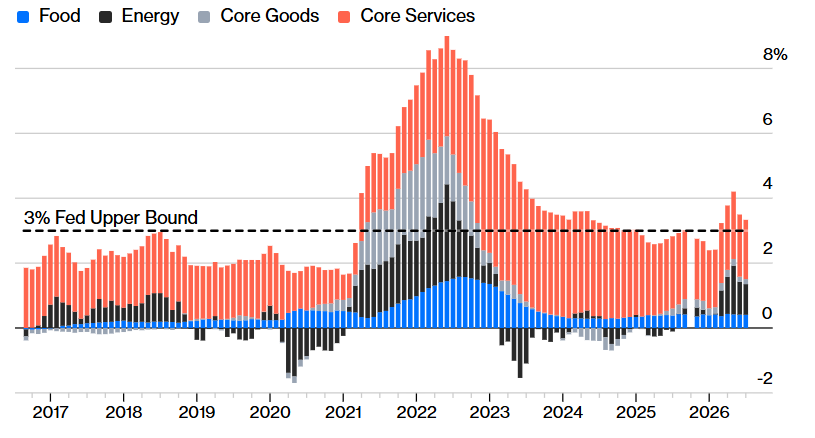
Very unusually, both headline and core inflation (excluding food and energy) came in exactly as expected by a consensus of economists. Falls in services and energy inflation helped bring the headline down, but it remains above 3%.
Services inflation is declining, but the headline remains above 3%.
The alternative measures of core or underlying inflation that are regularly monitored all declined. But while the decline is good news, the uncomfortable bad news remains that all remain above 2.5%, as they have been ever since the pandemic.
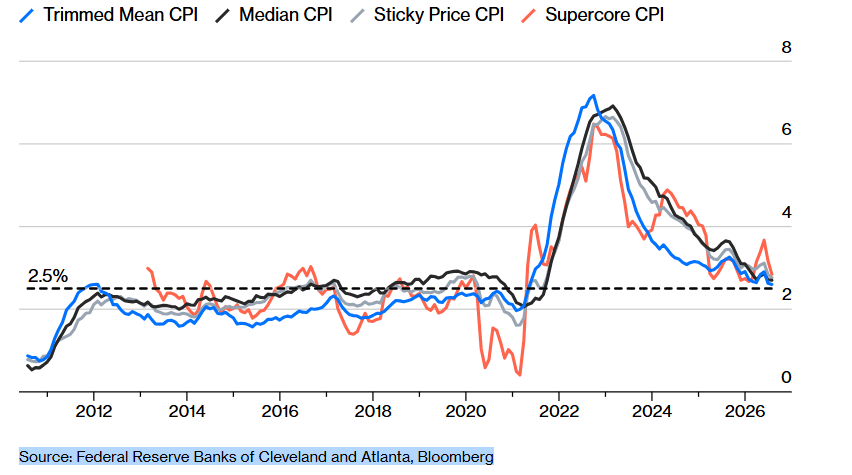
Since Covid, no technical measure of core inflation has fallen below 2.5%.
This is a marked change from the decade before Covid-19. If the Fed’s new chairman Kevin Warsh is serious about treating 2% as a target, it’s difficult to see that the central bank can go much longer without taking some concrete measure to get there, which would mean hiking rates. This is a similar conundrum faced by our SARB governor.
Combine this CPI print with labour market reports suggesting the US is operating at full employment, and the only path for rates is upward. That’s still the market’s base case, but the market is still betting on at least one hike this year…
Fed funds are unchanged this year, and could move only once, with that probability also fading. Mr Warsh must be relieved; he made a bet on the rate of inflation, and despite the Iran war, it looks like it might pan out for him.
These numbers are sufficiently benign that he can get away without a hike at the next meeting. The longer he can kick that can down the road, maybe even into next year, the less chance he has of getting fired by his boss. Unfolding news about the ‘Catering Truck Gate’ or ‘Operation Chicken Force One’, has filled timelines this week, but has also revealed just how little DJT cares about his staff and appointees by leaving Rubio, Bessent and Karoline Levitt on his apparently targeted plane. Ms Levitt has since resigned.
In an inflation sidenote – software etc is no longer as cheap as chips. The revolutionary goings-on in technology have complicated the job of predicting price levels. For a generation, the prices of both software and devices have followed a steady downward path. But software and even hardware have suddenly stopped getting cheaper. AI might well be disinflationary in the long run. But in the short run?

Copper has been on a remarkable six-week rally that has brought it to an all-time high for the fourth time this year. The drivers of the copper price are changing.
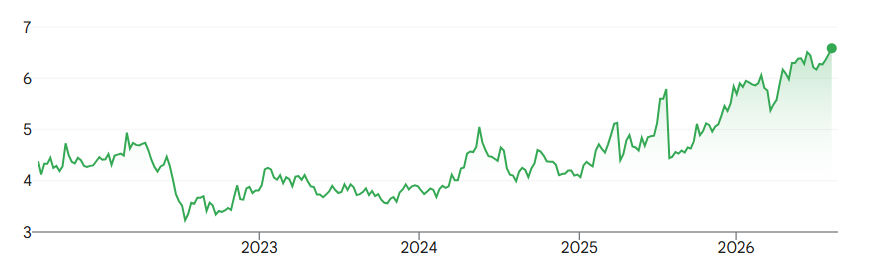
Image: Copper futures in USD
For decades, a robust Chinese economy has meant strong demand from copper’s largest consumer, and translated into strong prices. Beijing’s economic woes have weakened that correlation, and the metal is fuelling its latest rally elsewhere.
China hasn’t lost its influence over prices, of course. But beyond that, the ongoing massive AI buildout is a major factor in the shift in demand. Copper is required in power distribution, cooling systems, server interconnects, and building wiring. All told, the metal is said to account for approximately 6% of total data-centre capital expenditure. S&P Global Research forecasts copper demand just for data centres will increase from 1.1 million metric tons last year to 2.5 million by 2040.
Chile is the #1 copper producer, followed by the DRC, Peru and China (Zambia is only at 4%).
AI-related demand is dwarfed by the huge energy transition, encompassing electric vehicles, renewables, and grid infrastructure. In general, EVs require nearly three times as much copper as conventional cars, and their rapidly growing sales add to demand. Global EV sales last year were 25% higher than total new-car sales in the US, the world’s second-largest new-car market.
Altogether, global copper demand is expected to shoot up by about 50%, rising to 42 million metric tons by 2040. Meanwhile, supply is expected to fall short by as much as 10 million. Increasing demand for AI buildout and the energy transition widens the deficit.
Beyond the long-term structural deficit, Washington’s tariffs on certain copper products exacerbate rising prices. The US now imposes a 50% duty on semi-finished and derivative copper products while, for now, exempting refined copper cathodes. That could change following a Commerce Department review, which could pave the way for tariffs of 15% in 2027 and 30% in 2028.
US copper inflows hit a 12-year high in mid-2026 as traders rushed to stockpile ahead of a possible tariff, and the policy direction looks firmly skewed toward more duties rather than fewer, with the Commerce Department simultaneously expanding Section 232 coverage to new derivative products and opening entirely new metal fronts.
This all adds to the upward pressure on overall inflation indexes. There should be beneficiaries, most obviously the major producers Chile and Peru, whose equity markets have historically tracked the red metal closely. This helps to explain the rally in their stock markets over the past six weeks. International investors tend to treat both nations as though they are very large copper mines. Is RSA any different when it comes to gold?

The dog days of US summer may soon be over, as US politics is about to provide a new wave of market turbulence. Midterms come in November, and history suggests that a wave for Democrats should be close to inevitable.
Presidents in their second term always suffer major losses in Congress, and with both chambers finely balanced, that should normally mean a Democratic clean sweep.
Remember that in the midterms the entire House is up for election, but only 1/3 of the Senate. In the House, the term is only 2 years, but it is 6 years in the Senate.
This race is going to be important for all of us around the globe, especially when it comes to reigning in the President who has effectively ignored Congress for the last 18 months and ruled by ‘executive order’ like any good dictator.
The United States Congress is the legislative branch of the federal government and is bicameral — meaning it consists of two separate chambers:
The Senate (Upper Chamber)
The House of Representatives (Lower Chamber)
And there is an important wrinkle: the Senate is currently 53 Republicans, 45 Democrats and 2 independents who caucus with the Democrats.
That means Democrats need a net gain of four seats to reach 51 outright, or potentially three if they can maintain the vice-presidential tie-breaking advantage. The House requires a net gain of only a handful of seats to change control because the current margin is so narrow.
That would be true even without the unpopular war in Iran, and even if President Donald Trump didn’t have the lowest approval rating of his presidency. But the path to a blue wave isn’t smooth.
The problem for the Democrats is the Senate, where they are defending the majority of the seats up for election this time (and were last on the ballot in 2020, a good year for Democrats when Joe Biden won the presidency). They need to flip four seats in the full chamber. That’s a heavy lift, made harder by the party’s own internal ructions.
On prediction markets, their chances were seen to dip severely when their original nominee in Maine, a blue state held by the Republican veteran Susan Collins, was forced to withdraw after sexual assault allegations. Insurgent campaigns by a range of avowed Democratic Socialists in other states, notably Michigan, further damaged their prospects.
While a blue wave is no better than a 50-50 shot, a wave of stock market volatility seems much more likely. Vol tends to be seasonal, and generally increases from now until the election.
To some extent, the extraordinary AI boom has so far insulated against domestic and international political uncertainty under Trump 2.0, but this might not last.
Bear in mind that AI has become a weaponised political topic now; it also may not be plain sailing for the tech bulls between now and the elections in early November.The last 18 months have seen a US president exercise power in an unprecedentedly unencumbered way – despite being a so-called lame duck. On the most salient issues for markets, support from Congress has either been irrelevant or a given. There’s a risk that will soon change, and markets will start to try to price that risk.

The US economy’s growing reliance on equities
It’s generally accepted that US investors own a lot more equities than households in other G7 nations. The precise reasons for this, is it a specific risk-taking mentality, or simply downstream of pension structures are open for discussion
But it does mean two things. One is that US households have benefited greatly from an equity-driven “wealth effect” as the US market has soared on the back of its tech sector dominance. Two is that it means the fate of the US equity market is far more important to the wider economy than it once was.
It’s not just about US households feeling more flush, and thus being willing to spend more (though they are — the US personal savings rate has fallen to 2.7%, very close to a historic low).
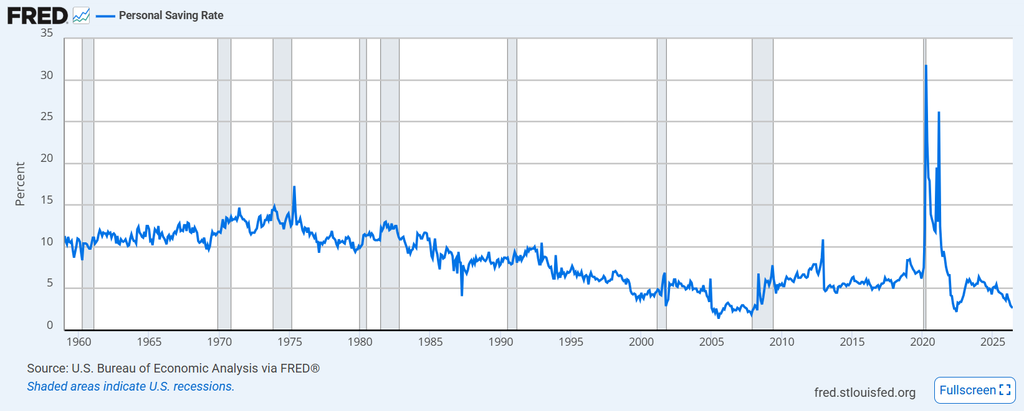
High equity prices also support the AI buildout by lowering the cost of capital for these companies, and the AI buildout in turn now drives a large chunk of US GDP. Higher equity prices also mean more capital gains taxes for the government.
So quite a lot hinges on the ongoing desire of US savers to keep investing their money in stocks.
If the savings rate were to fall below 0%, that would leave only two options. One is for households to borrow in order to keep spending. The other is for households to liquidate their assets to fund spending. One of those options keeps us going along much the same road as we’re already on. The other, selling up, implies something potentially rather more dramatic.
If consumers sell stocks, share prices will go down, and that would hit everything from the wealth effect to the tax take to the cost of capital for those all-important data centre builders.
Do we need to consider it seriously? A reasonable retort is to point out that US household borrowing has fallen sharply since it peaked during the financial crisis of 2007 to 2009. Why wouldn’t they just borrow more money?
This makes sense, and maybe they will. One issue is age. The US population is getting older. Old people are the ones who own most of the assets, because this is what happens as you get older: you earn more, you pay off your house, you save more into your retirement fund. Nothing to do with fairness, and all to do with years under one’s belt.
These people are not looking to borrow more money; they did that when they were young, mostly to buy homes and defer some future consumption. Instead, they’re looking to spend the money they’ve built up.
That leads to the other, less obvious, issue, which is that the nature of the wealth held by these people has changed since the financial crisis. The proportion of US household assets accounted for by property has fallen. If you live in a house, then the easiest way to access that wealth is to borrow against the house, not sell it.
But if you have a portfolio of stocks, and you want to raise cash to spend, the easy option is simply to sell some of them. Hence, that seems like the most likely option if US consumers do indeed drop their savings rate below 0% for individuals (and with the dropping savings average, there are plenty that are falling into this category).
Housing is not really an asset that experiences panic selling at a large scale. Unless you are a forced seller, then the solution to a house price crash for most people is to tough it out. It’s a slow-moving, illiquid asset, and when prices are falling, it gets even slower. By the time the market has turned, it’s probably already too late to get out with your profits intact.
Equities are different. You can, in normal circumstances at least, get out easily. And just as importantly, you can get back in easily. So if markets wobble, and you start to fear that your retirement stash is under threat, it’s an easy call to duck out, in the deluded but firm belief that you’ll be able to get back in further down the line. So panic selling is a much more common feature.
In a market dominated by index fund flows, and one that in effect relies on momentum more than it used to, you’d probably expect corrections to be more aggressive and more volatile than in the past (because people are swinging from being “all-in” to “all-out”, essentially).
Whether this ever happens or not is another issue. Another point about index flows is that they are largely automated. It would take quite the shift for this “relentless upward momentum” to go into reverse – but if and when it does, the new downward momentum is likely to be just as slow to turn around. We have discussed the ETF effect (tail wagging the dog) in this newsletter several times. The ETFs, as a source of much of the ‘new’ money flowing into the market, and are moving stock prices as ETFs have to ‘buy’ those shares to mirror the index. The opposite will happen when outflows occur. It could be argued that the increased dependence of the wider US economy and retirement system on the US equity market would make it easier for the Federal Reserve to rationalise overtly stepping in this time, should a crash become too painful. It wouldn’t be the first central bank to buy stock market ETFs.
Author: Dawn Ridler

(As always, this isn’t investment advice)
It’s been tough for retailers in South Africa. The first problem is that the economy isn’t really growing. This means that one has to look after one’s current client base first; secondly, growth will come from other shoppers joining one’s pay till queue. That means you will have to lure the customer through your doors, and by default another retailer will not earn from that customer. The second problem is that there is very little wiggle room on price. SA grocers are all highly competitive, and price outliers easily lose market share. That then leaves food inflation, and its impact on how long prices can be kept at lower levels. If one is looking for an easy business.. don’t pick grocery sales in South Africa!
But Shoprite seems to have gotten it right.
The business was the same size as Pick and Pay in 2011 and even though growth outpaced PnP, Covid was the opportunity set they had been waiting for. Enter Sixty60! What was supposed to be the delivery service for the main grocery outlet quickly became the default option for shoppers. It is estimated that online sales made up 9% of total sales in 2025, up from a mere 1% in 2021. For 2026, that number will probably approximate 10%.
Now bear in mind that in 2021 the business recorded Revenue of R168 billion, which grew to R 252 billion at the end of 2025. That’s a 10% annual growth in Revenue over the last 5 years. It’s estimated that the YE June 2026 Revenue number will be R 271 billion. That’s another 7% higher in a country where GDP growth is stagnant. That takes some smart manoeuvring to achieve that! Over the same 5 year period, Pick and Pay grew sales by 6% p.a. and Woolworths by 2% p.a. This I am sure sparked the management reshuffle at Woolies.
There was a time when each of the retailers operated in specific LSM target groups. Woolworths right at the top, Pick and Pay somewhere in the middle and Shoprite somewhere below that. But much of that perception has now gone, with Shoprite providing high-end alternatives in line with its competitors. For results, it matters where the marginal shopper is going. Consumers will still go to their retailer of choice for a specific item such as a ready-made meal, but if the majority of goods are ordered from a competitor, that is what drives the turnover higher.
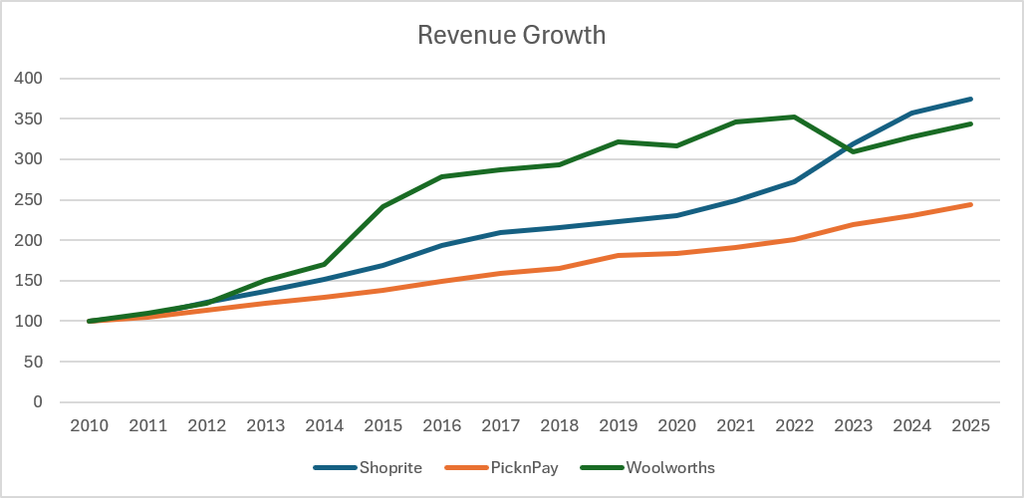
When one looks at the long term, it becomes easy to see what good management can do for a business. It’s not always evident from year to year but over long periods of time the numbers start showing it. Pick and Pay has lagged its two competitors, and their lacklustre performance has seen them spin off Boxer Superstores. They still hold a majority stake in it, but clearly work needs to be done at Pick and Pay.
Woolworths is still recovering from their misadventure in Australia after they disposed of David Jones. When one looks at performance numbers for companies it is important to ask why. And often that why comes down to management teams with a deep understanding of their territory and what it takes to move a business forward. Arguably, Shoprite today has everything to lose, but it’s going to take a proper effort to unseat them. We remain happy shareholders.
Author: Cobie Le Grange
EXCHANGE RATES and other Indices:
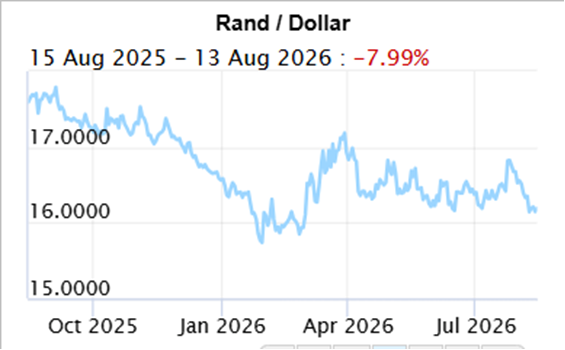
Rand/Dollar: The rand is trading at roughly R16.15–16.20 to the US dollar, little changed on the week, as softer US data curbed expectations of further Fed rate hikes and supported emerging-market currencies. The Rand/Dollar closed at R16.17 (R16.14, R16.55, R16.47, R16.31, R16.22, R16.40, R16.39, R16.27, R16.55, R16.23, R16.46, R16.68, R16.39, R16.63, R16.29, R16.41, R17.07, R17.06, R16.89, R16.55, R15.93, R16.01, R15.96, R16,03, R16.15, R16.10, R16.50, …R16.91, R17.13, R17.36, R17.13,16.52 )
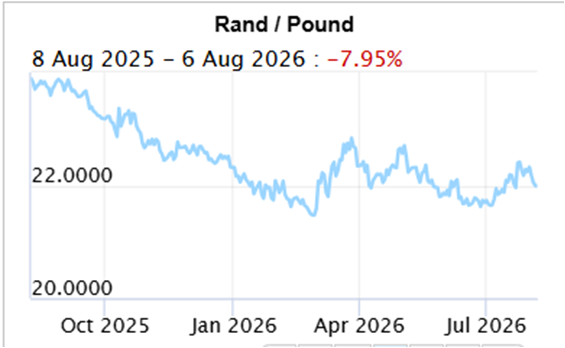
Rand/GBP: The rand is around R21.75–22.00 to the pound – not the same sort of rand appreciation we have seen vs the dollar recently. The Rand/Pound closed at R21.88 (R21.78, R22.31, R22.16, R21.86, R21.64, R21.64, R21.67, R21.80, R22.06, R21.80, R22.09, R22.21, R22.30, R22.56, R22.35, R22.02, R22.09, R22.77, R22.76, R22.35, R22.20, R21.48, R21.59, R21.78, R21,82, R22.11, R21.97, R22.13, …R22.57, R22.68, R22.74, R22.56,
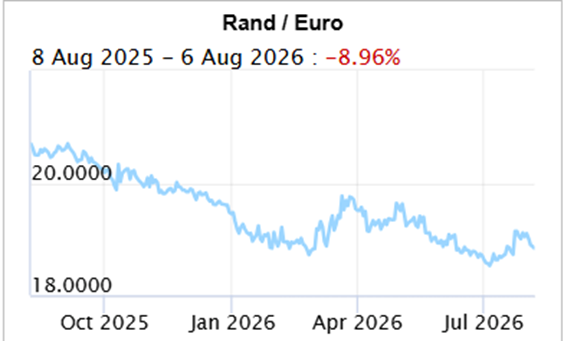
Rand/Euro: The rand sits at about R18.60–18.70 to the euro, tracking the same broadly stable trend. The Rand/Euro closed the week at R18.71 (R18.66, R19.09, R18.84, R18.62, R18.52, R18.66,R18.89, R19.16, R19.08, R18.91, R19.11, R19.38, R19.29, R19.48, R19.37, R19.17, R19.24, R19.70, R19.77, R19.33, R19.23, R18.80, R18.87, R18.94, R18.93, R19.14, R19.04, R19.20)
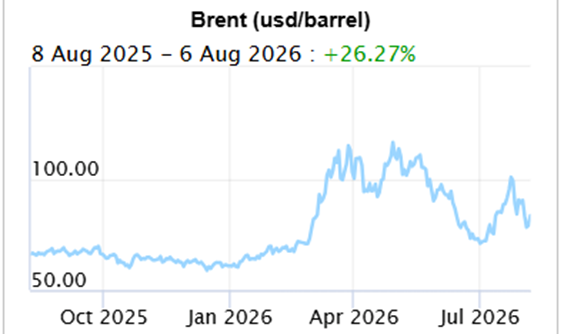
Brent crude: Brent is trading near $87 a barrel, having spiked from about $79.60 just a week earlier (August 6) on renewed Strait of Hormuz tensions, though it’s pulled back slightly from a near-$90 peak on August 12 as diplomatic talks resume.Brent Crude: Closed the week $88.52 ($83.55, $87.93, $88.10, $76.01, $72.10, $71.99, $80.59, $87.33, $93.09, $91.12, $104,24, $109.26, $101.29, $108.83, $105.33, $90.38, $95.20, $107.88, $112.36, $103.14, $92.88, $73.19, $71.76, $67.75, $68,05, $69.32, $65.88, $63.34, …$63.71, $63.19, )
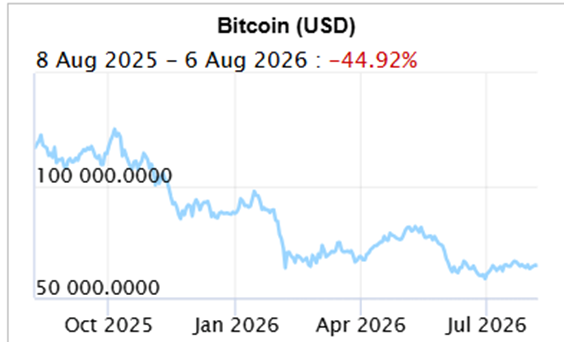
Bitcoin: Bitcoin is trading around $63,400–63,900, essentially flat to slightly softer over the past week after a pullback from recent highs.Bitcoin closed at $62,911 ($64,921, $63,143, $64,718, $63,815, $62864, $60,063, $64,029, $64,131,$60,762, $73,788, $74,559, $77,879, $80,733, $78,204, $78,049.98, $75,519, $70,904, $68,691 , $68,586, $70,869, $67,310, $63,534, $68,04, $69,649, $68,553, $81,301, $89,295, $90,585,)
Articles and Blogs:
Investment series part 1 (NEW)
Investment series part 2 (NEW)
Legacy Series Part 4
Legacy Series part 3
Legacy Series Part 2
Legacy Series Part 1
Holiday checklist
Next year – Action Plan
Next year – Vision, Mission etc
Medical Risk Mitigation
Next Year – Consolidation
Abdication or diversification?
Carbo-loading your retirement Spoiled for choice
Who needs a plan anyway
8 questions you need to ask about retirement
What to do when interest rates drop
How to survive volatility in your investments
What to do when interest rates drop
Difficult Financial Conversations
Financial Implications of Longevity
Kick Start Your Own Retirement Plan
You matter more than your kids in retirement
To catch a falling knife
Income at retirement
2025 Budget
Apportioning blame for your financial state
Tempering fear and greed
New Year’s resolutions over? Try a Wealth Bingo Card instead.
Wills and Estate Planning (comprehensive 3 in one post)
Pre-retirement – The make-or-break moments
Some unconventional thoughts on wealth and risk management
Wealth creation is a balancing act over time
Wealth traps waiting for unsuspecting entrepreneurs
Two Pot pension system demystified
Cobie Legrange and Dawn Ridler,
Rexsolom Invest, Licensed FSP 45521.
Email: cobie@rexsolom.co.za, dawn@rexsolom.co.za
Website: rexsolom.co.za, wealthecology.co.za