

Active Versus Passive, Again: S&P’s 2025 SPIVA report shows 87% of US equity funds lagged their index over ten years, reinforcing the case for passive investing, though critics note the raw figures are skewed and adjusted numbers tell a less lopsided story. The piece traces why sustained active outperformance is so hard to maintain, pointing to capacity constraints and the outsized pull of a handful of mega-cap stocks, and predicts the active-versus-passive debate isn’t going away.
Making Crypto Great Again: Bitcoin jumped as much as 23% after the US Treasury said it would double buybacks of longer-dated securities, reviving the debasement trade and pulling in fresh ETF inflows. Its safe-haven credentials remain shaky given the recent slide during a period of rising inflation, and a stalled Digital Asset Market Clarity Act pushes the next real regulatory catalyst into late September.
US Debt: US national debt has reached $40 trillion, up from $19.95 trillion at Trump’s first inauguration, with annual net interest payments nearing $1 trillion and now rivalling the defence budget. Neither party has meaningfully slowed the trajectory, and debt held by the public crossed 100% of GDP in April 2026.
Deficit and Yield: Yields are edging toward the psychologically significant 5% mark last seen in 2007, widely read as a market verdict on fiscal discipline, though history (the Reagan and Clinton years) shows solid growth is possible even at higher rates. Treasury’s buyback move briefly pulled yields down, but the more lasting signal was a weaker dollar alongside rallying gold and Bitcoin, reinforcing the broader debasement narrative. Debasement Trades Surge Anew, Some History: Past deficit reduction pushes, Reagan’s Gramm-Rudman-Hollings and Obama’s Simpson-Bowles commission, were framed in similarly urgent moral terms but ultimately fizzled. Bessent’s current fiscal consolidation effort, including a fraud task force aimed at trimming hundreds of billions, follows the same pattern, this time without any bipartisan backing.
US and China G20 Talks: G20 finance talks broke down over the phrase “non-market” in language addressing trade imbalances, which Chinese officials read as a veiled attack on state-owned enterprises. The standoff plays out against sharply different global mineral rights regimes (private ownership in the US, state custodianship in South Africa, and China’s tightening grip through stockpiling and new transfer restrictions), just weeks ahead of Xi Jinping’s Washington summit with Trump.
When Japan Becomes Instructive: Bessent expects Japanese policy moves to support a stronger yen, and Japan’s shift away from central bank-controlled bond yields toward a more market-driven approach is being watched as a possible template for heavily indebted Western economies. The US Treasury’s own move to double long-dated bond buybacks from 9 September echoes that playbook, raising the question of whether the US is heading toward a similarly subdued growth path.

The rand traded in a range of about R15.95 to R16.19 to the US dollar during the week, ending near R16.00 to R16.04, as an escalating Iran conflict and a weak local manufacturing survey were offset later in the week by a softer dollar and firmer gold prices; Brent crude surged from about $88 to above $96 a barrel intraday before settling around $95 by 4 September as the United States and Iran exchanged fresh strikes around the Strait of Hormuz; gold swung from three month highs down to the low $4,330s before rebounding to around $4,469 to $4,478 an ounce; and Bitcoin eased from above $79,000 to around $77,000 to $78,000 as rate hike fears weighed on risk assets.




The logic behind the rise of passive investing is known well enough, and we’ve talked about it at length in this newsletter over the years. Taken together, active investors return just below the index; passive funds, by forgoing the costs of trying to beat it, undercut them on price; and over time, that cost advantage means index funds normally win.
Last week brought the latest instalment of S&P Global’s regular SPIVA report (S&P Indices Versus Active), covering 2025, to ram that home. Over 10 years, 87% of US equity funds had lagged their index after fees. Fixed income funds, where costs are more of a difference-maker, have also underperformed:

Asset managers are realising they can have the best of both worlds by blending active and passive strategies in an investment. (For example, if one wanted exposure to a poorly understood market – like China- then an ETF would make more sense than trying to find quality companies in an opaque environment. In the graph above, the biggest difference comes from fixed income instruments, which historically in the US have had a very low return, and those returns are further eroded by fees.
The last time a majority of active funds beat the S&P was in 2009, when the Global Financial Crisis had created bargains that roared back to life. Active funds lagged in all but three years since 2000.
Over history, even the greatest active fund managers have found it hard to keep compounding gains. Generally, they have particular strategies that don’t work indefinitely, and they come up against capacity constraints; strong performance attracts money, and it’s harder to outperform with a large fund where any one good stock pick will make less difference (this is the problem some of the very big funds find themselves in in SA Inc). This is what happened to Bill Miller’s vehicle, the Legg Mason (later ClearBridge) Value Trust after its 15-year streak of beating the S&P, and to Peter Lynch’s Fidelity Magellan fund:
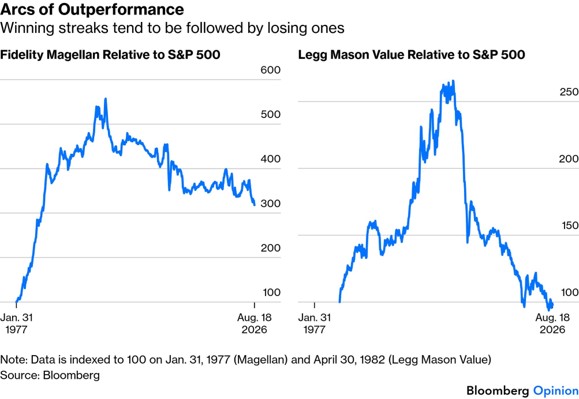
Compounding outperformance can generate astounding wealth, but it’s very hard to maintain. The latest SPIVA report makes that clear yet again.
Last year should have been good for active managers because it saw the highest dispersion (variation between the best and worst stocks) since 2009. As happened then, such dispersion should be just what’s needed to allow stockpickers to outperform. Why didn’t they? The problem seems to have been the massive outperformance of the biggest five stocks, whose dominance was greatest when dispersion was highest early in the year.
To beat the index, active managers had to pile in to those stocks, leaving their portfolios unbalanced. That was a big ask — and there’s an argument that the sheer weight of passive managers is making those mega caps ever bigger, and outperformance all the harder.
When investors pull money from an active fund, the manager must sell what he or she owns – often the overweights, the best ideas. When that money migrates to an index fund, it buys benchmark weights instead. Repeat with $3 trillion over 15 years, and you get relentless selling pressure on exactly the stocks active managers favour and relentless buying of whatever dominates the index.
It has been estimated that each percentage point of flow-driven demand moves fund returns by two to three points.
Crucially, that pressure from passive flows doesn’t wash out (rebase over time). Half of it is still in prices three years later. Sharp investors trade against short-term selling pressure, but no one has the patient capital to trade against a generational structural shift.
There have been criticisms that the above report is somewhat biased toward the ‘passive story’ (lies, damn lies and statistics at work). Because much of this report is so technical, it is easy to ‘snow’ readers and investors with statistics that look good while ignoring those that tell a different story. I see it all the time in Fund Fact sheets of RSA v funds where ‘benchmarks’ are cherry-picked to make a fund look good.
If you scrub some of the biases out of the numbers, the proportion of US equity funds lagging over five years dropped to 56.2% from 73.7%, while over 20 years the drop was to 55% from 99.2%. The case for passive remains, but it’s not as overwhelming as it appears — or at least before the weight of money in index funds made active managers’ lives even harder. One safe prediction: This issue will not go away.

Bitcoin’s uninspiring run this year is making a turn for the better. It needed a catalyst, and the announcement from the US Treasury Department that it will double the size of buybacks for longer-dated securities jolted the debasement trade, a bet against fiat currencies like the dollar, back to life. The cryptocurrency surged as much as 23% in the days following Secretary Scott Bessent’s decision:
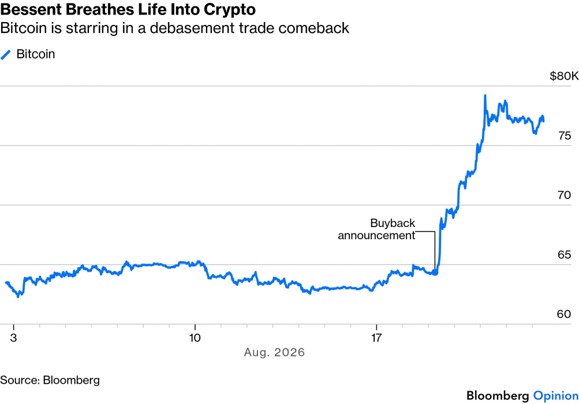
The lifeline drove the biggest daily gains since February.
More than 10 months after Bitcoin began a plunge of nearly 50% from its peak, it still needs an even stronger catalyst to reclaim former glory. If last week’s strong inflows into Bitcoin exchange-traded funds are anything to go by, investors are starting to believe again. The harder question is how durable that conviction will be.
Bitcoin’s rally continued even after bonds swiftly reversed their gains. What matters now is just how hard Bessent tries to put a lid on Treasury yields.
If he continues on this course, the dollar, which fell as much as 1% after the announcement, remains another key variable. Further tumbles, together with a cap on yields, would likely keep money flowing into Bitcoin ETFs.
Conversely, if the $40 trillion debt burden and persistent inflation pressures push the term premium higher again, forcing the Federal Reserve toward tighter policy, the current high-beta rally across crypto assets could face another round of repricing pressure.
There remains a sense that the regulatory policy framework needs to be clearer. The Senate’s failure to take up the Digital Asset Market Clarity Act before this month’s recess pushed the next major possible catalyst to later in September. The Commodity Futures Trading Commission is expected to push for broader access to crypto and greater regulatory certainty, which might lower the barriers to institutional adoption.
Given Bitcoin’s spectacular collapse since October last year, there’s no guarantee that such policies would make a difference, but the combination of favourable policy (apparently a Trump administration priority) and a macroeconomic pivot might be just what it needs.
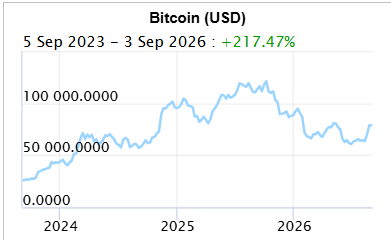
Crypto’s safe haven reputation has been badly damaged. It has recently declined during a period of rising inflation – the precise environment where the haven/inflation-hedge thesis predicts it should outperform. And the Iran conflict still presents meaningful risks. Crypto enthusiasts will bask in Bessent’s bounty for the time being. But the uneventful months before his move should not be forgotten. Bitcoin will need to sustain the next leg of its recovery long after this burst of enthusiasm dies down.

Bessent has a big problem – the rising cost of debt alongside an ever-growing national debt.
US
Debt is already at historically high levels; now the interest they have to pay out is going to significantly erode their kitty. Look at this timeline:
Across his campaigns, Trump’s rhetoric on the national debt shifted noticeably from grand elimination promises to more general “balance the budget” language, while independent fiscal analysts consistently found the actual policy proposals moved in the opposite direction.
2016 DJT campaign: Trump was the most explicit. He told CBS’s Norah O’Donnell, “I’m the king of debt. I’m great with debt. Nobody knows debt better than me,” and told The Washington Post in March 2016 he could eliminate the then $19 trillion national debt “over a period of eight years, crediting trade renegotiation as the mechanism (“The power is trade”). He later walked this back to reducing, rather than eliminating, the debt. Clearly neither happened.
2024 DJT campaign: The rhetoric was less specific about a dollar-for-dollar elimination and centred on three planks: extending and expanding the 2017 Tax Cuts and Jobs Act, new tariffs (he floated an “External Revenue Service” to collect them), and government efficiency savings, which became the Department of Government Efficiency (DOGE) once Elon Musk’s involvement was announced late in the campaign, with a stated target as high as $2 trillion in cuts. He also pledged to end taxes on tips, overtime and Social Security benefits.
Net interest payments on US debt have climbed from about $345 billion in fiscal 2020 to roughly $970 billion in fiscal 2025, and are tracking north of $1 trillion in fiscal 2026, now essentially matching or exceeding the circa $1.15 trillion defence budget.
When government borrows this much, it competes with households and businesses for the same pool of capital, which can push up the cost of borrowing economy-wide: mortgages, corporate credit, everything priced off the Treasury curve. It also leaves less fiscal room to respond to the next genuine emergency (a recession, a pandemic, a war) without piling on even more debt at a worse starting point. Debt held by the public crossed 100% of US GDP in April 2026, a threshold widely treated as economically significant because it puts debt service on a scale comparable to the economy’s own growth capacity.
A large share of US debt is short-duration Treasury bills that need to be refinanced constantly, so if investors ever demanded a higher premium to hold it, whether from inflation concerns, rating downgrades, or doubts about fiscal trajectory, the cost would reprice quickly across the whole stock of debt, not just new borrowing. That’s part of why the new Fed chair’s hawkish inflation stance and the debt trajectory are being watched together right now: persistent inflation limits the Fed’s room to cut rates and ease the government’s own refinancing costs.
Some economists (associated with Modern Monetary Theory) argue a country borrowing in its own currency, as the US does, faces very different constraints than a household or even most other countries, and that the debt-to-GDP ratio matters less than the trend in interest-to-revenue and whether borrowing funds productive investment versus consumption. Others point to the US dollar’s reserve-currency status as a genuine, if not infinite, buffer. But even that camp generally agrees the current trajectory, debt growing faster than the economy, interest costs compounding, isn’t sustainable indefinitely without eventually forcing a choice between higher taxes, lower spending, higher inflation, or some combination.
The nonpartisan Committee for a Responsible Federal Budget modelled the full 2024 platform and estimated it would increase debt by about $7.75 trillion through 2035, pushing debt-to-GDP to roughly 143% versus a 125% current-law baseline, since the tax cuts and new spending pledges outweighed the proposed tariff and efficiency offsets by a wide margin.
There are many reasons the bond market is a difficult topic to discuss. It’s extremely complicated and based around counterintuitive mathematics that many find opaque. Yields move in the opposite direction to prices, the yield curve steepens and flattens, much depends on duration, and so on. Stock and commodity markets are far easier to grasp.
It’s also emotive, because bond markets are extremely powerful. Revolts by bond investors toppled Italy’s Silvio Berlusconi in 2011 and the UK’s Liz Truss 11 years later, and also forced President Donald Trump into a swift climbdown from his Liberation Day tariffs.
But the greatest inhibitor to rational debate about a government’s debts is that it’s unavoidably suffused with a moral agenda. The very word ‘credit’ is derived from the Latin word credere, for “to trust” or “to believe.” As for deficit, it comes from the Latin for “it fails” or “it lacks.” And if investors believe that the value of the currency will whittle away over time, that’s “debasement.” When a deficit is a mark of failure and higher yields to fund it demonstrate a lack of trust, then dealing with a deeply technical financial issue soon grows morally charged, making resolution far harder. Look at the last few weeks: a rise in 30-year yields to 5.1% for the first time in a generation and a complicated technical manoeuvre by the Treasury to try to bring them down arrived at the same time as the shocking statistic that the US national debt had topped $40 trillion.

High yields imply a judgment on government profligacy and a lack of trust. A sense of unfairness rings through Trump’s Oval Office comments last Wednesday:
“We could have GDP of 10, 12, 15 times if they just leave us alone. Let interest rates go down. It’s a very unfair system. They should drop interest rates because it means we have a strong country and it’s all based on credit, meaning good credit, and we have the best credit and we’d pay off the debt very easily, very quickly.”
To be clear, this claim is flat-out absurd.
There is no way for the US to multiply its gross domestic product 10-fold in real terms. But it’s true that lower rates, all else equal, make it easier to drive economic growth. The president is not alone in taking high yields as some kind of unfair moral reproach. Couching a deficit and high yields in moral terms as a consequence for laziness and indiscipline is a political sport worldwide.
High yields don’t necessarily cut off growth. The 10-year Treasury currently yields 4.7%; fears are widespread that it could reach 5% for the first time since 2007. But it was above that psychological threshold without interruption from 1967 to 1998. The entire Reagan administration, and most of Bill Clinton’s presidency, both remembered as times of prosperity, played out with yields higher than they are now.

But Trump’s comments on the day the debt hit $40 trillion showed that the administration is worried. The Treasury Department’s intervention to double the amount it can spend buying back longer-dated bonds was largely symbolic, prompting a fall in yields that was quickly reversed the next day. But it was still a declaration of intent. Treasury Secretary Scott Bessent insists that “yields don’t reflect the underlying fundamentals.”
Scott Bessent’s bid to tame US borrowing costs knocked down long-term yields for barely a day a couple of weeks back. The more lasting market signal: the dollar weakened while gold and Bitcoin rallied, reinforcing a debasement trade narrative fueled by swelling US deficits and concerns over the direction of US economic policy.
The divergence exposed a deeper predicament. Washington wants cheaper money even as inflation remains a constraint on the Federal Reserve. And it comes just as governments and companies are competing more fiercely for capital, from large-scale public borrowing to the vast sums pouring into artificial intelligence.
The AI boom sits on both sides of that contest. Financing it adds another enormous claim on debt markets, while the profits investors expect it to generate are helping stocks withstand its rising cost.
Debasement Trades Surge Anew – some history
There’s a history of such things, generally presented as a moral crusade. In December 1985, President Ronald Reagan (R) hailed the Gramm-Rudman-Hollings deficit reduction act (named for two Republican and one Democratic senators) that applied automatic budget cuts to the appropriations process.
“The Government Gargantua has been gorging on taxpayer dollars for too long. We plan to get it slimmed down into shape by the end of the decade. For years, we’ve been warning that the growing deficit reflects a dangerous increase in the size of government. Now Gramm-Rudman-Hollings locks in a long-term commitment to lowering and eventually eliminating deficits.” (Reagan)
At the time, US debt was $1.8 trillion. Gramm-Rudman-Hollings lasted until 1990.
In 2010, President Barack Obama announced the Simpson-Bowles commission, like its predecessor, featuring leaders from each party. He couched it in a surprisingly similar way:
Those who believe government has a responsibility to meet these urgent challenges have a great stake in bringing our deficits under control — because if we don’t, we won’t be able to meet our most basic obligations to one another. So America’s fiscal problems won’t be solved overnight. They’ve been growing for years; they’re going to take time to wind down. But… I believe we are finally putting America on the path towards fiscal reform and fiscal responsibility. (Obama)
The US national debt then stood at $13.5 trillion. The Simpson-Bowles recommendations were never enacted.
Bessent said last week that he and Budget Director Russell Vought had been tasked with coming up with a plan for fiscal consolidation, that a fraud task force might save “hundreds of billions of dollars,” and that there was a “very good chance” that the fiscal deficit had already peaked. The national debt is now $40 trillion and counting. And this time there’s not even a whiff of bipartisanship. Watch this space as history unfolds.

A disagreement between Chinese and US officials at a Group of 20 finance chiefs meeting last week mostly revolved around a dispute over one word – ‘non-market’.
Treasury Secretary Scott Bessent publicly accused Chinese officials last Tuesday of preventing the group from issuing a joint communique after the two-day gathering in Asheville, North Carolina. The US side attributed that impasse to disagreements on language spanning issues from critical minerals to debt restructuring.
But the most crucial sticking point was the inclusion of the phrase “non-market” in a sentence addressing trade imbalances. That term was seen by Chinese officials as a veiled attack on state-owned companies that are a foundational pillar of the nation’s economy.
China proposed a tweaked phrase that would have addressed trade imbalances without putting a spotlight on the nation’s SOEs. Chinese negotiators privately received support from some countries for its suggestion, though they failed to reach consensus with the US, the people said.
The final statement from the US included a line saying countries should agree to “eliminate non-market policies and practices that exacerbate imbalances.”
The dispute highlights simmering tensions between the world’s biggest economies weeks before Chinese leader Xi Jinping heads to Washington for a high-profile summit with US President Donald Trump. Bessent is a key figure in steering Washington’s relationship with Beijing, leading trade negotiations and poised to helm bilateral talks in the coming weeks on artificial intelligence.
Core to this dispute is how different countries treat ‘mineral rights’.
Mineral rights regimes fall into two broad camps globally, and both the US and South Africa are interesting because each sits at (or moved through) the boundary between them.
United States: the US is the standout global outlier in that it allows genuine private ownership of subsurface minerals, severable from surface ownership entirely. This is the “split estate” concept: a landowner can sell or lease the mineral rights under their property while keeping the surface, or vice versa, and whoever holds the mineral estate can extract without needing the surface owner’s consent (subject to reasonable use). This traces back to 19th- and early 20th-century homesteading-era law (the Stock-Raising Homestead Act of 1916 is a key example) that deliberately split surface and mineral title on federal land grants. Alongside this private system runs a large parallel one: roughly 28% of US land is federally owned, and minerals there are leased out by the Bureau of Land Management rather than privately held, so the US is really a hybrid of private ownership and federal leasing. (Much of the (pristine) land in Alaska that companies want to drill for oil is state-owned).
Most of the rest of the world: the near-universal norm elsewhere is that the state (or the Crown, in Commonwealth countries) owns subsurface minerals by default, regardless of who owns the surface. The UK, Canada and Australia all work this way: private freehold title generally doesn’t include the minerals beneath it, and companies obtain the right to extract through state-issued licences or concessions rather than by buying mineral rights from a landowner. Canada has some pockets of freehold mineral rights in older-settled provinces (Alberta and Saskatchewan notably), but the bulk of Canadian mineral rights sit with the Crown. This state-licensing model, not the American private-ownership model, is what South Africa now follows too.
South Africa, though, is a genuinely interesting case because it changed systems. Historically, under Roman-Dutch common law, South Africa allowed private, severable mineral rights much like the US, often held separately from surface title and frequently by absentee or corporate holders built up over more than a century of mining history. That ended with the Mineral and Petroleum Resources Development Act (MPRDA), which came into force on 1 May 2004. It abolished the old common-law private mineral rights entirely and replaced them with a “custodianship” doctrine: the state, through the Minister of Mineral Resources, now holds all mineral and petroleum resources in trust for the nation as a whole, and nobody, individual or company, privately owns minerals anymore. Access is instead granted through prospecting and mining rights (time-limited licences) issued by the state. Existing private rights-holders had a transitional window (broadly 2004-2009 depending on the right type) to convert old-order rights into new-order licences or lose them outright, which was itself hugely consequential for the industry.
What makes South Africa’s version distinctive even compared to the UK/Canada/Australia custodianship model is that licensing is bound up with transformation policy: the Mining Charter requires a minimum level of Black ownership (26% has been the long-standing benchmark under the 2018 charter) as a condition of holding a mining right, something those other Crown-ownership countries don’t attach to their licensing. That has produced its own running legal battles, notably the “once empowered, always empowered” principle, upheld by the High Court, which established that a company doesn’t lose its compliance status if its BEE ownership partners later sell out, protecting historical deals from being invalidated retroactively.
China anchors the far end of the state-control spectrum, and it’s tightened its grip on that model quite dramatically in just the past two years, which is worth flagging given how central this has become to the broader critical-minerals and US-China rivalry story.
Constitutionally, China has never allowed anything resembling the US or old South African model. Article 9 of the PRC Constitution vests ownership of all mineral resources in the state outright, so there’s no private or severable mineral estate at all, not even in the licensed-custodianship sense South Africa now uses.
Individuals and companies, domestic or foreign, can only obtain exploration and mining rights (essentially permits) from the state through the Ministry of Natural Resources; they never own the resource itself. This framework dates to the original 1986 Mineral Resources Law (revised 1996), and state-owned enterprises have historically been favoured for strategically important minerals even where private and foreign firms are technically permitted to hold rights.
What’s changed recently is the degree of control layered on top of that baseline ownership structure. In July 2024, China moved to explicitly declare rare earth resources and deposits as state property under dedicated rare earth regulations, tightening the screws specifically on the minerals central to EVs, magnets and defence electronics. Then in November 2024, China adopted a full revision of the Mineral Resources Law, its first major overhaul since 1996, which took effect 1 July 2025. The headline addition is an entirely new chapter establishing a national critical-mineral stockpiling system, with three reserve types: physical product stockpiles, spare production-capacity reserves, and designated resource sites held in reserve for emergencies, plus a digital supply-demand early-warning system.
Most recently, detailed implementing rules for that law took effect on 15 June 2026, and these are where the real teeth are: competitive bidding requirements for scarce and strategic minerals, total volume (production quota) controls on strategic minerals, and a new five-year restriction on transferring mining rights, aimed at curbing speculative rights trading and hoarding.
Put next to the earlier comparison: the US sits at one extreme with genuine private, severable mineral ownership; the UK, Canada, Australia and now South Africa sit in the middle with state or Crown ownership administered through licensing; and China sits at the far extreme, where the state has always owned the resource outright and is now actively using that ownership as a supply-chain security and geopolitical instrument, stockpiling, quotas, transfer restrictions, rather than purely a resource-management framework
The US government officially defines “non-market” policies and practices as government interventions that distort global trade in favour of domestic industries, including conduct by state-owned or controlled enterprises.
The word has also long featured in US criticism of China’s trade practices, with the US Trade Representative describing a 2017 probe as a response to the Asian country’s “non-market economic system.” Including the phrase in a G20 communique could be read as a coded reference to China without naming the nation explicitly, the people familiar said.
China’s formidable export engine remains a flashpoint in ties with the US. The Asian country clocked a record trade surplus of $1.2 trillion in 2025 — a 20% increase from the previous year — and Bessent made it a key issue throughout the meeting of G20 finance chiefs. The US had a trade deficit of roughly $200 billion with China last year, Bureau of Economic Analysis data show.
Bessent reiterated criticism of China last Wednesday, saying its policies suppress domestic demand and rely on exports for growth. Claiming about 4% of the nation’s GDP goes into “industrial subsidies,” Bessent called out carmaker BYD Co. as a beneficiary.
“Anyone here ever seen a BYD car?” Bessent said at a Charlotte Economics Club event in North Carolina. “It is the best $70,000 car that $35,000 can buy — it is heavily subsidised.” However, a Rhodium Group report earlier this year found that direct grants to BYD translated into roughly $292 per vehicle, accounting for roughly 5% of the $4,700 cost gap relative to Tesla in China. Most of BYD’s cost savings came from the company making many of its own components and, because of the scale of its production, the report said. Bessent is clearly mimicking his boss’s love of hyperbole.
Author: Dawn Ridler

When Japan becomes instructive
Treasury Secretary Bessent at the G20 summit said he believed the Japanese government and Bank of Japan will take actions that lead to a stronger yen. Historically, the Yen has been weak relative to the Dollar as a consequence of their property market collapse back in the 90s. The cheap Yen made their exports competitive, and ultra-low yields allowed for the repayment of debt. The flip side of this was stagnant economic growth, which made Japan the poster child of a post-bubble collapse.
But the US and Europe are now dealing with their own debt issues. The Japanese situation has not only become instructive as to the path of debt monetisation but also to the role of policymakers during times of high debt. Japan has historically maintained tight control over its bond market, intervening to ensure an upward-sloping yield curve. These operations saw them buying and selling 10-year bonds. They have tried to curb this of late, relying more on banks, insurers, pensions, households, and foreign investors to absorb a greater share of government issuance. With inflation and wage growth becoming more durable, the Bank of Japan concluded that long-term Japanese Bond yields should again be formed principally by the market rather than by an explicit central-bank yield target. Free markets are only free until they start biting at the fabric of society, risking upheaval. And this is where the West is heading at the moment, with its ever-increasing debt levels.
Some warn of an Armageddon moment in bond markets as debt levels rise, but they forget that the US government controls bond issuance and can, by default, intervene if its objectives are no longer being met. If one controls the issuance and the price level of an asset an Armageddon moment becomes more distant.
The US Treasury has decided to at least double buybacks of longer-dated Treasury securities, from a maximum of $2 billion to at least $4 billion per operation, beginning 9 September and running through 4 November 2026. The official framing is market liquidity, but the market interprets it as the Treasury also trying to relieve pressure on long-term yields after the 30-year rate reached its highest level since 2007. It’s starting to look like the Japanese experience, and one has to ask: is the US also doomed to subpar growth, as the Japanese were, as they deal with ballooning debt levels? In part, this is why the US needs the effects of Artificial Intelligence. Look at stock market returns. Outside of big tech, returns have been anaemic as companies contend with a lacklustre economy. But AI players are spending vast sums to kickstart the next era of US-led growth. There is a lot riding on the success of AI. It’s not just the players central to the technology; the government also needs the growth to paste over ever-increasing levels of debt. This points to how complicated the AI boom has become. It’s not just about the technology and who can benefit, since the government could directly achieve its own fiscal objectives if this works. I think that the vested interests are sometimes underappreciated by some.
Author: Cobie LeGrange
EXCHANGE RATES and other Indices:

Rand/Dollar: the rand ended the week near R16.00 to R16.04 to the US dollar, a touch weaker than about R15.95 to R15.97 a week earlier, after trading as weak as R16.14 to R16.19 mid week. The Rand/Dollar closed at R15.95 (R 16.09, R16.02, R16.17, R16.14, R16.55, R16.47, R16.31, R16.22, R16.40, R16.39, R16.27, R16.55, R16.23, R16.46, R16.68, R16.39, R16.63, R16.29, R16.41, R17.07, R17.06, R16.89, R16.55, R15.93, R16.01, R15.96, R16,03, R16.15, R16.10, R16.50, …R16.91, R17.13, R17.36, R17.13,16.52 )

Rand/GBP: the rand was around R21.65 to R21.71 to the British pound, little changed from about R21.65 to R21.70 a week earlier. The Rand/Pound closed at R21.56 ( R21.79, R21.86, R21.88, R21.78, R22.31, R22.16, R21.86, R21.64, R21.64, R21.67, R21.80, R22.06, R21.80, R22.09, R22.21, R22.30, R22.56, R22.35, R22.02, R22.09, R22.77, R22.76, R22.35, R22.20, R21.48, R21.59, R21.78, R21,82, R22.11, R21.97, R22.13, …R22.57, R22.68, R22.74, R22.56,

Rand/Euro: the rand was around R18.55 to R18.58 to the euro, little changed from about R18.55 to R18.60 a week earlier. The Rand/Euro closed the week at R18.52 (R18.60, R18.72, R18.71, R18.66, R19.09, R18.84, R18.62, R18.52, R18.66,R18.89, R19.16, R19.08, R18.91, R19.11, R19.38, R19.29, R19.48, R19.37, R19.17, R19.24, R19.70, R19.77, R19.33, R19.23, R18.80, R18.87, R18.94, R18.93, R19.14, R19.04, R19.20)

Brent crude: Brent crude rose to around $95 a barrel, up sharply from about $86 to $88 a week earlier, as the US and Iran exchanged fresh strikes around the Strait of Hormuz.Brent Crude: Closed the week at $96.28 ($88.29, $94.39, $88.52, $83.55, $87.93, $88.10, $76.01, $72.10, $71.99, $80.59, $87.33, $93.09, $91.12, $104,24, $109.26, $101.29, $108.83, $105.33, $90.38, $95.20, $107.88, $112.36, $103.14, $92.88, $73.19, $71.76, $67.75, $68,05, $69.32, $65.88, $63.34, …$63.71, $63.19, )

Gold eased to around $4,469 to $4,478 an ounce after falling to the low $4,330s midweek, down from about $4,650 a week earlier. Gold closed at $4,432 ($ 4,454, $4,607.35)

Bitcoin eased to around $77,000 to $78,000, down from above $79,000 a week earlier, as rate-hike fears weighed on risk assets.Bitcoin closed at $79,776 ($78,701, $76,532, $62,911, $64,921, $63,143, $64,718, $63,815, $62864, $60,063, $64,029, $64,131,$60,762, $73,788, $74,559, $77,879, $80,733, $78,204, $78,049.98, $75,519, $70,904, $68,691 , $68,586, $70,869, $67,310, $63,534, $68,04, $69,649, $68,553, $81,301, $89,295, $90,585,)
Articles and Blogs:
Investment series part 4(NEW)
Investment series part 3 (NEW)
Investment series part 1
Investment series part 2
Legacy Series Part 4
Legacy Series part 3
Legacy Series Part 2
Legacy Series Part 1
Holiday checklist
Next year – Action Plan
Next year – Vision, Mission etc
Medical Risk Mitigation
Next Year – Consolidation
Abdication or diversification?
Carbo-loading your retirement Spoiled for choice
Who needs a plan anyway
8 questions you need to ask about retirement
What to do when interest rates drop
How to survive volatility in your investments
What to do when interest rates drop
Difficult Financial Conversations
Financial Implications of Longevity
Kick Start Your Own Retirement Plan
You matter more than your kids in retirement
To catch a falling knife
Income at retirement
2025 Budget
Apportioning blame for your financial state
Tempering fear and greed
New Year’s resolutions over? Try a Wealth Bingo Card instead.
Wills and Estate Planning (comprehensive 3 in one post)
Pre-retirement – The make-or-break moments
Some unconventional thoughts on wealth and risk management
Wealth creation is a balancing act over time
Wealth traps waiting for unsuspecting entrepreneurs
Two Pot pension system demystified
Cobie Legrange and Dawn Ridler,
Rexsolom Invest, Licensed FSP 45521.
Email: cobie@rexsolom.co.za, dawn@rexsolom.co.za
Website: rexsolom.co.za, wealthecology.co.za