

A tale of two economies:
China’s economy is running at two speeds. Factories are booming on demand for AI hardware and the trade surplus is on course to top USD 1 trillion again, but households are barely spending, borrowing has shrunk for six straight months and property keeps sliding. Growth slowed to 4.3% in the second quarter, and with no market support this time, the CSI 300 is heading for its worst quarter since 2022. As South Africa’s largest trading partner, China’s imbalance caps the upside for JSE resource counters, adds import competition for local manufacturers and weighs on sentiment towards the rand. The lesson is diversification: favour the global technology and infrastructure build-out and be cautious on assets that rely on a Chinese consumer or property revival.
OpenAI/China’s Moonshot spat:
OpenAI has accused users linked to Chinese start-up Moonshot AI of a coordinated effort to extract how its GPT models reason, the latest in a string of distillation allegations that include Anthropic’s claims earlier this year. Washington now treats covert, industrial-scale distillation as intellectual property theft, and sanctions or an Entity List designation remain on the table, which would cut Moonshot off from US chips and cloud services and cloud its planned $3 billion Hong Kong listing. AI and chips are the one area where neither side is giving ground, making this the most likely flashpoint before the trade truce expires on 10 January 2027.
Trump-Xi outcomes:
Xi’s state visit to Washington delivered flyovers and a state dinner but no trade deal; the headline outcome, extending the trade truce from November to 10 January 2027, was agreed before he landed. The concrete wins were modest: a $30 billion tariff cut each way on non-sensitive goods, progress on the Board of Trade, farm purchases broadly on track and a new “super intelligence” dialogue. Rare earths, chip export controls, broad tariffs and Taiwan were all left for the APEC and G20 meetings. For South Africa, where China and the US are our two largest trading partners, a stable truce supports the commodity demand behind our trade surpluses. Investors should avoid trading the headlines, understand their indirect China exposure and keep diversifying offshore.
The word of the week “Démarche”:
A démarche is a formal diplomatic protest, usually delivered by summoning a country’s ambassador. DIRCO issued US Ambassador Brent Bozell with his third démarche on 29 September, after an op-ed criticising the government for ignoring the Trump administration’s “five asks” on property rights, the Expropriation Act, B-BBEE, the “Kill the Boer” chant and farm safety. With US visa sanctions already imposed on some South Africans and more threatened, relations remain tense, and expulsion is a possibility if the ambassador keeps speaking out of turn.
UK Pensions:
Despite the headlines, Prime Minister Andy Burnham has reformed rather than scrapped the UK state pension triple lock. From April 2030, the pension will still rise by at least CPI or 2.5% each year, but the earnings link will only top it up when it falls behind about 30% of average earnings, removing the “ratchet” that let pensions outrun wages after inflation spikes. The change should free up about £15 billion a year by 2040 for social care, which is sensible but modest, and politically brave. For South Africans, two lessons stand out: a UK state pension paid to someone living here is frozen at its first rate, and every state pension is a political promise that can be revised. The only retirement income you truly control is the diversified income you build yourself.
To invest or not?:
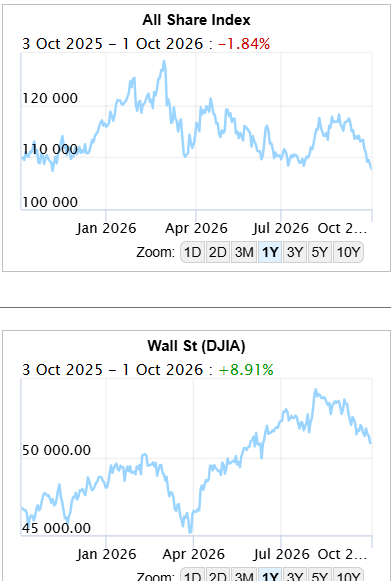
The All Share is down 3.22% this year, dragged by a 13.55% fall in Industrials as China’s struggles weigh on Naspers and Prosus, while bonds have returned only 3.5% as yields rose. The real returns have come offshore, especially in emerging markets (up 22%) driven by Taiwan’s and South Korea’s semiconductor industries, which South Africa has missed. Rising yields and AI disruption are repricing some companies and creating value elsewhere, and resources should benefit when gold resumes its climb. With US relations strained and the local economy stalling, Financials and Industrials need patience, and history shows patient investors are rewarded while market timers miss the compounding.

This Week’s Roundup

China’s supply side is thriving while its demand side stalls, and the gap is widening. That is not a good sign for the global economy.
Growth slowed to 4.3% in the second quarter, the weakest since late 2022 and below the target range. Even the China Statistics Bureau now concedes the imbalance between strong supply and weak demand remains pronounced.
The pattern is glaring. Factories are producing into a world hungry for AI hardware, and exports to the US alone rose 34.4% in August. At home though, shoppers are barely spending, household borrowing has shrunk for six straight months and property investment keeps falling.
The latest PMI fits the same mould. Factory activity returned to growth for the first time since June, but production did the lifting while new orders and new export orders both edged down. China’s trade surplus is on pace to top USD 1 trillion for a second straight year, which keeps trade partners, Washington included, pressing Beijing to consume more of what it makes.
Clearly, investors wanted more, and the numbers show it. On Wednesday morning last week the CSI 300 was barely moving off a one-year low set earlier in the week, and is on course for a 13% quarterly slide, its worst since the 2022 lockdowns (remember ‘Zero-Covid’?). The Shanghai Composite is heading for a 6.2% quarterly fall.
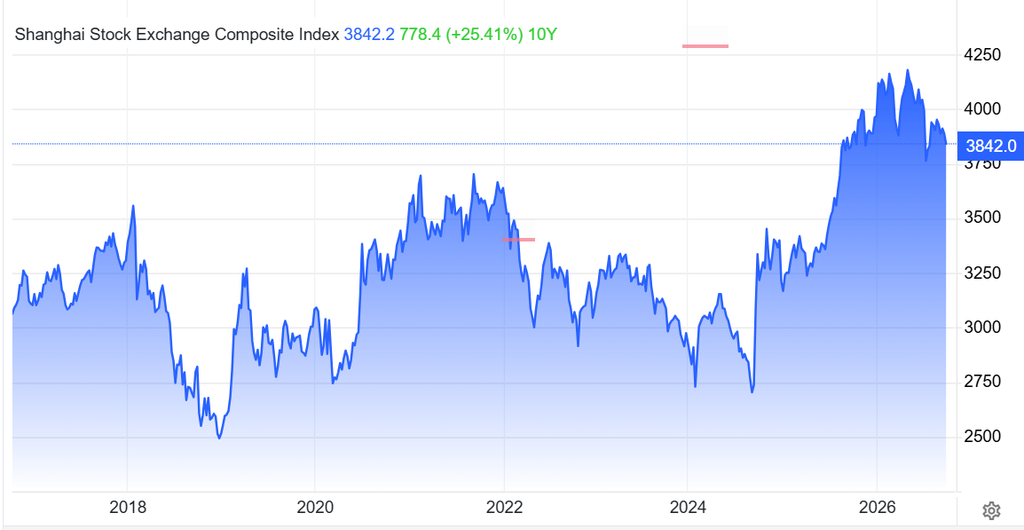
The big bugbear has been Property. Property shares whipsawed, with the CSI 300 Real Estate Index down as much as 9% before recovering. The former bright spot, tech, has also cracked: chip stocks are down about 32% since June and the CSI AI Index is set for a 25% quarterly fall.
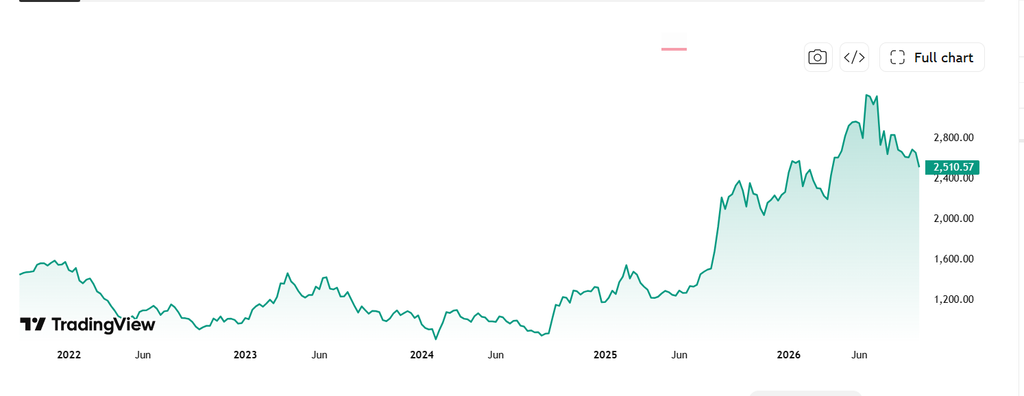
CSI AI Index
Turnover on the mainland exchanges fell to its lowest since July 2025 ahead of the week-long National Day holiday that starts on 1 October.
The contrast with September 2024 is instructive. Then, a broad package that included stock market support sparked a sharp rally. This time, the absence of any market support measures has left sentiment where it was.
Why it matters closer to home
China is South Africa’s largest single trading partner, so its growth model feeds straight into our markets. A China that builds and exports but does not consume or construct much at home has three consequences for local investors.
For long-term investors, the lesson is diversification rather than prediction. China’s two speeds reward exposure to the global technology and infrastructure build-out, and argue for caution on assets that depend on a Chinese consumer or property revival.
What we’re watching:

OpenAI says users linked to Chinese start-up Moonshot AI ran a coordinated effort to uncover the hidden information about how its GPT models reason through problems. The activity began in early July, around the time Moonshot launched its Kimi K3 model, and peaked at 16,000 requests later that month.
The technique at issue is distillation: training your own model on the outputs of a more capable one.
Done openly, it is routine, and every major lab uses it to build smaller, cheaper models. The dispute is about doing it covertly and at industrial scale, which Washington now treats as intellectual property theft.
Moonshot has been in the crosshairs for most of the year.
In February, Anthropic tied more than 3.4 million exchanges with its Claude models to Moonshot. In July, White House technology chief Michael Kratsios accused Moonshot of distilling Anthropic’s most advanced model to build Kimi K3, and of accessing restricted Nvidia chips through servers in Thailand. Treasury Secretary Scott Bessent said sanctions and an Entity List designation were on the table. Moonshot has denied that K3 was built on distilled outputs, and no sanctions have been announced.
OpenAI’s disclosure is notable for its shift in tone. In July, OpenAI president Greg Brockman called K3 a good model and said it was too early to tell whether Moonshot had used OpenAI’s systems. OpenAI is now pointing the finger directly, which strengthens the case Washington has been building.
This is where the summit’s goodwill meets its limits. Chips and AI are the one area where neither side is giving ground. An Entity List designation would cut Moonshot off from US chips and cloud services, and would cloud its planned Hong Kong listing, reported in early September to be targeting around $3 billion. AI is the most likely flashpoint ahead of the November and December meetings.
This summit is best read as risk deferred rather than risk removed. The truce now expires on 10 January 2027, just after the APEC and G20 meetings, and the difficult issues have been parked rather than solved.
What to watch
November 2026 brings the APEC summit in Shenzhen, the next Trump-Xi meeting and the first test of whether the hard issues move. The first US-China “super intelligence” dialogue is also due in November and will signal on chip export controls and the AI rivalry, including any action against Moonshot. December 2026 brings the G20 summit in Miami, the last scheduled meeting before the truce lapses. On 10 January 2027, the trade truce expires, and the tariff and rare-earth levers return to the table unless there is a further deal.

We started talking about the trump/Xi visit last week, and now that the visit is over, did it move the needle on anything? A decade ago, Donald Trump criticised then-President Barack Obama for hosting a state dinner for Chinese leader Xi Jinping, promising to never throw a lavish banquet for the leader of the world’s second-largest economy if he ever made it to the White House.
Trump, then mounting his first campaign for the presidency, said they should’ve just gone to McDonald’s instead. “Just take them to McDonald’s and go back to the negotiating table,” he told supporters at a rally in South Carolina in 2015.
Xi Jinping’s first state visit to Washington since that meeting with Obama gave us flyovers, a state dinner and a tour of the National Archives. It did not give them a trade deal. The headline outcome, a two-month extension of the US-China trade truce, was agreed before Xi’s plane even landed.
For investors, that is the real story: the world’s two largest economies have bought themselves time, not certainty, and the deadline has simply moved from November to January.
What happened:
On 23 September, the eve of the formal talks, Treasury Secretary Scott Bessent confirmed that the trade truce agreed in Busan last October, which was due to expire on 10 November, now runs to 10 January 2027. The summit showcased personal diplomacy. Trump called his relationship with Xi a great friendship, and both leaders confirmed they will meet twice more before year-end: at APEC in Shenzhen in November and the G20 in Miami in December. Analysts across the board noted how little of substance came out of three days of talks.
What was actually agreed
What was left on the table:
The list of unresolved issues is longer than the list of agreements. There was no progress on the broad tariff structure, rare earths, export restrictions on advanced chips or Taiwan. Xi pressed Trump to handle Taiwan with prudence, and no arms-sales concession has publicly emerged.
To put the $30 billion in context, it is small next to a US goods trade deficit with China of around $202 billion in 2025 alone, and it covers deliberately uncontroversial products. The hard issues, the ones that move supply chains and corporate earnings, have been pushed to the November and December meetings.
Why it matters for markets
At the height of last year’s trade war, US tariffs on Chinese goods reached 145% and China tightened exports of rare earths critical to electronics and advanced manufacturing. The truce is what keeps those levers holstered, and it now has a January expiry date.
The South African angle:
For South Africa, US-China relations are not a spectator sport. China is our largest trading partner and the US is second. As I mentioned above, this relationship is one of the most important for RSA’s economic wellbeing. Our biggest exports to China are gold, iron ore and platinum group metals, which means Chinese industrial demand feeds directly into the JSE’s resources counters, our trade balance and the rand. That is why a calmer US-China relationship matters more to us than the headline numbers suggest. Anything that dents Chinese growth tends to land on our mining shares first. Conversely, a stable truce supports the commodity demand that has underpinned South Africa’s trade surpluses this year.
A diversification story is also running alongside. Facing a 30% US tariff on many of our exports since August 2025, Pretoria signed a framework partnership with Beijing in February aimed at duty-free access for South African goods, and China said it would not demand reciprocal tariff cuts. Our own trade relationship with Washington remains strained, so the more predictable the US-China relationship becomes, the more room South African exporters have to grow in the Chinese market.
The takeaway for investors:
For South African portfolios, three things follow:

The word of the week “Démarche”
This French word, used almost exclusively in diplomatic circles, was all over the RSA media last week (based on the word ‘to march’/démarcher).
A Démarche (n) is a formal diplomatic communication in which one government officially conveys its position, concerns or objections to another, usually through that country’s ambassador. It is typically used to persuade, inform, or obtain information from a foreign government, and in practice “being demarched” often means the envoy is summoned to the host country’s foreign ministry to hear a formal protest.
The US Ambassador and South Africa DIRCO “demarched” US Ambassador Leo Brent Bozell III in March 2026 after his remarks at a BizNews Conference in Hermanus on 10 March, where he criticised BEE, the Expropriation Act and South Africa’s ties with Iran, and appeared dismissive of the judiciary, including calling “Kill the Boer” hate speech despite the court ruling.
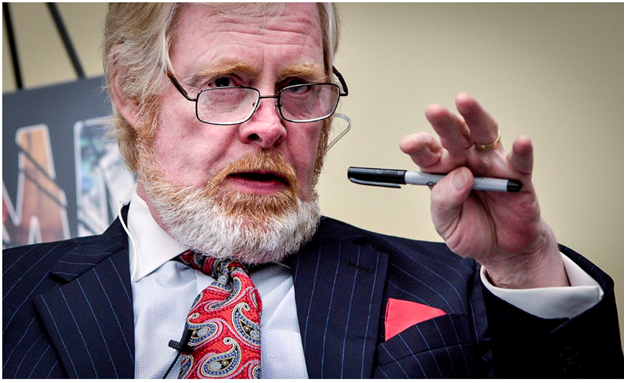
DIRCO Director-General Zane Dangor said the ambassador apologised and expressed regret, including for comments that seemed to undermine the judiciary, while Minister Lamola warned Pretoria would take further action if his conduct did not improve.
It was not a first: in May 2023 DIRCO (Department of International Relations and Cooperation,) demarched then-Ambassador Reuben Brigety over his allegation that South Africa sold weapons to Russia, and he also apologised.
On Tuesday 29 September 2026, the US was issued with a third demarche. This followed a public statement in which Bozell pressed Pretoria to address five demands from the Trump administration. Those demands cover protecting private property rights, reversing the Expropriation Act, changing B-BBEE policy, condemning the “Kill the Boer” chant, and improving rural safety for farmers. The immediate trigger was an op-ed he wrote criticising President Ramaphosa’s government for ignoring those “five asks”. That op-ed followed US Secretary of State Marco Rubio imposing visa sanctions on targeted South Africans, and Bozell warned the visa restrictions would be the first in a series of escalating measures. On the SA side, DIRCO said both countries remain committed to resolving the outstanding bilateral issues. Pretoria may have no option but to expel him (declare him persona non grata) if he keeps speaking “out of turn”.

Pension reform always grabs headlines. The first of the Gen Xers (1965-1980) are over 60 and staring retirement in the face. If you saw this week’s headlines out of London, you could be forgiven for thinking the UK state pension “triple lock” had been thrown out with the rest of the furniture. It hasn’t. Prime Minister Andy Burnham announced a reform, not an abolition, and having looked at the detail, it is a sensible change that arguably should have happened years ago. It is also a lot less dramatic than the headlines suggest. All pension reform around the world needs to be watched – they copy each other and watch for reaction from the voting public. Most Western countries have a huge looming pensions problem. Many government pension schemes are almost run ‘ponzi’ style’ with new entrants financing the retirees, but that pool is shrinking fast – and the GenXers are going to be the ones to first feel that.
First, a quick refresher on how the current UK system works. Every April the UK state pension rises by the highest of three numbers:
For April 2027, the earnings figure released in mid-September came in at 3.9%, which would lift the full new state pension from £241.30 to roughly £250.70 (circa R5500) a week. UK inflation was 3.1% in August, so unless the September reading due on 21 October jumps sharply, earnings will set next year’s increase.
The triple lock was introduced in 2011 for a good reason. In 1979, the state pension was worth about 26% of average earnings. The link to wages was cut in 1980, and by the time the triple lock arrived it had shrunk to around 16%. Pensioners were not getting poorer in absolute terms, but they were falling steadily behind everyone else. The triple lock fixed that, and today the full new state pension is worth roughly 30% of median full-time pay. In other words, the job it was designed to do has been done.
The problem is what happens if you keep running the machine after the job is finished.
The triple lock has a built-in “ratchet”. When inflation spikes, the pension rises with inflation. Wages usually catch up a year or so later, and the pension then rises with wages as well, even though inflation has already cooled.
The UK saw exactly this after Russia invaded Ukraine: a 10.1% increase in April 2023 on the back of inflation, followed by 8.5% in April 2024 on the back of earnings. Pensioners got both bites of the cherry. The more volatile the economy, the faster the state pension pulls ahead of the people paying for it, and the harder it becomes to forecast its cost. The Institute for Fiscal Studies estimated the triple lock could cost anywhere from £5 billion to £40 billion a year more than a simple earnings link by 2050. That is not a forecast; that is a shrug.
So what changes? From April 2030, under what Labour is calling an “adjusted triple lock”, the pension will still rise by the higher of CPI or 2.5% every year. That part is untouched, so pensioners will never lose purchasing power in any given year. What changes is the earnings leg. Instead of automatically matching wage growth whenever it is the highest number, the pension will only be topped up to keep pace with earnings if it has fallen behind its long-term ratio, which Labour says will stay at around 30% of average earnings.
In practice, that means if wages stall in the early 2030s while inflation or the 2.5% floor keeps pushing the pension up, pensioners pull ahead and keep that gain. If wages then surge while inflation is low, the pension keeps rising at 2.5% or inflation, but it lags wages until they catch up. Over the long run, the state pension tracks earnings rather than outrunning them. The ratchet is gone, the guarantee remains.
The government estimates the change will free up around £15 billion a year by 2040, earmarked for Burnham’s plan for social care that is free at the point of use.
First, this is not a spending cut. The UK will still spend more on state pensions every year, just less than it otherwise would have. Second, £15 billion a year in 2040 is very unlikely to fund free personal care on its own. Expect the tax conversation to follow, and watch the Budget on 28 October for the first real numbers.
Politically, it is a brave call. Around two-thirds of the British public say they want the triple lock kept as it is, and Burnham himself defended it during his leadership campaign. Interestingly, an estimated 45% of the UK population was born before 1980. Pushing implementation past the next general election, due by 2029, gives voters the final say and gives Labour room to sell it as part of a bigger social care package. Fiscally, it is sensible but modest. Politically it is anything but.
Why should a South African investor care? Two reasons.
State pensions are small when compared to Western countries, but there has been significant private pension reform and a push by the ANC, from time to time, to hijack all pension saving and put it under the auspices of the PIC (with their ‘spotty’ track record, which we have often covered in these newsletters).
If you or your parents have UK National Insurance years, remember that a UK state pension paid to someone living in South Africa is frozen at the rate first paid. No triple lock, adjusted or otherwise, ever reaches you here. That is a planning issue worth getting right before retirement, not after. The broader lesson is one I keep coming back to: any state pension promise is a political promise, and political promises get revised when the numbers stop adding up. Our own older persons grant has no formula at all and is set each year at the Minister of Finance’s discretion. The only retirement income you truly control is the income you build yourself – and make sure it is diversified.
Author: Dawn Ridler

Investors are starting to grow impatient with the lack of returns in the local market. Year to date, the All Share index has lost 3.22%. This has been driven by lacklustre returns from Resources and Financials, and the fact that Industrials have lost -13.55% for the year so far. Consider that the Chinese economy (discussed above) has been battling, thus placing pressure on large-cap weighers such as Naspers and Prosus, 2 stocks which should at least help when local stocks are battling.
| Equity | YTD % |
| All Share | -3.22% |
| Resources | 1.19% |
| Financials | 3.77% |
| Industrials | -13.55% |
| Fixed Income | |
| ALBI | 3.54% |
| STeFI | 5.13% |
| Global | |
| MSCI World | 10.58% |
| MSCI EM | 22.09% |
In a well-diversified portfolio, one should be able to draw on its diversification, but so far this year, with yields rising, the ALBI (FTSE/JSE All Bond Index) has only managed to expand by 3.5%. Money market (STeFI) is on track to gain, assisted by a recent rise in interest rates, but long-term investors aren’t fully invested here.
The one area that has seen returns is the MSCI World Index, which has gained 10.58%, but look at the return of its Emerging Market component, which South Africa hasn’t captured at all (we are only 3.2%, after all). Returns here stemmed from Taiwan and South Korea amongst others, as their semiconductor industries are direct beneficiaries of the data centre build out globally. The rest of the markets are pretty much flat as non-tech sectors battle under the weight of rising interest rates. And this by default is where valuations are the best not only locally but also in markets across the world.
The question for active investors is how AI will influence the earnings of some companies. Legitimately, some companies are being repriced as their ability to defend their earnings moats is becoming more questionable. In other cases, assets are becoming mispriced, and the rise in bond yields is driving those valuations even cheaper.
South Africa is a direct beneficiary of excess global capital. For it to find its way here, Resources need to find favour with investors. This should happen as the Gold price rises as a direct result of global monetary debasement. The gold price, though, has taken a breather this year after gaining 54% in 2025 and 22.8% in 2024. This has now become a game of patience as there are not many compelling reasons to sell Resources. Another area where investors are being asked to be patient is Financials and Industrial companies. Both these sectors delivered double-digit results in 2025, but I am afraid they are being hampered by the overall geopolitical situation unfolding in South Africa at present. South Africa’s Department of International Relations and Cooperation gave the US Ambassador Brent Bozell a third démarche since his tenure started here (see above). This is as the US and South Africa are unable to find each other on issues such as hate speech and BEE, amongst others. I am afraid that this will continue to hold back growth of local stocks as the economy continues to stall. As with anything, this now requires patience. In my experience, timing this sort of thing is impossible. Markets are attempting to price in the future continuously and if news today points to any form of resolution, markets swiftly price in the new news. Patient investors are then rewarded, and market timers miss out on the compounding effect that markets produce.
Author: Cobie LeGrange
EXCHANGE RATES and other Indices:
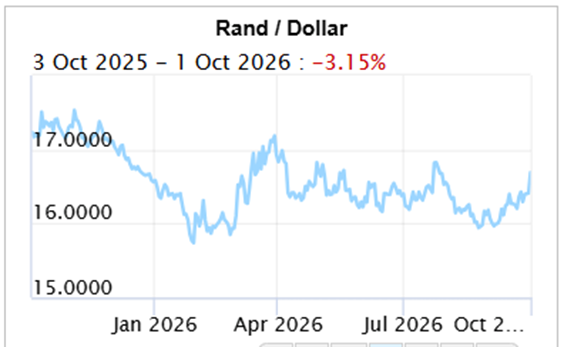
Rand/Dollar: the rand weakened to around R16.69 to the US dollar at Thursday’s close and was little changed near R16.69 on Friday morning, its weakest level since late July, having firmed to R16.33 on Wednesday afternoon.
The Rand/Dollar closed at R16.62 (R16.28, R16.25, R16.11, R15.95, R 16.09, R16.02, R16.17, R16.14, R16.55, R16.47, R16.31, R16.22, R16.40, R16.39, R16.27, R16.55, R16.23, R16.46, R16.68, R16.39, R16.63, R16.29, R16.41, R17.07, R17.06, R16.89, R16.55, R15.93, R16.01, R15.96, R16,03, R16.15, R16.10, R16.50, …R16.91, R17.13, R17.36, R17.13,16.52 )
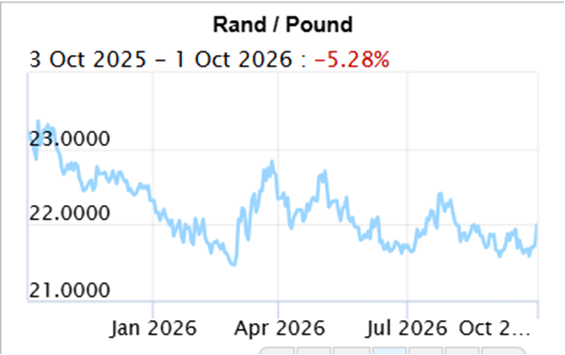
Rand/GBP: The rand was around R21.89 to R22.01 to the British pound at Thursday’s close, weaker on the day, weakening further on Friday to R22.02.
The Rand/Pound closed at R22.02 (R21.57, R21.77, R21.79, R21.56, R21.79, R21.86, R21.88, R21.78, R22.31, R22.16, R21.86, R21.64, R21.64, R21.67, R21.80, R22.06, R21.80, R22.09, R22.21, R22.30, R22.56, R22.35, R22.02, R22.09, R22.77, R22.76, R22.35, R22.20, R21.48, R21.59, R21.78, R21,82, R22.11, R21.97, R22.13, …R22.57, R22.68, R22.74, R22.56,
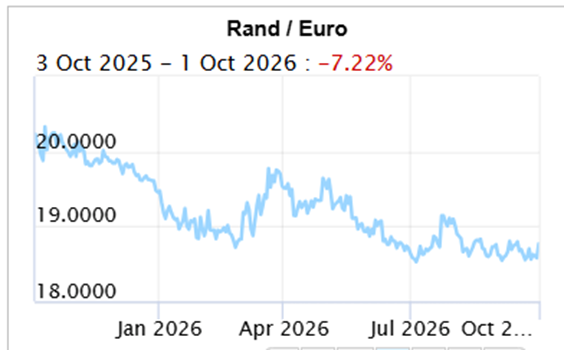
Rand/Euro: The rand was around R18.74 to R18.76 per euro, weaker on Thursday and little changed on Friday morning ending the week on R18.72.
The Rand/Euro closed the week at R18.72 (R18.55, R18.67, R18.68, R18.52, R18.60, R18.72, R18.71, R18.66, R19.09, R18.84, R18.62, R18.52, R18.66,R18.89, R19.16, R19.08, R18.91, R19.11, R19.38, R19.29, R19.48, R19.37, R19.17, R19.24, R19.70, R19.77, R19.33, R19.23, R18.80, R18.87, R18.94, R18.93, R19.14, R19.04, R19.20)
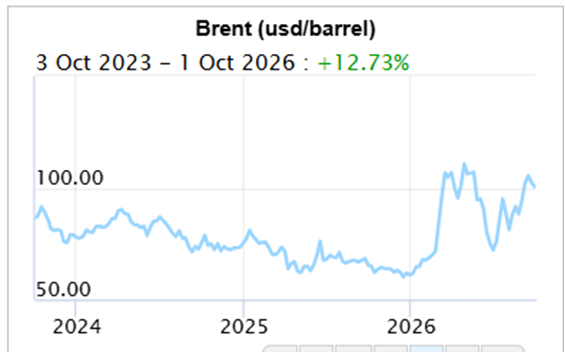
Brent crude: December Brent settled at $102.31 a barrel on 1 October, up 4.4% on the day, and eased to around $101.45 on Friday morning but eased up a tad over the weekend.
Brent Crude: Closed the week at $102.25 ($104.32, $103.87, $104.61, $96.28, $88.29, $94.39, $88.52, $83.55, $87.93, $88.10, $76.01, $72.10, $71.99, $80.59, $87.33, $93.09, $91.12, $104,24, $109.26, $101.29, $108.83, $105.33, $90.38, $95.20, $107.88, $112.36, $103.14, $92.88, $73.19, $71.76, $67.75, $68,05, $69.32, $65.88, $63.34, …$63.71, $63.19, )
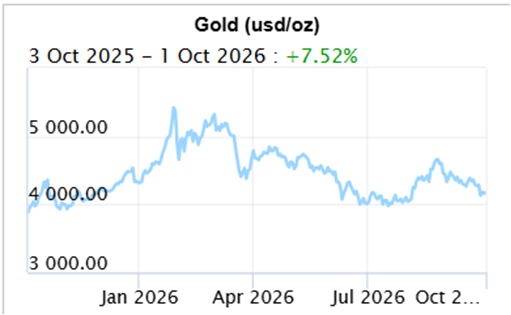
Spot gold was near $4,183 an ounce on Friday morning, down from about $4,213 on 30 September and roughly 25% below its January record, by the end of the weekend it had slipped even further.
Gold: $4,136 ($4,285, $4,379, $ 4,454, $4,607.35)
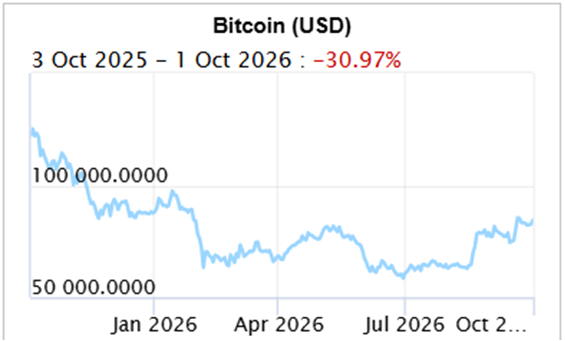
Bitcoin traded around $84,600 to $84,700, within a roughly $83,000 to $85,000 range this week.
Bitcoin closed at $85,071 ($83,725, $80,354, $76,582, $79,776, $78,701, $76,532, $62,911, $64,921, $63,143, $64,718, $63,815, $62864, $60,063, $64,029, $64,131,$60,762, $73,788, $74,559, $77,879, $80,733, $78,204, $78,049.98, $75,519, $70,904, $68,691 , $68,586, $70,869, $67,310, $63,534, $68,04, $69,649, $68,553, $81,301, $89,295, $90,585,)
Articles and Blogs:
Investment series part 7 (NEW)
Investment series part 6 (NEW)
Investment series part 5 (NEW)
Investment series part 4
Investment series part 3
Investment series part 1
Investment series part 2
Legacy Series Part 4
Legacy Series part 3
Legacy Series Part 2
Legacy Series Part 1
Holiday checklist
Next year – Action Plan
Next year – Vision, Mission etc
Medical Risk Mitigation
Next Year – Consolidation
Abdication or diversification?
Carbo-loading your retirement Spoiled for choice
Who needs a plan anyway
8 questions you need to ask about retirement
What to do when interest rates drop
How to survive volatility in your investments
What to do when interest rates drop
Difficult Financial Conversations
Financial Implications of Longevity
Kick Start Your Own Retirement Plan
You matter more than your kids in retirement
To catch a falling knife
Income at retirement
2025 Budget
Apportioning blame for your financial state
Tempering fear and greed
New Year’s resolutions over? Try a Wealth Bingo Card instead.
Wills and Estate Planning (comprehensive 3 in one post)
Pre-retirement – The make-or-break moments
Some unconventional thoughts on wealth and risk management
Wealth creation is a balancing act over time
Wealth traps waiting for unsuspecting entrepreneurs
Two Pot pension system demystified