

Too Busy? Got Better Things to Do? Read the Summary…
Gold back on fire?: Gold surged over 4% last week, its best weekly gain since February, closing above $4,300 an ounce. Investors read Fed Chair Kevin Warsh as less inclined to tighten policy than inflation warrants, while easing Iran tensions pushed oil below $80 and the 10-year Treasury yield down to about 4.60%. A weakening dollar, not falling real yields, is now the bigger driver. Record central bank buying (289 tons in Q2, up 62% year on year) continues to underpin prices, with further upside possible if AI valuations unwind sharply, though a resolute Fed could keep the rally muted.
Is inflation under control?: Markets remain confident inflation is anchored near 2% long term, but consumers disagree. The New York Fed’s three-year inflation expectations are at their highest since 2022, and services sector executives still see elevated price pressures. Warsh has appointed task forces to review Fed data and inflation frameworks, fueling speculation he could redefine the target, though doing so risks damaging Fed credibility given inflation has run persistently above target.
Occam’s Razor, Oil and Mag 7 edition: The S&P 500 is nearing record highs, best explained by strong earnings, with S&P EPS growth of 47.4% year on year this quarter. Oil’s slide from the mid-$80s to under $80 has relieved stocks of a key drag, despite rising risk of escalation in the Middle East, partly due to “strait fatigue” among investors. Hyperscalers rebounded sharply after reassuring Microsoft and Amazon earnings, and low VIX levels suggest confidence in continued AI-linked earnings growth, though risks remain around escalation, AI profitability, and credit conditions.
Yen, Bessent talks: Treasury Secretary Scott Bessent said yen weakness is worsening Japan’s inflation and risks triggering competitive devaluation across Asian currencies. This follows a joint US-Japan intervention, the first in 15 years, which helped the yen recover from a four-decade low near 164 to around 157.5 per dollar. Bessent noted Japan is moving toward budget discipline and said further coordinated action remains on the table.
June shakeout: Most hyperscalers have recovered from June’s tech selloff, with Microsoft and Amazon posting the strongest year-on-year gains, while Meta remains down 22% over the year. Concerns about capex and cloud demand have eased as client engagement hits records, though the sector faces a balancing act between building enough capacity and overbuilding. Valuations (Meta at 22x, Microsoft at 27x) remain reasonable if earnings growth continues, with enterprise cloud migration seen as the next major demand driver for AI adoption.



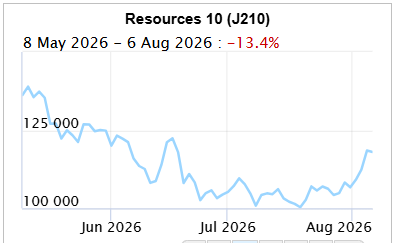
surged, with Gold Fields up 8.75%, AngloGold Ashanti up 8.19% and Impala Platinum up 5.91% intraday.
Big Tech earnings; the rally faded by 5 to 6 August as the Dow fell more than 460 points on renewed inflation concerns tied to a rebound in oil prices.
from a revised 95,000 in June, while announced layoffs fell to 33,429.
Nonfarm payrolls fell by 23,000 in July, well below the prior 12-month average monthly gain of 34,000. The unemployment rate held at 4.1%, with 6.9 million people unemployed. Local government education lost 50,000 jobs, and retail trade lost 19,000, while health care kept trending up (+22,000) and financial activities kept trending down (-14,000, now down 121,000 since its May 2025 peak). Average hourly earnings rose to $37.62, up 3.2% year over year, and the average workweek held at 34.3 hours.
additional 50% tariff on certain Canada-origin goods due to take effect on 19 August, alongside Section 301 tariffs of 10% to 12.5% on imports from 60 countries that took effect on 24 July.

Gold back on fire? A week on from a Federal Reserve press conference that left many baffled, we spoke about that last week, the gold market seems to have come to its own conclusion. It surged more than 4.3% last Wednesday, its third-largest daily gain this year and the strongest since February. As a traditional haven asset, this sudden rebound underscores increasing concerns that the Fed may not be doing enough to control inflation — despite a succession of statements from governors this week that they remain ready to raise rates.
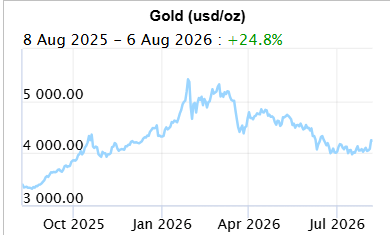
At more than $4,300 per ounce, it’s back to where it was in mid-June when Washington and Tehran reached a ceasefire.
Despite Chairman Kevin Warsh’s mixed messaging, investors concluded that the Fed was less inclined to tighten policy than elevated inflation warranted. Then, progress toward reopening the Strait of Hormuz eased perceived geopolitical risks further. With crude oil futures back below $80 a barrel, the odds of a September rate hike was reduced. That helped pull the 10-year Treasury yield down to about 4.60% from last week’s 4.75%.
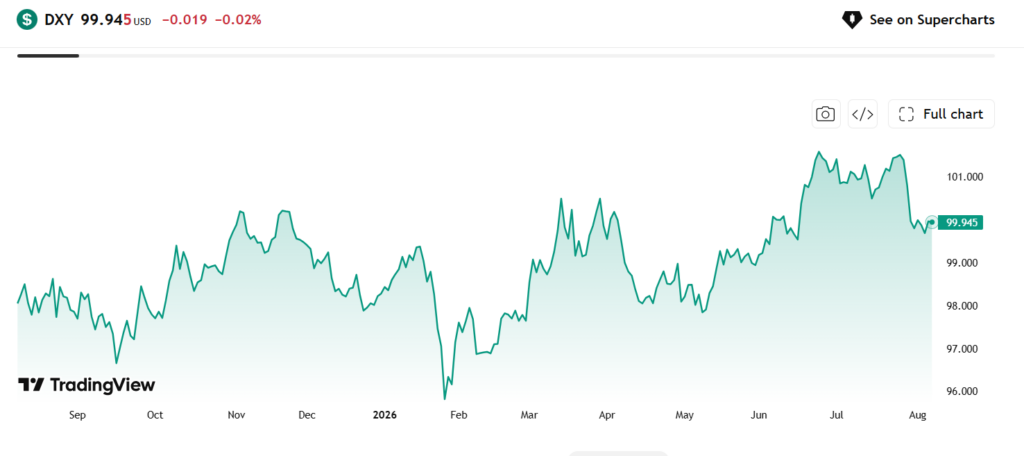
Previously, gold’s rally hinged on the trajectory of US interest rates and belief in a feckless Fed. The sharp rise in real yields since the outbreak of hostilities in Iran was damaging; gold pays no yield and historically loses appeal when real returns on bonds are higher. Wednesday’s advance, however, suggests that the weakening dollar is now having a greater short-term impact than high real yields. The move in gold is less about interest rates and more about the US dollar sliding to its weakest levels since early June.
Does this mean gold’s worst days are over? Going forward, barring a total breakdown in diplomacy and a surge higher in oil prices, US bond strategists expect real rates to trend broadly sideways over the months ahead. This would support a bottom in gold prices.
Other structural drivers of the gold price include central bank purchases.
According to the World Gold Council, central banks and sovereign wealth funds bought a net 289 metric tons in the second quarter of 2026, a record and 62% up from the same period last year. The Iran conflict may have set off a flight to bullion even as US rate expectations rose.
Gold has appeal if US real rates start to fall (inflation rises and interest rates don’t keep up). What about the future gold trajectory? Historically, in tough times, the price of gold rises:
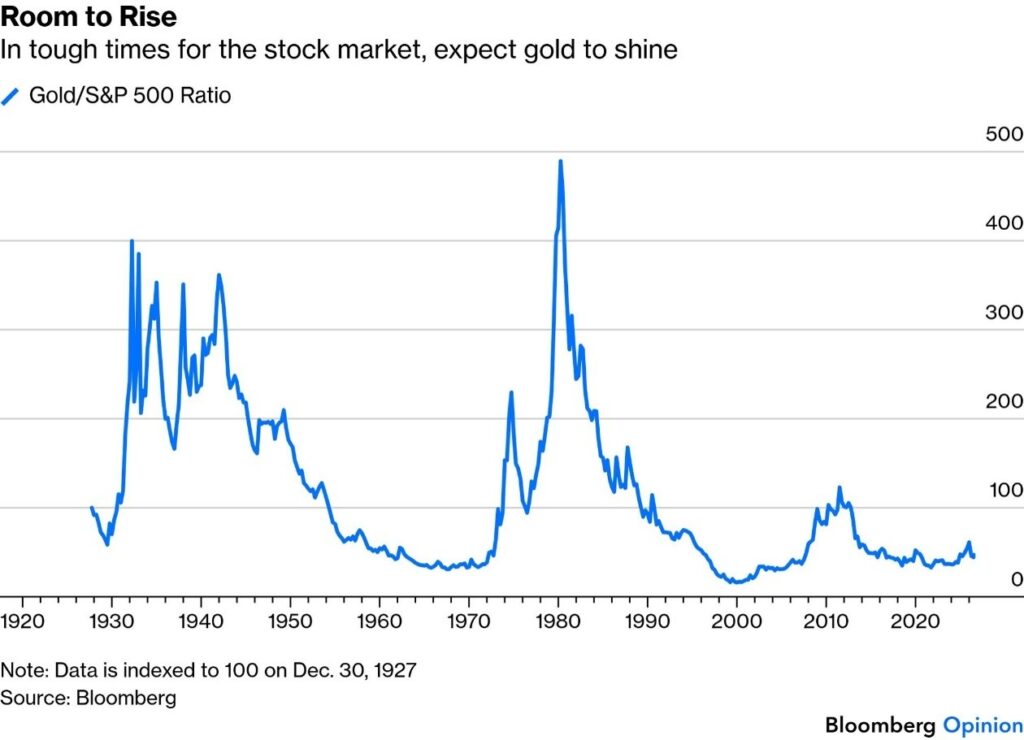
Each of the prior peaks was catalyzed by a stock market crash from historic large-cap equity valuations and a substantial dollar devaluation.
There are pundits pushing a $20k an ounce narrative – unlikely, but more upside to gold is not out of the question if this AI bubble unwinds badly. After the dot-com bubble and the Global Financial Crisis, the S&P logged falls of 50.4% and 57.4% respectively, so if you think the AI boom could inflict as much stock market damage as those two incidents, there’s a case for gold. If Warsh does his job and protects real interest rates, then the effect on gold will be more muted. His resolve in the face of compelling inflationary pressure is still to be tested.

Inflation – is it really under control?
Despite the confusion over the new broom at the Fed, financial markets seem confident that inflation is safely under control (or “anchored” in central bank jargon) in the longer term. Expectations for the next five years, and particularly for the five years after that (the so-called five-year/five-year breakeven that the Fed tracks closely) have remained strikingly stable and close to the 2% target ever since the post-pandemic spike. Indeed, they are stabilizing at a lower level than was typical in the decade around the Global Financial Crisis.
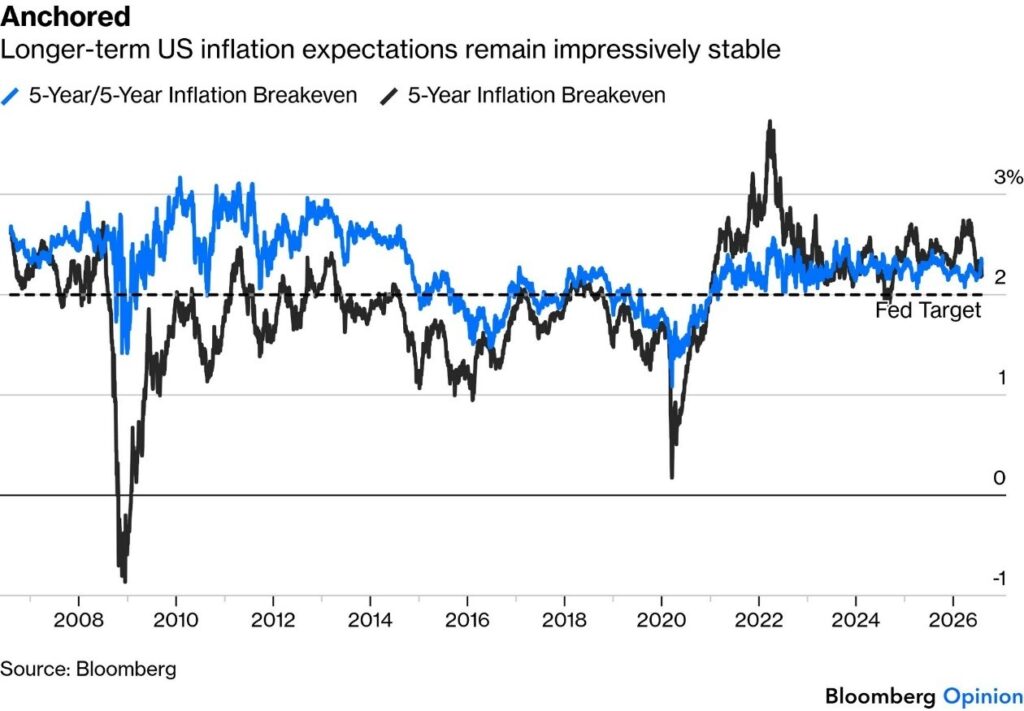
That far into the future, the current oil price should be irrelevant. Consumers are less convinced. The New York Fed’s regular survey shows forecasts for inflation three years hence at their highest since 2022, and also higher than at any point in the nine years leading up to the post-Covid surge.
The latest round of surveys shows executives in the services sector, which these days accounts for the bulk of the consumer price index, also see elevated price pressures.
Further, the issue of defining inflation is back on the agenda. Warsh appointed five task forces to assess Fed policies, including panels on data and on inflation frameworks, and hinted last week that he would look “at a broader set of data” than the current Personal Consumption Expenditure deflator (PCE) target.
There are cynical suggestions that Warsh will now attempt to “define the problem away.” But that’s unlikely to work given the public’s current acute consciousness of declining affordability — and in practice, the Fed is unlikely to keep its credibility if it changes its target before achieving success on the current measure.
Changing the inflation measure behind the 2% target would damage Fed credibility, as it would be seen as moving the goalposts at a time when inflation has run persistently above target. The Fed has two policy targets (a dual mandate) but only one policy instrument (interest rates). To have any chance of hitting both targets simultaneously, officials must assume that those targets are jointly determined.

Occam’s razor – Oil and Mag 7 edition
Occam’s Razor has much to be said for it. The 14th-century Franciscan friar William of Ockham held that when there are many possible explanations for something, the simplest tends to be correct. (Yes, some would say even that is over-simplifying, but it will do for now.)
The S&P 500 returned almost to its all-time high last week. So, how do we explain the US stock market? It’s still underperforming the rest of the world (represented by the FTSE All-World excluding US index) since Donald Trump won his second election, so this is no longer an overblown story about “American Exceptionalism.”
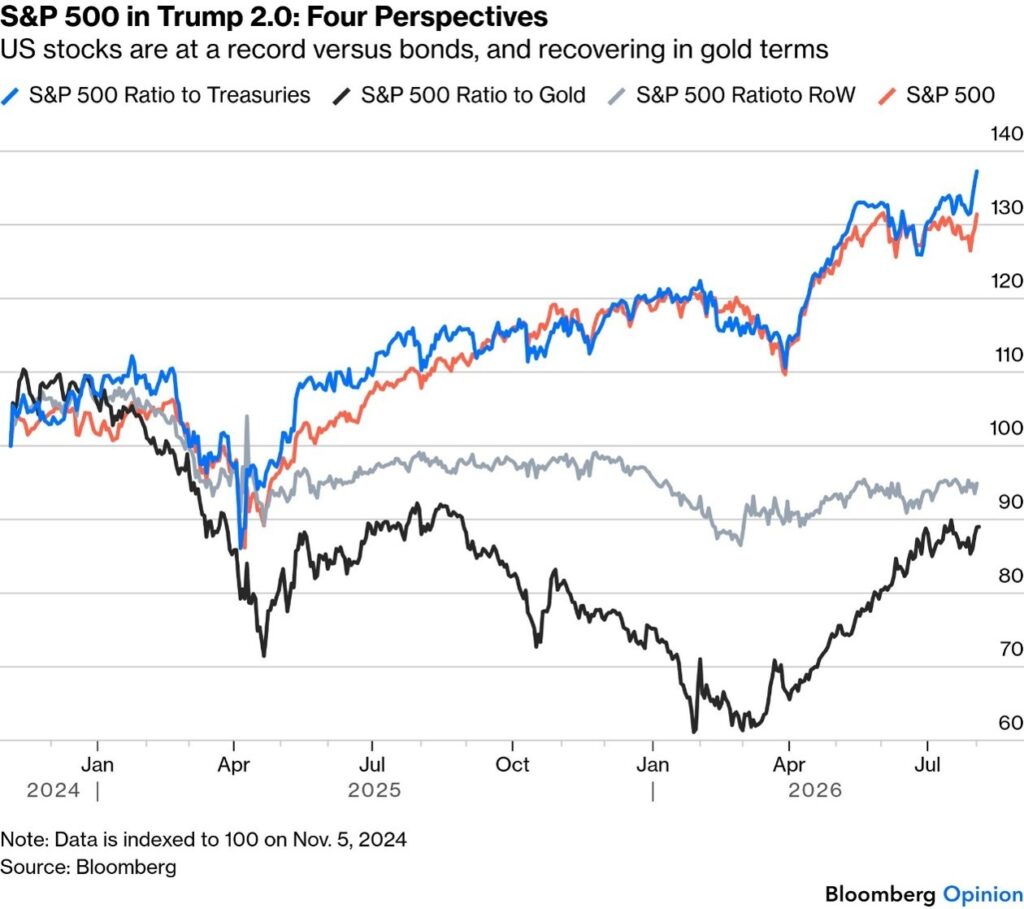
Before we get into the weeds, the explanation that would appeal to Ockham concerns earnings. The second-quarter earnings announcement season, nearing completion, is likely to show that S&P 500 earnings per share have grown 47.4% since the same period last year. The surge in expected earnings for 2027 as a whole has been quite remarkable.
A stock is worth the present discounted value of its future earnings. That’s what you buy when you purchase a share. So of course, earnings growth like that will be good for the stock market. Watch this space.
Oil
In the first month of the Iran conflict, there was a clear negative correlation between the crude oil price and the stock market. Higher oil was bad for stocks. That relationship didn’t work from April through June as Washington switched to seeking peace, and the countries cycled through various ceasefires. But since the conflict resumed, it’s been different. Oil prices surged again as Iranian proxies threatened to shut off the Bab el-Mandeb while hostilities returned to the Strait of Hormuz, contributing to turbulence for stocks. And Monday’s sharp fall in crude as Trump (once more) called off threatened attacks seemed to have a big effect. What’s very odd is that we’ve seen this movie before. The president threatens an escalation and then calls it off because he says Iran is willing to negotiate, only to find that they aren’t; rinse and repeat.
The sharp fall in the oil price looks odder still because the risk of escalation appears to be rising.
This isn’t due just to the involvement of the Houthis in Yemen, who can plausibly threaten to cut off shipping access to the Red Sea and Suez Canal. It’s also because of potential linkage with the war in Ukraine. Russian support for Iran was cited by [Ukraine President Volodymyr] Zelenskyy to justify drone attacks on Iranian shipping in the Caspian Sea on 25 July – a move that merges the two wars into each other in a way that Kyiv clearly judges will strengthen its position. US casualties resulting from such ‘escalation contagion’ reduces the chances of a revived Memorandum of Understanding with Iran in time to avert a rising energy crunch.
But despite this, the prevailing belief in the oil market appears to be that the problem will remain manageable. Futures prices suggest that Brent crude will still be elevated six and 12 months hence, but at levels that are not wildly above what was expected a year ago:
That helps the stock market rally. Then there is what might be called “Strait Fatigue”. After months of worrying about narrow necks of water in the Middle East, the global media is losing interest, and so the situation creates less of a lead weight on investors’ sentiment.
Put all of this together, and the oil price can tumble and liberate stocks to set new records.
Magnificent Momentum again?
In the last week we have seen the return of the hyperscalers — the companies spending money hand over fist to build the infrastructure on which artificial intelligence will run. For a while, they sold off while investors poured money into chip manufacturers instead. Then for much of last month they rose in tandem. Since Microsoft Corp. and Amazon.com Inc. released reassuring earnings numbers last week, hyperscalers have enjoyed a remarkable resurgence:
Occam’s Razor suggests that we should look no further than the earnings. But something strange is definitely afoot.
Overall, volatility hasn’t been all that high. The VIX index, measuring how far investors will use options to hedge against volatility in the S&P 500 as a whole, has been unremarkable. An astonishing shakeup within the market appears to have done little or nothing to rattle confidence in equities:
It’s probably true that the latest S&P 500 surge reflects confidence that the Middle East situation won’t escalate further, and that a nasty technical accident in the tech sector (Situational Awareness) is now over.
But earnings remain the heart of the matter.
None of the risks currently on the horizon have yet stopped a mighty impressive rise. There are risks. The Mid East war might escalate, taking the price of crude above $100 and leaving it there. Credit markets and banks might call time on the huge sums of money pouring into the AI buildout. Or something could happen (most plausibly another Chinese breakthrough) to show that AI will not, in fact, be profitable enough to justify the sums being thrown at it. Those are the risks specific to the moment. These are in addition to all the usual concerns of the macroeconomy. They could overheat or move into recession, and politicians could get fiscal or monetary policy wrong. Those risks are always there, and some combination of them inevitably catches up with every expansion.

Yen – Bessent talks
Treasury Secretary Scott Bessent said the weakness of the yen has contributed to Japan’s inflation problem and raised the risk of broader depreciation of Asian currencies as he reiterated US support for efforts to stabilise the situation.
“It’s just the level of the yen that could trigger other problems or trigger competitive devaluations, which is unhealthy,” Bessent said on Tuesday. “A stable yen is not only important for the US but very important for the entire region” of Asia.
Bessent was speaking days after the US joined Japan in intervening to support the yen, which in recent weeks had dropped to the lowest in four decades against the dollar. Asked whether the US would engage in further intervention, Bessent said that “we’re in close contact” with Tokyo and that “we will do whatever it takes to support them in a way that helps the American economy, the American taxpayer and stabilises the global economy.”
The yen has surged in the wake of the US-Japan operations to support the currency, though the rally stalled Tuesday, trading around 157.54 per US dollar. On July 23, it sank near 164, the lowest since 1986.
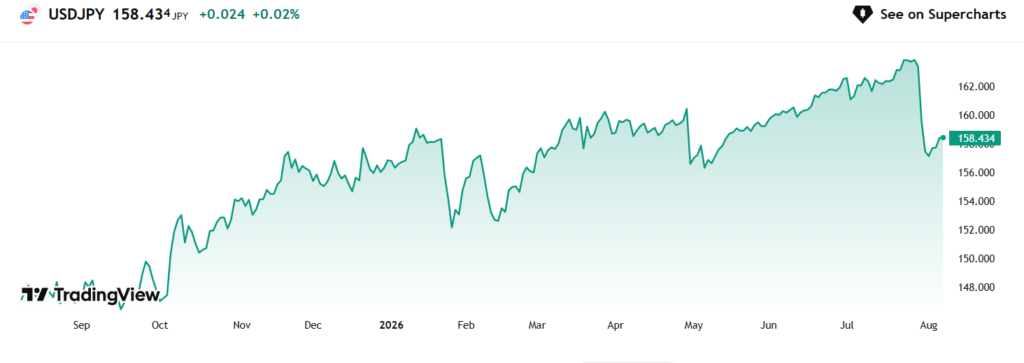
Bessent said part of Japan’s inflation “problem” is due to the pass-through of the weak yen — which drives up Japanese energy costs. He also said that “if the yen were to weaken substantially, then the other currencies would follow it. We’ve seen excess volatility in the Korean won. Many people believe that the Chinese RMB is undervalued.”
Bessent, who specialized in currencies during his decades-long hedge-fund career before becoming Treasury secretary, said that currency intervention can “give market signals,” but ultimately “it’s policy that turns it.” He said that Japanese Prime Minister Sanae Takaichi’s government is “moving toward budget discipline,” including a primary surplus.
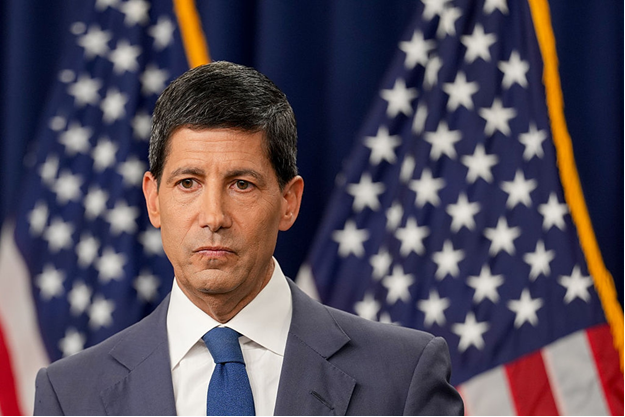
Last week, the US joined forces with Japan to try to stop the yen’s slide. It’s the first time the two sides have intervened in the Japanese currency in 15 years, and in many ways it was an unprecedented and unusual move, with Treasury Secretary Scott Bessent choosing to sell euros (as opposed to dollars) and the use of a little-known Federal Reserve repo facility.
Author: Dawn Ridler

The tech shakeout of June is now almost gone with most of the hyperscalers having recovered. The one exception is Meta which over the last year is down -22%. Google, Amazon and Mircosoft has seen decent lifts in prices since June and over the last year both Microsoft and Amazon are clear winners.
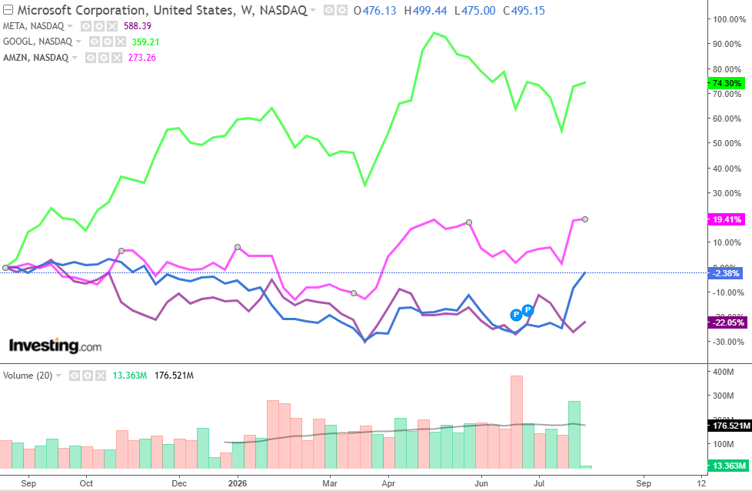
There was concern regarding both capex and cloud demand but much of that has been laid to rest as record client engagements have been recorded. The balancing act for these companies is in developing just enough cloud capacity so that if a downswing in demand occurs it doesn’t leave them with large unallocations. The flipside to this though is that the hardware required for new builds have been sold way into the future. If you’re not actively building, trying to get into the race becomes so much more difficult. The irony of this ramp-up in markets is that in many ways it is different from previous times in that much of the share gains in markets are supported by actual demand.
And this translates into actual earnings. These continue to drive the valuations of everyone in the value chain lower and provides the impetus for share price growth. Take Meta at a P/E of 22x (forward P/E of 18x) or Microsoft at 27x (forward: 25x). These are not excessively priced but it does require investors to believe that they can continue to produce the earnings. Naysayers will point out that the demand can suffer leaving hyperscalers with nothing more than capex and lower earnings. This can certainly happen but consider that there is only a fraction of the population who are currently using AI tools. What if there is a marginal uptick in these numbers as broader adoption occurs? Who will stand ready to provide the compute power? This is why the hyperscalers are spending Capex at the rate they are. If the current build-out was reliant on the public firing AI up and getting it to answer questions, I would probably agree that the Capex is overdone. But the broader adoption is probably yet to come through enterprises.
Enterprises can save operating costs by making AI adoption more broad-based. This was a pipe dream only a few years ago. The underlying tools may have existed, but the manpower required to bring one’s own in-house AI tools to life would have a cost a fortune and for that to happen effectively would have required wide-spread cloud adoption by the enterprise.
The introduction of LLM’s (Large Language Models) has changed all of that. Developing AI tools has now has become easier and cheaper. The only other thing which needs to happen is wide-spread cloud adoption. Most companies still run their IT on servers centrally located. Up to now, the migration to the cloud was seen as a headache and a drain on finances which would given a similar outcome than allowing users to access servers from your basement.
Once companies counted for the disruption and costs, cloud adoption was a priority for another day. But seeing that AI adoption can save costs and drive better margins, companies may be more inclined to endure the once off headache of migrating to the cloud. The hyperscalers are standing at the ready to provide a full cloud service offering to enterprises. This could see large-scale data migration across the world. Basement servers in the next decade will become a thing of the past. Once a company is in the cloud, the development of AI tools can commence. I don’t think companies change overnight but the slow steady push driven by more efficient competitors will drive the change. This is what will drive the earnings at the hyperscalers.
Author: Cobie Le Grange
EXCHANGE RATES and other Indices:
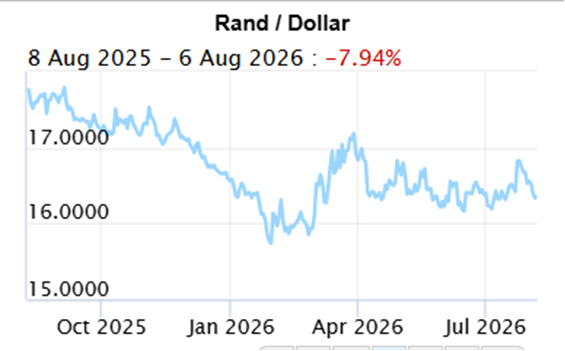
The Rand/Dollar closed at R16.14 (R16.55, R16.47, R16.31, R16.22, R16.40, R16.39, R16.27, R16.55, R16.23, R16.46, R16.68, R16.39, R16.63, R16.29, R16.41, R17.07, R17.06, R16.89, R16.55, R15.93, R16.01, R15.96, R16,03, R16.15, R16.10, R16.50, …R16.91, R17.13, R17.36, R17.13,16.52 )
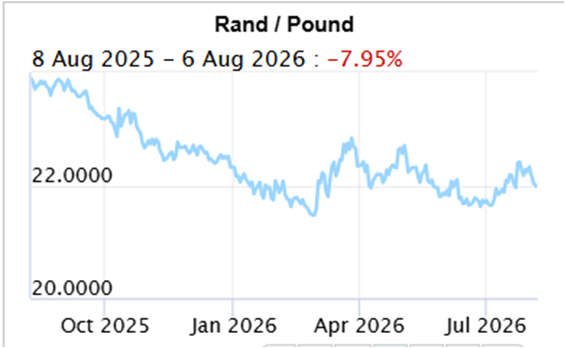
The Rand/Pound closed at R21.78 (R22.31, R22.16, R21.86, R21.64, R21.64, R21.67, R21.80, R22.06, R21.80, R22.09, R22.21, R22.30, R22.56, R22.35, R22.02, R22.09, R22.77, R22.76, R22.35, R22.20, R21.48, R21.59, R21.78, R21,82, R22.11, R21.97, R22.13, …R22.57, R22.68, R22.74, R22.56,
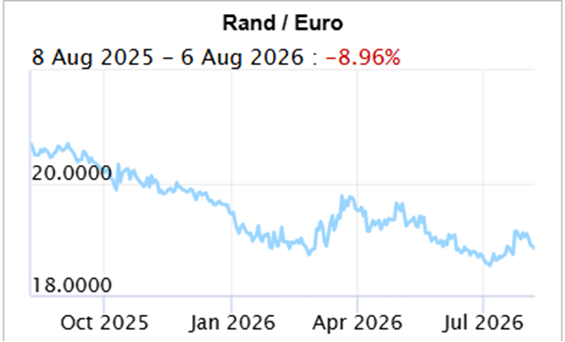
The Rand/Euro closed the week at R18.66 (R19.09, R18.84, R18.62, R18.52, R18.66,R18.89, R19.16, R19.08, R18.91, R19.11, R19.38, R19.29, R19.48, R19.37, R19.17, R19.24, R19.70, R19.77, R19.33, R19.23, R18.80, R18.87, R18.94, R18.93, R19.14, R19.04, R19.20)
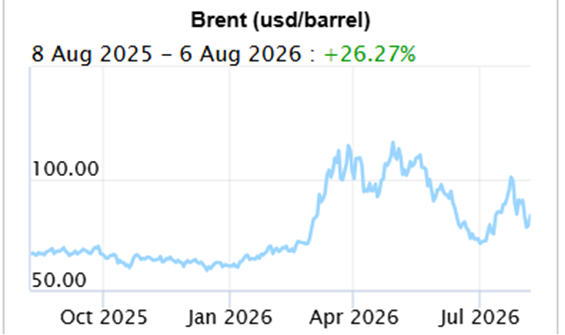
Brent Crude: Closed the week $83.55 ($87.93, $88.10, $76.01, $72.10, $71.99, $80.59, $87.33, $93.09, $91.12, $104,24, $109.26, $101.29, $108.83, $105.33, $90.38, $95.20, $107.88, $112.36, $103.14, $92.88, $73.19, $71.76, $67.75, $68,05, $69.32, $65.88, $63.34, …$63.71, $63.19, )
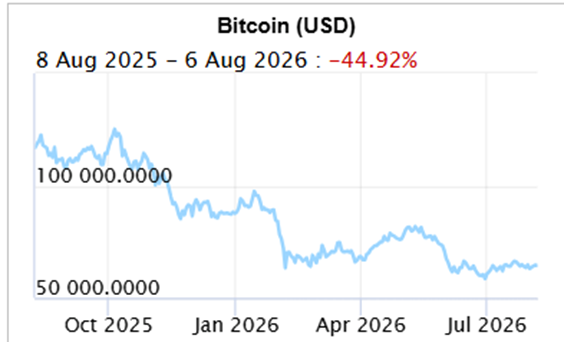
Bitcoin closed at $64,921 ($63,143, $64,718, $63,815, $62864, $60,063, $64,029, $64,131,$60,762, $73,788, $74,559, $77,879, $80,733, $78,204, $78,049.98, $75,519, $70,904, $68,691 , $68,586, $70,869, $67,310, $63,534, $68,04, $69,649, $68,553, $81,301, $89,295, $90,585,)
Articles and Blogs:
Investment series part 1 (NEW)
Investment series part 2 (NEW)
Legacy Series Part 4
Legacy Series part 3
Legacy Series Part 2
Legacy Series Part 1
Holiday checklist
Next year – Action Plan
Next year – Vision, Mission etc
Medical Risk Mitigation
Next Year – Consolidation
Abdication or diversification?
Carbo-loading your retirement Spoiled for choice
Who needs a plan anyway
8 questions you need to ask about retirement
What to do when interest rates drop
How to survive volatility in your investments
What to do when interest rates drop
Difficult Financial Conversations
Financial Implications of Longevity
Kick Start Your Own Retirement Plan
You matter more than your kids in retirement
To catch a falling knife
Income at retirement
2025 Budget
Apportioning blame for your financial state
Tempering fear and greed
New Year’s resolutions over? Try a Wealth Bingo Card instead.
Wills and Estate Planning (comprehensive 3 in one post)
Pre-retirement – The make-or-break moments
Some unconventional thoughts on wealth and risk management
Wealth creation is a balancing act over time
Wealth traps waiting for unsuspecting entrepreneurs
Two Pot pension system demystified
Cobie Legrange and Dawn Ridler,
Rexsolom Invest, Licensed FSP 45521.
Email: cobie@rexsolom.co.za, dawn@rexsolom.co.za
Website: rexsolom.co.za, wealthecology.co.za