

Too Busy? Got Better Things to Do? Read the Summary…
Canada leading the way?: Talks between Washington and Ottawa collapsed, triggering 50% US tariffs on about $20 billion of Canadian goods under a rarely used 1930s statute, with Canada now planning dollar-for-dollar retaliation from September 8. The direct economic hit is small (under 0.6% of total US goods imports), but the episode matters more for what it signals: an obscure law letting the president impose tariffs with no investigation or oversight, rising escalation risk with Trump threatening 50% Canadian auto tariffs from January, and further damage to the US’s reputation as a reliable trading partner ahead of the midterms.
War update, the new normal?: Rather than settling toward stability, the world looks set for a prolonged period of structural instability driven by four overlapping shocks: a great power contest as China, Russia, Iran and North Korea challenge US led rules; a China shock from industrial overcapacity in steel, EV batteries and semiconductors; an AI shock reshaping economies and warfare; and a USA shock as fiscal strain, munitions shortages and unpredictable policy erode Washington’s traditional stabilising role. Expect this perma-crisis backdrop, not a return to post-Cold War order, to persist for years.
Natural Gas, back in the news: European gas prices are near five-month highs, with winter contracts more than double last year’s level, and gas has overtaken oil as bond traders’ top inflation worry even though Brent remains well below its US-Iran war peak. Storage is only 63% full for this time of year (the lowest since 2009), the Strait of Hormuz carries about a fifth of global LNG supply with no alternative route, and markets are pricing further ECB and Bank of England hikes if gas prices keep climbing.
Nvidia: Nvidia guided for roughly 70% revenue growth next fiscal year, well above analyst estimates of 45%, easing fears that AI spending is slowing, and shares jumped over 7% on the news. Data centre revenue of $89 billion beat estimates; CEO Jensen Huang said demand is only accelerating with the new Vera Rubin chip in full production, but rising memory costs are squeezing margins and competition is building, from memory makers struggling to keep pace with demand to customers like OpenAI developing their own chips.
On the Frontier: Writing from Italy’s Trentino region, Cobie reflects that AI will reshape daily life much as it is already easing travel through translation apps and AI-enabled glasses, and more broadly will restructure work and bargaining power the way past technological revolutions did, only faster and beyond the reach of governments to control. Apple’s device dominance and Microsoft’s subscription ubiquity position them well for this shift, and recent medical breakthroughs such as Moderna and Merck’s personalised mRNA cancer vaccine show the technology already changing lives, though as with the railways, a period of overinvestment may eventually follow the current supply-constrained boom.

The rand traded in a range of about R15.95 to R16.14 to the US dollar during the week, ending near R15.95 to R15.97, its strongest level since the Iran conflict began in late February; Brent crude fell from around $93 to $95 a barrel to about $86 to $88 by 27 August as Iran and Oman made progress on a Strait of Hormuz agreement; gold eased from three month highs above $4,700 to around $4,650 an ounce; and Bitcoin surged past $79,000, its highest level since early June.




After US-Canada trade talks collapsed last Friday, the United States imposed a 50% tariff on a long list of Canadian goods via the never-used Section 338 of the Tariff Act of 1930. US Trade Representative Jamieson Greer went on TV first thing Monday in an attempt to calm financial markets with some basic tariff math. He said the new action hits a small percentage of Canadian imports into the US and an even smaller share of consumption, so there’s “no possible way it can really affect US well-being.”
Greer is basically right on the issue of the tariffs’ direct effects. The problem for both America’s chief trade negotiator and the US economy is that the new levies raise other issues that are much more important – and troubling.
Why is all of this important for us to know down on the Southern tip of Africa? It has been said for decades that ‘when the US sneezes, the rest of the world catches a cold ’, but that is changing, and smart coalitions might just be on the rise – which will inevitably include the BRICS nations. Sure, the ‘s’ for South Africa is almost an afterthought, and at 0,5% of global GDP we are an economic minnow, but that has never stopped us having Main Character personality and punching well above our weight.
Canadian imports hit by the new duties totalled $20.2 billion in 2025 – just 5.3% of the $382 billion in goods the US imported from Canada last year and a little under 0.6% of all goods imports over the same period. The tariffs omit most of the essential things that Canada supplies in large volumes: energy, fertilizer, minerals, seafood, and the goods – metals, automotive, wood, and more – already facing “national security” duties. And more than a third of the US tariff list is just for show: Of the 554 items, 66 saw no Canadian imports at all last year, while another 136 were less than $1 million each. On a static basis, the 50% tariffs would yield about $10 billion in additional tariff revenue, which is around 3% of current collections. None of this will move the macroeconomic needle. In other words, much of this is posturing – but with enough razmataz for Trump to think it’s real.
Some discrete pain will nevertheless occur, especially where Canada is a major source of imports (and there is little doubt that the Canadians are picking products favoured in the Red/Republican states.) In 2025, for example, Canada supplied 73% of imported whiskey (other than Irish or Scotch), worth $221.5 million. Targeted Canadian plywood and veneer panels were more than 90% of US imports last year, and several other construction materials also had significant import shares. Newly tariffed dairy products, including high-demand whey proteins, were 45% to 95% of imports. Adding a 50% duty on top of existing tariffs will mean real pain for American buyers, maybe prohibitively so. Homebuilders, automakers and other US industries also lose out because the now-scuttled deal would have cut American lumber, steel, and aluminium tariffs that have significantly increased production costs.
Pain certainly lands on the Canadian side, too. Because most products the US targeted have substantial imported alternatives, Americans may switch away from Canadian items (albeit over time and at a cost). Moreover, US tariffs disproportionately hit smaller companies in numerous industries, complicating mitigation efforts. The real action, however, lies beyond the tariffs’ direct economic effects.
Escalation – the most common trade war fallout – is a real risk, with Prime Minister Mark Carney announcing dollar-for-dollar retaliation beginning Sept. 8 and President Donald Trump responding with a threat to hike duties on Canadian automotive goods to 50% on Jan. 1. Cooler heads can still prevail, but both the Canadian and US sides see little chance for a quick resolution. And politics will discourage a ceasefire: The now-seething Trump has staked his reputation on countries backing down from a trade fight, but polls in Canada consistently show that fighting Washington is a political winner.
It’s a tinderbox, with vocal match-throwers on each side of the border. The US-Mexico-Canada Agreement also faces new risks. Trump’s “emergency” global tariffs and their replacements importantly exempted USMCA-compliant goods. This not only removed more than 80% of all Canadian imports from the new duties’ coverage but also strongly indicated the agreement’s durability. The Section 338 proclamations, on the other hand, feature no such carveout – a distressing sign of where things might be headed.
Trump’s future use of Section 338 – a vague, Depression-era statute with no precedent or implementing regulations – is the biggest risk of all.
The law allows the president to impose tariffs of up to 50% on imports from any country he says “discriminated” against US commerce. It requires no investigation, injury finding, or published determination, and – as Trump just showed – the undefined “discrimination” can mean almost anything. A legal challenge to the new Canada tariffs is likely, and many scholars think the White House will lose. But litigation takes time, and a law that’s neutered in two years is a law that works for two years. Markets and trading partners must now wonder who’s next.
Finally, the conflagration is important for political and geopolitical reasons.
The US midterm elections are rapidly approaching, and Trump’s chaotic tariffs, which affordability-obsessed Americans overwhelmingly dislike, are a key point of contention. Although the new Canada tariffs are small, the headlines certainly aren’t, and they land right as Trump is promising to lower beef prices by cutting tariffs. On the subject of beef… Trump promised to import tonnes of beef from Argentina (to hell with the concerns of the US cattle farmers (red states btw), which was recalled because of heavy growth-hormone contamination. It looks like it may have been the same consignment China rejected very recently for the same problem. With DOGE having gutted regulatory bodies, this consignment slipped through without oversight.
The administration will also take a hit on the international stage with this anti-Canada stance. The Canada deal’s collapse will accelerate plans by nations to remove the United States from the centre of the global trading system and will reinforce negotiators’ view of the US as a bad-faith bargainer whose market isn’t worth the loss of sovereignty needed to enter it. What point is a deal when one party refuses to uphold the terms?
None of this means the US-Canada tariffs are a full-blown crisis – yet.
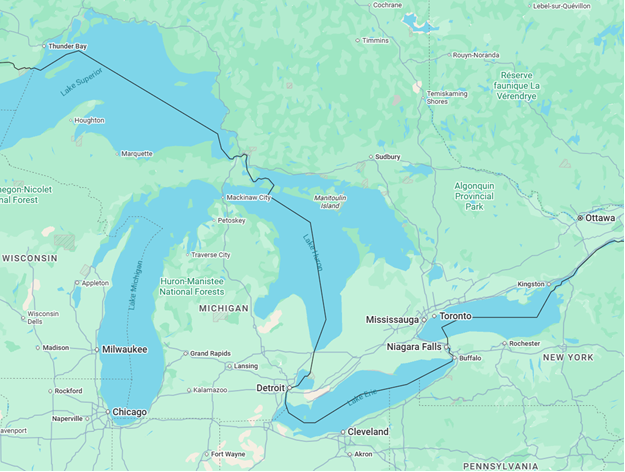
A deal could arrive in the coming weeks, and things could return to almost normal. In the meantime, uncertainty – and the risk of a spiralling conflict that cripples one of the world’s most integrated multinational supply chains – will weigh on both economies. Trump just sits on the sidelines like a schoolyard bully changing names of lakes, with Lake Michigan renamed Lake America (p.s. Oceans are next).
Just as importantly, resolving this conflict won’t fix its underlying cause, which is not a capricious, tariff-loving president but US trade laws that let him wreak economic havoc without congressional oversight. Bills to repeal Section 338 are sitting dormant in the House and the Senate. Until they advance, we’ll await the next country found guilty of “discrimination” by a president who gets to define the word.
The struggle for the Strait of Hormuz rages on, new US sanctions threats against Iran notwithstanding. Russian drone and missile strikes punctuate a savage war in Ukraine now approaching its half-decade mark. Fierce competitions afflict regions from East Asia to Eastern Europe. American alliances are in a state of upheaval, while the global economy is fractured by tariffs and sanctions. It seems that nearly every week brings the next AI breakthrough, both promising and portentous.
It’s natural to wonder, amid all the present furies, when the world will settle into a stable equilibrium. The answer is that it won’t, at least anytime soon. (See Cobie’s piece below).
Four historic shocks- a great-power shock, a China shock, an AI shock and a USA shock- are convulsing the global landscape.
They have jolted the world into a messy, likely protracted transition from one era to the next. For now, expect to live in a period of perma-crisis, in which the sources of instability are structural, and disruptions are constant.
The post-Cold War order was defined by hegemony and integration. Dominant US power and globe-spanning US alliances provided geopolitical stability. Globalisation brought deepening economic and financial interdependence. The world looked to be converging toward democratic values; the benefits of technological progress seemed assured.
Washington worked to suppress threats such as international terrorism, with mixed success, while staving off the return of great- power rivalry through military deterrence and economic integration. But every aspect of that system is being challenged and perhaps transformed.
The great-power shock comes as ideological states, principally China and Russia, as well as Iran and North Korea, assail US influence and alliances in every key region of Eurasia. They shatter global rules, whether freedom of the seas or prohibitions on conquest.
At the core of this rivalrous era is a new clash for domination between America and China, the sort of system-defining conflict that tends to produce catastrophic hot wars, decades-long cold wars and other upheavals that polarise and pervade the globe. At the moment, China is not rising to the bait, but for a nation known for infinite patience, they may be biding their time and quietly winning influence through infrastructure investment across the globe.
The geopolitical shock is related to the China shock. (There is a very good article on this from the Fed here.)
President Donald Trump’s protectionism gets more headlines, but the greatest economic disruption of our time is Chinese industrial overcapacity: Beijing’s drive for primacy in areas from steel and aluminium to EV batteries and semiconductors. Beijing are quite happy to get to work while Trump hogs the headlines.
The resulting distortions threaten countries everywhere. Chinese overcapacity could stunt the rise of developing economies hoping to establish their own manufacturing sectors. Deindustrialisation often leads to political radicalism that economic distress can bring.
An earlier China shock, at the outset of this century, flooded the world with low-cost goods. Today’s China shock could entrench Beijing’s dominance in sectors that define global growth, even as it creates dangers, from industrial deflation to a wave of retaliatory protectionism, for China itself. You just have to watch China’s contributions to the AI race as an example, already significantly undercutting coupon costs that will impact the profitability of the US LLMs.
The AI shock reverberates violently across the globe, even if you aren’t really noticing them.
New models are turning once-hypothetical propositions into concrete facts. Advances in AI could turbocharge economic productivity; they are already revolutionising cyberwarfare, spycraft and the ways that countries build and wield military might. As AI remakes economies, social dislocations and political blowback inevitably follow.
Technological revolutions always disturb the balance of power between geopolitical competitors. This revolution, like the Industrial Revolution before it, will affect every aspect of society by disrupting the relationship between humans and machines.
The resulting instability is amplified by the USA shock.
For decades, American foreign policy helped the world navigate economic and geopolitical dangers. Today, the nation’s ability to play that role is being tested by chronic fiscal strains, acute munitions shortages and political dysfunction. Its willingness to play that role is also in doubt, as Trump lacerates the world trading system, threatens longtime allies and conducts globe-shaking military interventions with little forethought. US power is still unmatched. But profound questions about America’s global purpose may take several more electoral cycles to resolve.
Natural Gas – back in the news
Natural gas has overtaken oil to become the biggest concern for European bond traders as depleted supplies of the key fuel threaten a resurgence in inflation. European gas prices are near five-month highs and winter contracts cost more than twice as much as they did a year ago. Yields on 10-year German and UK debt have touched levels not seen in decades, even as Brent crude trades 30% below the peak hit on the back of the US-Iran war.
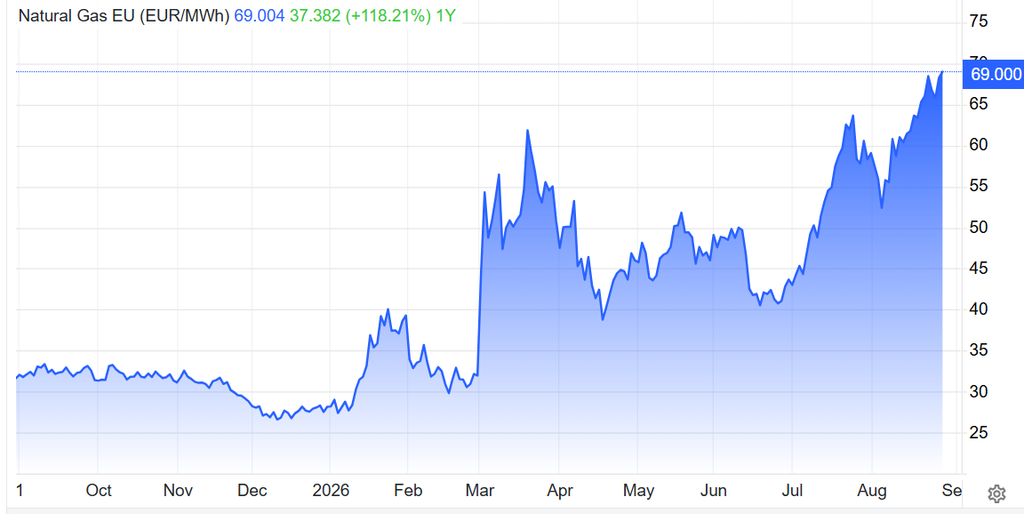
Investors worry rising gas prices will reignite inflation, forcing central banks to raise interest rates more aggressively than markets currently expect. Gas plays a central role in the region’s economy, accounting for 21% of the EU’s energy mix, and between 25% and 35% for the UK.
Bond yields have spiked on other worries too, including unsustainable public finances, a flood of borrowing by hyperscalers and unpredictable US policymaking. But market participants say gas is now the biggest energy-related risk to the outlook for European and UK interest rates, even though prices remain way below highs hit after Russia invaded Ukraine in 2022.
The war in the Middle East prompted governments and companies to delay refilling tanks, hoping that the conflict would be short and prices would moderate. Meanwhile, extreme heat boosted demand over the summer, leaving gas storage just 63% full, the lowest for the time of year since 2009.
The Strait of Hormuz typically accounts for about 20% of global LNG supply, and unlike in oil, there are no alternative routes to get that gas to market and few strategic stockpiles to help absorb the shortfall.
The European Central Bank has already raised rates once this year, while the Bank of England has held steady. Money markets are pricing one hike by both central banks by the end of this year, followed by another one by September 2027. Some market participants say those assumptions may have to change, given the risk of higher gas prices and the lack of agreement between the US and Iran on reopening the Strait of Hormuz.
Nvidia Corp., the chipmaker at the heart of the artificial intelligence boom, said revenue will grow about 70% next fiscal year, easing concerns that AI spending is losing momentum.
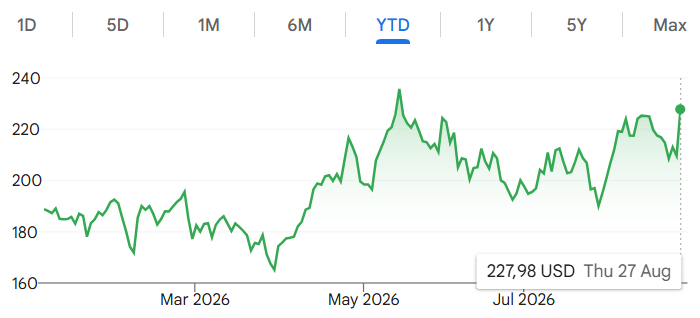
The projected sales growth for fiscal 2028 outstrips analysts’ estimates for a 45% jump, according to data compiled by Bloomberg. Nvidia shares rose 7.4% before the market opened in New York on Thursday, poised to add about $370 billion to its market value. The shares are up 12% this year through Wednesday’s close.
Nvidia would grow faster if it had access to more supplies, Chief Financial Officer Colette Kress said during a post-earnings conference call. “Incredibly, we are seeing demand acceleration even at our scale,” she said. “Customers’ forecasts point to our growth doubling next year.”
The upbeat outlook offered relief to investors concerned about a bubble in the AI economy. Nvidia, the world’s most valuable company, is the leading provider of AI accelerators, a key component for training and running artificial intelligence models. That status has turned its quarterly earnings into a barometer on the state of the wider industry.
In Nvidia’s second-quarter earnings report, Chief Executive Officer Jensen Huang said demand is only accelerating. He also touted the rollout of the company’s latest chip line, Vera Rubin.
“The AI infrastructure build-out is at full steam,” he said. “Vera Rubin, now in full production, was built to power exactly this moment.”
Revenue in the current period will be $108 billion, plus or minus 2%, according to the company. Analysts had estimated $105.2 billion on average. Gross margin, the percentage of sales remaining after deducting the cost of production, will be roughly 74% in the quarter.
The company warned that margins would narrow in the coming months while Nvidia copes with a surge in memory costs.
The broader message was that there’s been no letup in customer demand. After years of runaway growth, some investors had become concerned about a potential bubble. Nvidia’s myriad investment pacts with companies in the AI economy also sparked fears that circular deals will leave the industry on shakier ground.
Nvidia’s all-important data centre division generated $89 billion in revenue, compared with an average estimate of $85.8 billion. A group known as hyperscalers, which includes Amazon.com Inc. and Alphabet Inc.’s Google, accounted for much of those sales. Nvidia has sought to expand its customer base, aiming to show that it’s less dependent on a small group of tech giants for much of its sales.
Investors, meanwhile, have gotten harder to impress. Nvidia has now delivered sales above Wall Street estimates for 16 quarters in a row. But that hasn’t always helped its stock, with shareholders taking its rapid growth and outperformance as a given. The stock has fallen the day after five of its last six earnings reports.
The only companies in the semiconductor industry that rival Nvidia’s revenue run-up are the memory-chip makers: Samsung Electronics Co., SK Hynix Inc. and Micron Technology Inc.
Training and running AI software requires a massive amount of computer memory, which has fuelled growth but also placed a huge strain on their factories. While they’re expanding capacity, the companies don’t expect to catch up with demand for years. The shortages have caused memory chip prices to soar.
NVidia has notified customers that it’s raising prices of its products to account for the growing costs.
At the same time, a stampede of would-be rivals is eyeing Nvidia’s lucrative market. And the company’s own customers are increasingly developing in-house chips, potentially reducing their reliance on Nvidia in the long run.
Just this week, ChatGPT maker OpenAI said its new Jalapeno processor performed better than Nvidia’s current lineup during testing.
Nvidia has spent much of the past year lining up investment deals with major AI companies, including both software developers and the infrastructure that supports them. Those agreements — and the promised financial backing — have, in theory, put Nvidia on the hook for tens of billions of dollars of liabilities.
The company has said such deals will speed AI adoption, which will create even more demand for its products. But critics have warned that circular financing could foster artificial demand. The company is also still fighting for greater access to the world’s biggest market for semiconductors: China. It’s been given limited scope by Washington to sell some of its AI chips in that country, but Beijing has held up the process by keeping a tight rein on purchases. For the company — and its investors — building a foothold in China is seen as both a pathway to growth and a way to ensure that the country’s homegrown chipmakers don’t get too powerful.
Author: Dawn Ridler

I keep saying we are witnessing history unfold before our very eyes. I am visiting the Trentino region in Italy at the moment and if there is one thing that strikes me is how the Italians have blended beauty and efficiency to create a destination worth visiting in summer and winter. I am told that Southern Italy is a different story altogether, but don’t rely on me for expertise on this. But here in the Italian alps, the world of AI and supercomputing seems a lifetime away. And this is a place which has witnessed history. Think of the Roman Empire and its effect on the world and the region, and this was over 1500 years ago. Italy has seen civilisations come and go, and the very mountains I am climbing were here then as they are now. Somehow this makes one feel very small indeed.
But AI will affect us, as it will affect Trentino.
The size and the speed is yet to be seen but we may be pleasantly surprised on how it could enrich our lives. Already translation apps, cars that speak to us and adaptive search makes navigating a country where you cannot speak the language much easier. If I decided to swap my current eyeglasses for Ray-Ban’s Meta-enabled glasses, the Italian experience could be enriched even further as the glasses suggest and lead me in accordance with my preferences, which it learns over time. I had the pleasure of putting a pair on and dare I say that this is going to become the norm rather than the exception in the future as the technology improves. You may choose your new pair of glasses for its technological prowess rather than how it expresses your uniqueness.
Artificial Intelligence is going to change the world much like a war would change the face of a nation. It’s not government-imposed rules or political will but rather technology that shapes how we work and interact in the future. The power of central bargaining, jobs for life and a vocation which guarantees decent lifetime earnings is becoming obsolete. Whereas governments could at least stem the tide in the past, AI is enabled with an internet connection which is everywhere, even in the Italian Alps. And it’s on this frontier where the large US-centric companies are placing their bets.
Apple is a device company, and they have almost never missed a beat on putting a superior device in your hands. They know that without their App Store and device, no AI is going to work. Microsoft, through decades of market penetration, is everywhere. They have won the longevity battle and are the world’s supreme subscription model. How they build on this and how we interact with it is unfolding in front of our eyes. Just in the last 2 weeks, Moderna has shown how their mRNA cancer vaccine promises better outcomes for those with skin cancer. Taken in conjunction with Merck’s Keytruda, this is the first successful late-stage trial for an individualised mRNA cancer vaccine. Yes you read that right… It’s personalised based upon the specific properties exhibited by a patient’s cancer. This is technology at work and, in this case, to prolong the life of patients. Perhaps in the future surgery is going to become a distant option for cancer treatment as personalised drugs eliminate the need for oncology. Much like the railways changed the efficiency of doing business in the past, AI-enabled technology will do the same. Like someone needed to put down the rail network to enable this, today’s tech enablers are putting down the AI rails and no doubt there will come a point of overinvestment. This doesn’t seem to be a problem at present as demand continues to outstrip supply. Long may it last.
Author: Cobie LeGrange
EXCHANGE RATES and other Indices:
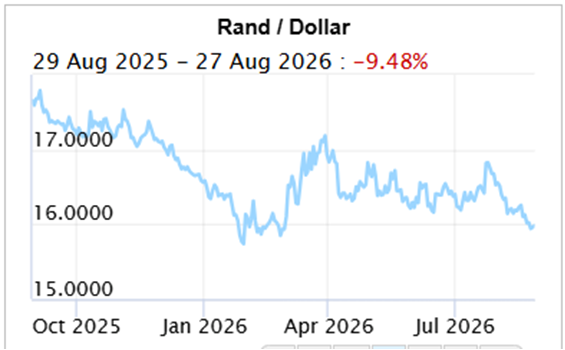
Rand/Dollar: the rand firmed further this week to around R15.95 to R15.97 to the US dollar, from about R16.09 to R16.10 a week earlier. The Rand/Dollar closed at R 16.09 (R16.02, R16.17, R16.14, R16.55, R16.47, R16.31, R16.22, R16.40, R16.39, R16.27, R16.55, R16.23, R16.46, R16.68, R16.39, R16.63, R16.29, R16.41, R17.07, R17.06, R16.89, R16.55, R15.93, R16.01, R15.96, R16,03, R16.15, R16.10, R16.50, …R16.91, R17.13, R17.36, R17.13,16.52 )
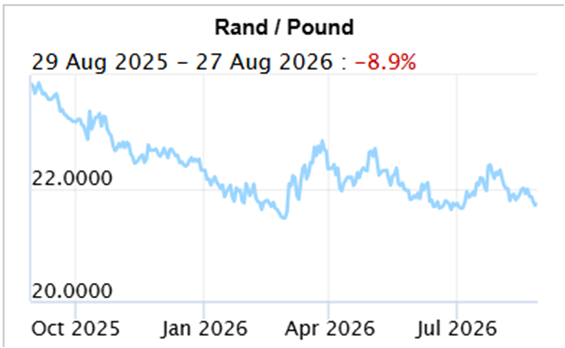
Rand/GBP: the rand firmed to around R21.65 to R21.70 to the British pound, from about R22.00 to R22.04 a week earlier. The Rand/Pound closed at R21.79 (R21.86, R21.88, R21.78, R22.31, R22.16, R21.86, R21.64, R21.64, R21.67, R21.80, R22.06, R21.80, R22.09, R22.21, R22.30, R22.56, R22.35, R22.02, R22.09, R22.77, R22.76, R22.35, R22.20, R21.48, R21.59, R21.78, R21,82, R22.11, R21.97, R22.13, …R22.57, R22.68, R22.74, R22.56,
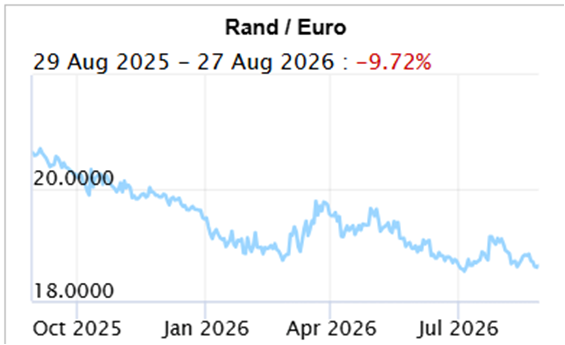
Rand/Euro: the rand firmed to around R18.55 to R18.60 to the euro, from about R18.81 to R18.82 a week earlier. The Rand/Euro closed the week at R18.60 (R18.72, R18.71, R18.66, R19.09, R18.84, R18.62, R18.52, R18.66,R18.89, R19.16, R19.08, R18.91, R19.11, R19.38, R19.29, R19.48, R19.37, R19.17, R19.24, R19.70, R19.77, R19.33, R19.23, R18.80, R18.87, R18.94, R18.93, R19.14, R19.04, R19.20)
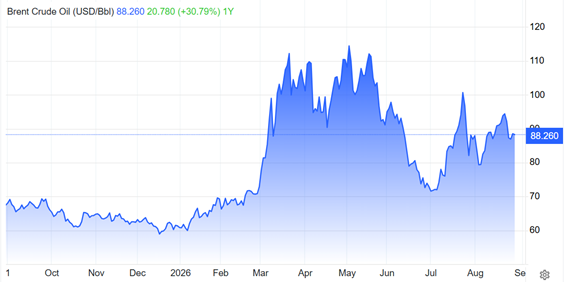
Brent crude: Brent crude fell to around $86 to $88 a barrel, down from about $93 to $95 a week earlier, as Iran and Oman made progress toward a Strait of Hormuz agreement.
Brent Crude: Closed the week at $88.29 ($94.39, $88.52, $83.55, $87.93, $88.10, $76.01, $72.10, $71.99, $80.59, $87.33, $93.09, $91.12, $104,24, $109.26, $101.29, $108.83, $105.33, $90.38, $95.20, $107.88, $112.36, $103.14, $92.88, $73.19, $71.76, $67.75, $68,05, $69.32, $65.88, $63.34, …$63.71, $63.19, )
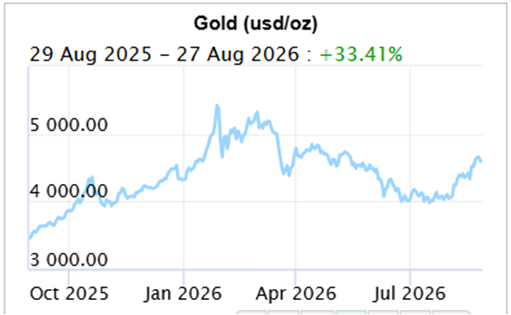
Gold: gold eased to around $4,650 an ounce after touching three month highs above $4,700 during the week, still up from about $4,466 a week earlier.Gold closed at $ 4,454 ($4,607.35)
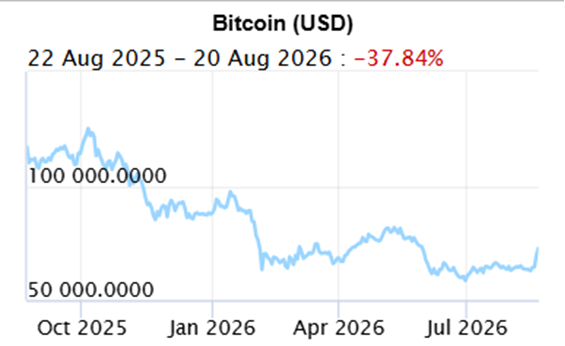
Bitcoin: Bitcoin surged past $79,000, its highest level since early June, up from about $75,500 a week earlier.Bitcoin closed at $78,701 ($76,532, $62,911, $64,921, $63,143, $64,718, $63,815, $62864, $60,063, $64,029, $64,131,$60,762, $73,788, $74,559, $77,879, $80,733, $78,204, $78,049.98, $75,519, $70,904, $68,691 , $68,586, $70,869, $67,310, $63,534, $68,04, $69,649, $68,553, $81,301, $89,295, $90,585,)
Articles and Blogs:
Investment series part 4(NEW)
Investment series part 3 (NEW)
Investment series part 1
Investment series part 2
Legacy Series Part 4
Legacy Series part 3
Legacy Series Part 2
Legacy Series Part 1
Holiday checklist
Next year – Action Plan
Next year – Vision, Mission etc
Medical Risk Mitigation
Next Year – Consolidation
Abdication or diversification?
Carbo-loading your retirement Spoiled for choice
Who needs a plan anyway
8 questions you need to ask about retirement
What to do when interest rates drop
How to survive volatility in your investments
What to do when interest rates drop
Difficult Financial Conversations
Financial Implications of Longevity
Kick Start Your Own Retirement Plan
You matter more than your kids in retirement
To catch a falling knife
Income at retirement
2025 Budget
Apportioning blame for your financial state
Tempering fear and greed
New Year’s resolutions over? Try a Wealth Bingo Card instead.
Wills and Estate Planning (comprehensive 3 in one post)
Pre-retirement – The make-or-break moments
Some unconventional thoughts on wealth and risk management
Wealth creation is a balancing act over time
Wealth traps waiting for unsuspecting entrepreneurs
Two Pot pension system demystified
Cobie Legrange and Dawn Ridler,
Rexsolom Invest, Licensed FSP 45521.
Email: cobie@rexsolom.co.za, dawn@rexsolom.co.za
Website: rexsolom.co.za, wealthecology.co.za