

Canada sees opportunity in the chaos: Canada and the EU are deepening ties across trade, defence, space and research as a counterweight to US and Chinese influence, with a summit set for October and Von der Leyen and Carney addressing each other’s institutions later this month. Relations with Washington have deteriorated: Canada’s new 15 to 50 per cent tariffs on US goods took effect 8 September, reversing Carney’s earlier tariff rollback, after a preliminary deal collapsed in acrimony, including Bessent’s “little yippy dog” remark. Trump has also threatened to block Bombardier jet sales, even as Canadian growth rebounded in the second quarter, though job creation remains weak in export-dependent sectors.
Traditional software and AI: Wall Street has dubbed the collision between AI disruption and heavily leveraged, private equity-owned software companies the “SaaSpocalypse.” Buyouts financed with debt tied to subscription revenue are vulnerable as AI tools threaten to displace the very products backing that debt, with over 150 billion dollars of software sector debt due for refinancing by the end of 2029. Rising base rates and tougher refinancing terms compound the risk, though sticky enterprise software and firms integrating AI directly, such as those partnering with Google Cloud, may be better insulated.
Trump’s ‘surprising’ midterm convention ‘dividend’: At the GOP’s Dallas convention, Trump floated a 5,000 dollar “Trump dividend” payout to voters, an idea with little chance of passing given its trillion-dollar-plus cost and prior Republican resistance to similar proposals. Markets showed little reaction, seeing the pledge as implausible given US public debt has just passed 40 trillion dollars. The speech reflected growing pressure ahead of the midterms, with affordability concerns, the Iran conflict and Treasury yields near multi-year highs all weighing on sentiment.
Bessent: Burning down the house?: Treasury Secretary Scott Bessent’s declaration that he is “the house now” and his tripled bond buyback programme failed to reassure markets, sending the 10-year Treasury yield up to 4.84 per cent, its highest in three years. Equities have so far absorbed rising yields, buoyed by confidence in the AI buildout and strong earnings growth, but a break above 5 per cent on the 10-year, last briefly touched in 2023, would mark a more concerning threshold given how much of US equity value rests on future earnings.
$100 Oil: The Sequel: Brent crude broke back above 100 dollars a barrel for the first time in two months as the Iran conflict escalated, pushing US diesel prices to fresh records and lifting a simple model’s projected headline inflation to 4.9 per cent if gasoline holds current levels for six months. Equity markets and inflation breakevens have shown far less alarm than when oil first hit 100 dollars, partly because fears of an all-out ground war have faded, though the Strait of Hormuz remains closed and regional fighting, including strikes on Jordan and Lebanon, continues. Diesel has outpaced gasoline because Gulf crude is disproportionately suited to diesel production, and refineries cannot easily convert gasoline back into diesel, a structural gap that has widened and narrowed with the conflict rather than resolving.
Google: Alphabet is transforming into a compute giant, upsizing its equity raise to 84.75 billion dollars to fund AI data centres and infrastructure while maintaining a return on invested capital near 30 per cent, rare for a company of its size, even as incremental ROIC has declined from 42.9 per cent in 2021 to 24.2 per cent today. Capital expenditure reached 91.4 billion dollars in 2025 against operating cash flow of 164 billion dollars, funding investments such as its proprietary TPU chips, which aim to lower the cost of serving its own AI products and Google Cloud customers over time. Google also announced a 13 billion euro investment in Finland, its largest ever single investment in Europe, adding data centres, wind power and battery storage while securing a 22-year nuclear power deal.

This Week’s Roundup
The rand weakened from about R16.00 to R16.04 to the US dollar a week earlier to around R16.16 to R16.18 by Friday 11 September, as an escalating conflict between the United States and Iran drove Brent crude from about $95 a barrel to above $105 to $107 intraday on 10 September, its highest level since around May; gold eased to around $4,368 an ounce from about $4,469 to $4,478 a week earlier as Federal Reserve rate hike expectations built ahead of the 15 to 16 September policy meeting; Bitcoin held broadly steady around $77,000 to $78,000; and the FTSE/JSE All Share Index slipped from 116,725.80 to around 115,000 in early Friday trade as global risk appetite deteriorated.




Canada – seeing the opportunity in the chaos
The EU and Canada are moving toward a broader relationship spanning trade, defence, space and scientific research, positioned as a counterweight to US and Chinese power politics. Von der Leyen delivers her state of the union address in Strasbourg on September 16, with Carney attending and addressing EU lawmakers the following day. Short of full membership, both sides are exploring how close the relationship can legally get, including possible cooperation through the Trans-Pacific Partnership. Canada was the first non-EU country to join the bloc’s €150 billion defence procurement fund last year. A Canada-EU summit is scheduled for October.
On the US front, Canada’s new tariffs of 15% to 50% on hundreds of American products took effect September 8, hitting steel (raised to 50% from 25%), plus motorcycles, cosmetics, cheese and other consumer goods. States like Michigan and Ohio, heavily tied to Canadian trade, face the brunt just ahead of November’s midterms.
Carney had scaled back Trudeau-era counter-tariffs a year ago, making this a deliberate reversal; the administration maintains it won’t tolerate retaliation, noting only Canada and China have countered with tariffs of their own. Trump separately threatened to block US sales of Bombardier jets despite the company’s roughly 2,800 US-based suppliers.
A preliminary deal announced August 18 collapsed within days, triggering mutual blame, with Bessent likening Canada to a “little yippy dog” on Fox News. Carney has called US demands “unacceptable,” citing threats to sovereignty and industries like heavy trucking, and noted the US-Mexico-Canada Agreement’s “signature was written in pencil.” Domestically, growth rebounded in Q2 after a stall, though job gains have averaged just 3,400 per month this year, with layoffs concentrated in US-export-dependent industries per Statistics Canada. The tariff war will hurt Canadians too.
Wall Street has coined a term for the collision now underway between AI disruption and the private equity playbook built around software: the “SaaSpocalypse.”
Cheap credit and steady SaaS subscription revenue once made software one of the most attractive sectors for leveraged buyouts, but AI tools now threaten the very products that revenue stream depends on, and the risk is sharpest at heavily indebted, PE-owned firms.
The exposure runs through the deal structure itself. In a typical buyout, the private equity fund covers part of the purchase price with equity and finances the rest with debt loaded onto the acquired company’s balance sheet, a structure that can magnify returns when the business grows but leaves it fragile if revenue slows. That debt now sits inside the portfolios of major asset managers, insurers, pension funds and retail investors in private credit, meaning trouble in software lending could ripple well beyond the tech sector.
Not every company faces the same risk. Sticky, deeply embedded enterprise software may prove hard to displace, and some firms are moving to integrate AI directly, as Thoma Bravo (Chicago-based private equity firm, widely regarded as the world’s largest software-focused buyout investor) has done through its partnership with Google Cloud.
A buyout fund also only needs a handful of winners to offset a weak position elsewhere, and most borrowers are still growing revenue and servicing their debt. But rising base rates, floating-rate loan structures and lenders now demanding higher yields to refinance maturing debt make this a precarious window, particularly for loans underwritten on assumptions of continued subscriber growth. The AI overhang has also weighed on listed software names like Salesforce and Workday, though their comparatively lower leverage gives them more room to manoeuvre than their private equity-owned peers.
The buyout boom traces back to the low interest rates that followed the 2008 financial crisis and then the COVID-19 pandemic, both of which made it far easier for private equity to fund acquisitions cheaply. Post-crisis regulation played a role too: it pushed riskier lending outside the traditional banking system and fuelled the rise of private credit for large transactions. Major asset managers like Blackstone and Apollo Global Management, once known primarily for buyouts, built out substantial lending arms alongside this shift.
Institutional private credit funds now hold roughly $1.8 trillion in assets globally, and retail investors piled in too, chasing returns through business development companies (BDCs), including a perpetually operating structure that stays permanently on the hunt for fresh capital and new deals.
Private credit lenders were enthusiastic financers of software businesses. Many of these deals resembled standard leveraged loan and junk bond structures, but some buyout sponsors pushed further, seeking loans underwritten against contracted subscription revenue (measured as annual recurring revenue) rather than earnings.
Interest rates today sit above what many companies expected when their buyout deals were struck in the early 2020s. Newer deals carried less leverage relative to earnings, but they still rested on optimistic revenue growth assumptions, and markets are now pricing in the risk of further Federal Reserve rate hikes. Higher rates and lower valuations have made it harder for private equity to exit investments through sales or public offerings, a dynamic that risks becoming self-reinforcing.
The software leveraged loan selloff began earlier this year, triggered by new models from Anthropic and OpenAI that gave individual users the ability to build tools that could, at least in theory, replace services from established software vendors. Private credit funds felt the impact too, with several well-known names facing investor redemption requests.
The real test will come as software companies approach refinancing. More than $150 billion of software sector debt, spanning leveraged loans, junk bonds and BDC-held loans, comes due between now and the end of 2029. Standard practice is to refinance at least a year ahead of maturity, and many borrowers are already running up against that deadline. Whether the AI threat to software fully materialises remains an open question, but the refinancing risk facing indebted private companies is real regardless of the answer. Every new AI model release adds fuel to the SaaSpocalypse narrative, and so far lenders have shown little appetite to step back in and change the ending.
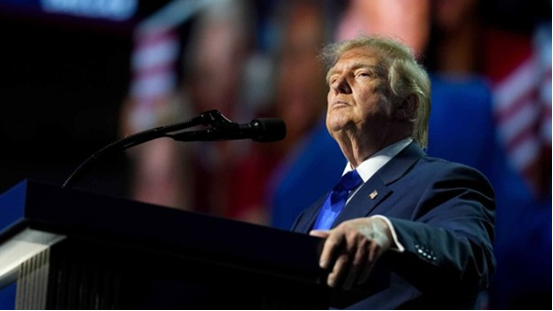
Trump’s ‘surprising’ midterm convention ‘dividend’
For months, President Trump has dismissed affordability concerns as a hoax, insisting his economy is roaring. Polling suggests Americans aren’t buying it, and with popularity sagging and enthusiasm fading, the president dangled a quid pro quo at voters: elect Republicans, get a $5,000 payout.
Speaking last Wednesday at the GOP’s midterm convention in Dallas, Trump offered no details, and the proposal has little chance of becoming law. Republicans have already baulked at his earlier push to pay out tariff revenue as dividends, and any cash payment programme would need congressional approval, carrying a price tag well above $1 trillion.
“It will be called the Trump dividend,” he said. “Now all we have to do is win.”
US public debt has just topped $40 trillion for the first time, already pressuring borrowing costs. Treasury futures stayed steady after the speech, a sign bond traders see little likelihood the dividend materialises.
The pledge, paired with equally far-fetched promises to make his tax cuts permanent and scrap credit card swipe fees, reflected the desperation creeping into Trump’s messaging as he faces midterm losses that could push him into lame duck territory and trigger a wave of congressional investigations into his administration and family.
Market reaction has been muted, precisely because almost no one expects this to happen. The US economy is strong, arguably running too hot already, so injecting this scale of fiscal stimulus while funding pressures mount would intensify the dynamics markets are already watching closely: weaker Treasuries, a softer dollar, and a rotation into commodities and real assets. The parallel to COVID-era stimulus payments is hard to ignore, given their direct link to the inflation spike that the Fed still hasn’t fully tamed.
Over a prime-time address running more than 100 minutes, Trump urged voters to treat the midterms as though he himself were on the ballot, aiming to energise the independent and low-propensity voters who powered his two presidential wins. “Your vote will decide whether our country stumbles at the starting gate of our next 250 years or surges forward and never ever looks back,” he told the crowd at the American Airlines Centre.
But the electorate remains broadly frustrated with his handling of the economy and the Iran war, and many Republicans in competitive races skipped the two-day event altogether. Empty seats were visible during the prime-time address, which went up against the NFL’s kickoff game.
Cost-of-living concerns dominate, compounded by the renewed escalation in Iran and rising gas prices. Trade tensions have also strained party unity: plans to ease tariff-rate quotas on imported beef have angered rural-state Republicans, while the escalating trade war with Canada has frustrated lawmakers from northern border states. Trump claimed, without evidence, that Canada wants to broker a deal.
He has continued to dismiss affordability concerns as a Democratic “hoax,” and the White House has stood firm on its immigration crackdown.
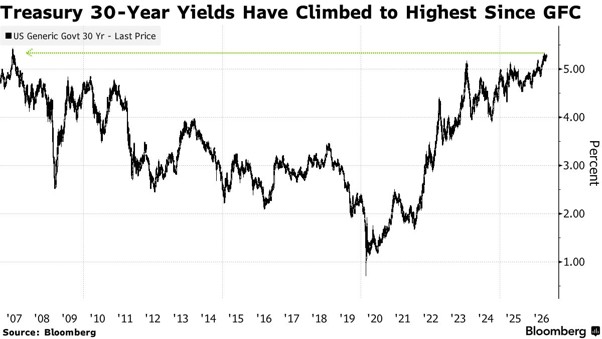
The remarks landed as 30-year Treasury yields sat near their highest level since the global financial crisis, after the government’s plan to buy up to $6 billion of longer-dated debt fell short of what some investors had expected.
“he general reaction from markets is very muted, precisely as everyone sees almost zero chance of this happening. Are any of the electorate that gullible? I suspect they are also getting wise to DJT’s lies.
Treasury markets have been under pressure in recent weeks as renewed tensions in the Middle East pushed oil prices higher, fuelling bets that the Federal Reserve may need to raise rates again. Persistent worries over US fiscal health, now that public debt has crossed $40 trillion, are adding to the strain. Should Republicans hold both chambers, fiscal concerns would likely deepen further, given Trump’s record of fiscal imprudence through his second term so far.

Bessent: Burning down the house?
Goading markets into betting against you rarely ends well.
On Tuesday last week, Treasury Secretary Scott Bessent declared, “I am the house now,” referring to his efforts to strengthen the yen, while also framing the expanded Treasury bond buyback programme as treatment for a “fever” in the bond market. He’s been clear he wants yields lower. But after that buildup, Wednesday’s announcement that buybacks were being tripled fell flat.
Markets read it as insufficient shock and awe, pushing the 10-year Treasury yield up to 4.84%, its highest in three years. Having signalled he’s willing to intervene, Bessent all but invited the market to test his limits, and that’s exactly what happened.
Yields have climbed steadily without yet triggering a stock market selloff. Even on Wednesday, the S&P 500 recovered much of its earlier decline. The question is whether there’s a tipping point ahead where rising yields finally drag equities down, and whether the 10-year could reach 5%…
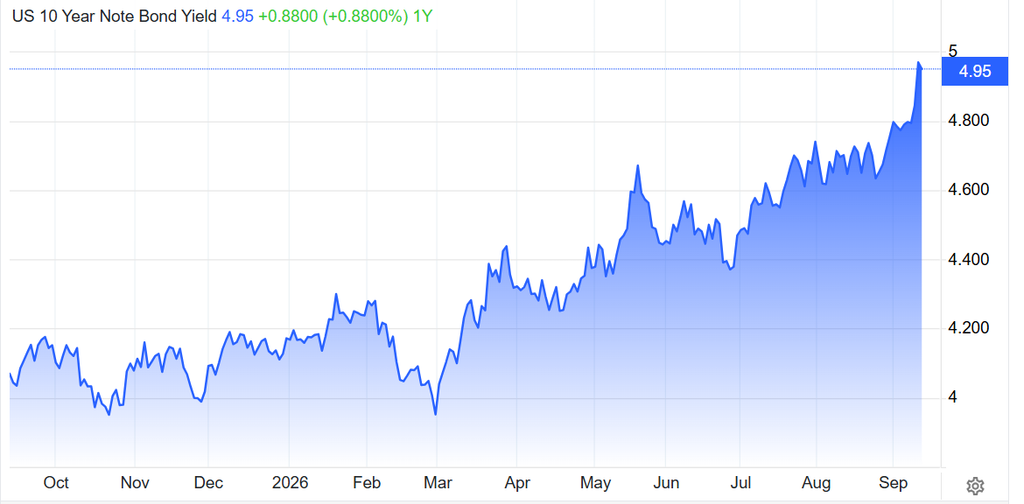
That threshold, closer now than at any point in three years, gets cited partly because it’s a round number and partly because it would mark the highest level in nearly two decades.
Most major bond markets are already at post-financial-crisis highs, but the US has yet to revisit the 5% briefly touched in 2023. If the 10-year breaks through and holds above that level this time, a set of considerably more alarming scenarios becomes far more plausible.
The main reason investors have been willing to look past rising yields is the AI buildout. When tech companies are betting on effectively limitless demand, a few basis points aren’t going to slow them down, particularly with big tech’s leverage cycle only just getting underway, though some names are further along than others. As long as that financing loop holds, it feeds on itself.
Strong earnings growth has so far outweighed the tighter valuations that have come with shifting bond markets, and investors appear confident that can continue.If any equity market is exposed to rising bond yields, it’s the US, given how much of American companies’ value sits in future earnings. Those earnings become mechanically cheaper as higher yields force them to be discounted at a steeper rate.
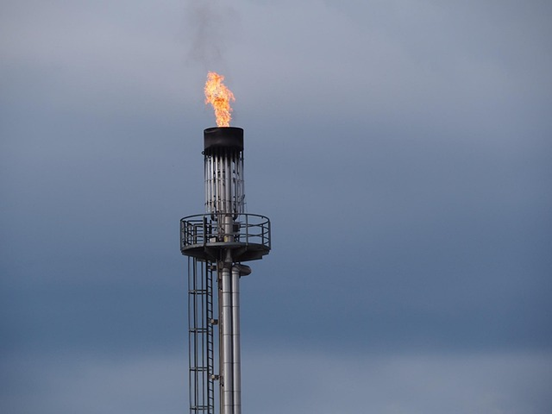
Early in Wednesday trading last week, Brent crude broke back above $100 a barrel for the first time in two months. November delivery pricing shows the market never expected prices to stay this elevated this late in the year. There’s some confidence levels will ease back toward $80 by next summer, but this is a development nobody saw coming even a few weeks ago.
Sustained high crude prices hit hardest through the refined products consumers actually experience. Per the American Automobile Association, average diesel prices have set a fresh record, surpassing the previous high set after the Ukraine invasion. Persistently elevated crude also keeps these critical inputs for industry and agriculture pinned higher. Gasoline, always the more politically sensitive number, remains below this year’s peaks but has climbed back above $4 a gallon.
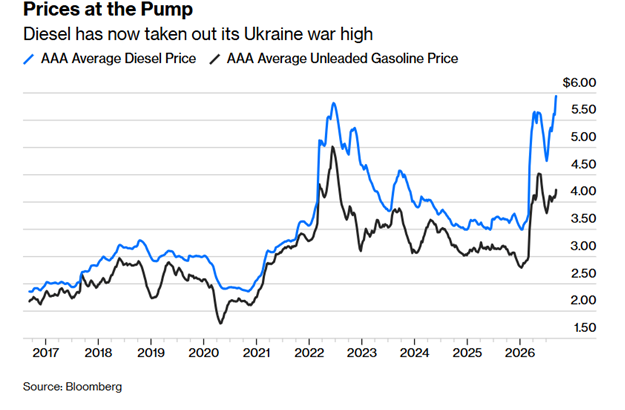
Higher oil prices mechanically push up headline inflation in the near term. A simple model from Absolute Strategy Research suggests that if gasoline holds at current levels for six months, US headline inflation would climb to 4.9%, a level that would more or less compel the Federal Reserve to raise rates.
That sounds like genuinely bad news. Higher oil acts like a tax hike that slows growth, while also forcing rate increases that weigh on growth further. Yet markets aren’t treating it that way. One-year inflation breakevens sit at barely half the level they reached when oil first crossed $100 back in March.
Equity markets, too, seem to have made peace with higher oil.
Through the first month of the Iran conflict, Brent and the S&P 500 moved as mirror images, with stocks only rising when Brent fell. That relationship has broken down. Global stocks now sit 14% above where they were when oil first hit $100.
Why the calm? Partly because the risk of an all-out, Vietnam- or Iraq-style ground war has faded, the US clearly doesn’t want that path, and escalation to destroying Gulf oil infrastructure hasn’t materialised either. Global stocks have simply done well over the past six months regardless.
But the Strait of Hormuz remains closed in a way that looked unlikely during the brief thaw two months ago. Prediction markets show fading hope of reopening this year, and oil futures are undercutting the more optimistic assumptions held by traders closest to the situation. The most nightmarish scenarios may be off the table, but some genuinely bad ones remain live.
Pakistan warned that continued Houthi attacks on Saudi Arabia could trigger the Mecca defence pact; Israel’s Netanyahu said from Syria that Iran’s government is “very close” to collapse; Lebanon saw the war’s deadliest ground fighting in this window (29+ killed in Israeli strikes since September 4). Jordan absorbed real damage: a September 8-9 Iranian missile salvo on Muwaffaq Salti air base, previously described as causing no casualties, is now confirmed to have damaged an A-10’s wing and lightly damaged roughly eight F-15Es.
The market isn’t just pricing today’s disruption; it’s pricing the odds of more disruption to come. Even though equities imply the energy shock won’t derail the economy or corporate earnings, markets can be simultaneously rational about long-term fundamentals and complacent about low-probability risks.
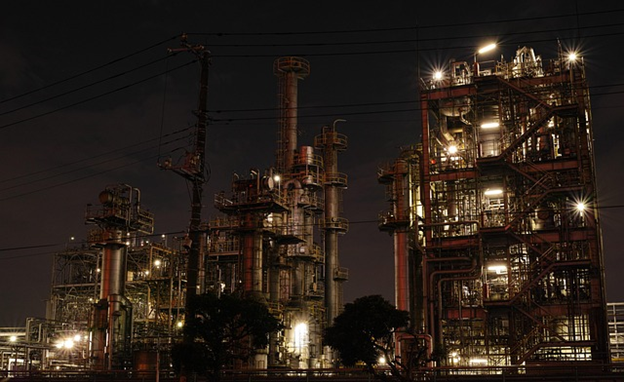
Point of interest: why don’t petrol and diesel prices move in lockstep?
The gap you’re seeing, where diesel prices are rising faster than petrol, traces back to the US/Israel-Iran war that began around February 28, 2026, which has repeatedly disrupted Middle East oil and refined fuel exports, particularly through the Strait of Hormuz. A few reasons diesel has outpaced gasoline:
The Iran conflict itself has been unstable rather than a single shock. A 60-day US-Iran ceasefire has expired without extension, and Houthi attacks on Red Sea oil infrastructure have picked up again, keeping supply risk elevated on and off through the year rather than resolving cleanly. Diesel peaked around $5.55 to $5.80 a gallon in April versus roughly $4.10 to $4.30 for gasoline at the same point, before both eased over summer.
Heading into September 2026, the conflict remains unresolved, and regional fuel markets such as the UAE are again showing diesel rising faster month over month, so the structural gap hasn’t closed. It continues to widen and narrow in waves that track the conflict’s escalations and lulls, rather than settling as a one-off event.
Both fuels come from crude oil but from different points in the refining process, ending up chemically distinct because they’re built for fundamentally different engines.
They can’t be freely swapped, though refineries do have some flexibility. Cracking units (catalytic cracking, hydrocracking) can break heavier molecules into lighter ones, letting a refinery convert some diesel-range material into more gasoline. Going the other way, turning gasoline into diesel, is much harder, since it requires stitching shorter molecules into longer chains, which isn’t economical at scale using these processes. This asymmetry is a big part of why diesel supply is so inflexible when disrupted: refineries can dial up gasoline output by cracking heavier fractions, but they can’t easily manufacture diesel from surplus gasoline. The final stage, desulfurisation or hydrotreating, also has a fixed capacity bottleneck at each refinery, which is part of why global diesel capacity is structurally tighter than gasoline capacity, tying back to the Gulf region’s product mix discussed above.
Author: Dawn Ridler

Google is quietly transforming itself into a compute giant. First, they used the cash generated from their search business; then they tapped the bond markets. Most recently, they’ve used the equity markets to raise more capital. Alphabet, the parent company of Google undertook an unusually large equity capital raise in June, principally to accelerate spending on AI data centres, servers and global compute infrastructure. It announced an $80 billion programme on 1 June, but then upsized it to a potential $84.75 billion after strong demand for the underwritten offerings. And all of this is done by a business which started as an online advertising and search business.
The evolution of Google is telling. A key measure we use is Return on Invested Capital (ROIC): the return a company earns on the capital it has invested over time. Incremental ROIC is equally telling. It’s what a company incrementally earns from new dollars invested in projects. The chart below tells the story of Google
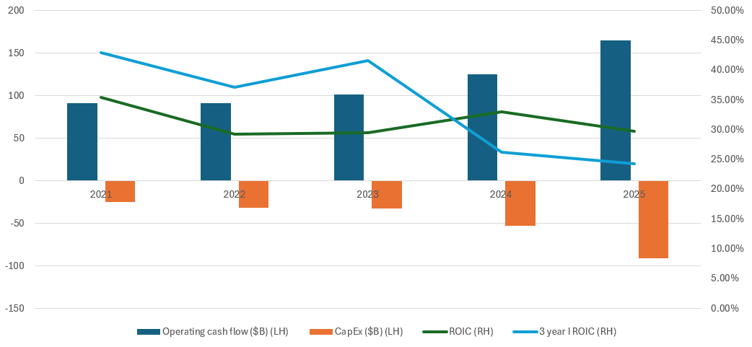
To find a company which has a ROIC of 30%, especially at the size of Google, is not easy.
Generally, the larger a company gets, the harder it is to sustain high ROIC levels. But this is what makes the likes of Google so interesting. Despite their size constraints, they have maintained their ROIC profile. The incremental number has been coming down from a rolling 3-year average in 2021 of 42.9% to today’s 24.2%.
Again, this is interesting to know but would be far more concerning in a smaller entity than at Google. Now look at Capex. That number has incrementally grown as the data centre build-out takes hold. The 2025 Capex number of $91.4 billion far outweighs the $ 24.6 billion spent in 2021, but then their Operating Cash Flow at the same time has gone from $91.7 billion to the current $ 164 billion. Conservative shareholders would want to spend more conservatively, but they may not be taking into account the AI revolution underway.
Google started developing their TPU chip in 2015 and launched it in 2016. It’s a Tensor Processing Unit and is Google’s custom-built AI accelerator chip. It is designed specifically for the large matrix calculations that power neural network training and inference, rather than for general computing or graphics like a CPU or GPU. TPU’s underpin Google’s internal AI systems, including Gemini, and are also sold to external customers through Google Cloud.
TPUs are a major element of Alphabet’s AI investment story. They may show up as capex today, but they are a proprietary compute platform that can potentially lower the cost of serving Google’s own AI products and generate Google Cloud revenue. And that’s the point of compute. Over time, costs will go down. For players banking on compute prices staying where they are today to drive returns, they may be in for a surprise. In the case of Google, driving the cost lower is exactly what they want. Combined with their scale, they hope to dominate. I am fully expecting their ROIC’s to come down as they build out capacity. But once this is done, they could stand a chance to harvest some of the biggest compute contracts there are.
On Thursday last week, they announced plans to invest €13B in Finland AI infrastructure over the next 2 years, marking its largest-ever single investment in Europe. The buildout includes 3 new data centres in Kajaani, Muhos, and Vaala, along with an expansion of Google’s existing Hamina site. Google is also adding new wind-power agreements and a 94 MW battery system at Kajaani, while Fortum signed a 22-year power deal that will eventually cover 50% of output from its two-reactor Loviisa nuclear plant. The projects are expected to support more than 37,000 jobs during construction and about 7,000 jobs once completed, underscoring how AI infrastructure growth is increasingly tied to long-term power access across Europe. This is another building block in Google’s ever-increasing ecosystem.
Author: Cobie LeGrange
EXCHANGE RATES and other Indices:
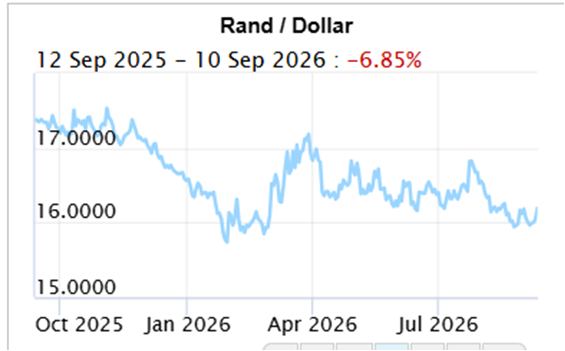
Rand/Dollar: the rand weakened to around R16.16 to R16.18 to the US dollar by Friday 11 September, from about R16.00 to R16.04 a week earlier, after touching a firmer R15.99 to R16.03 midweek. The Rand/Dollar closed at R16.11 (R15.95, R 16.09, R16.02, R16.17, R16.14, R16.55, R16.47, R16.31, R16.22, R16.40, R16.39, R16.27, R16.55, R16.23, R16.46, R16.68, R16.39, R16.63, R16.29, R16.41, R17.07, R17.06, R16.89, R16.55, R15.93, R16.01, R15.96, R16,03, R16.15, R16.10, R16.50, …R16.91, R17.13, R17.36, R17.13,16.52 )
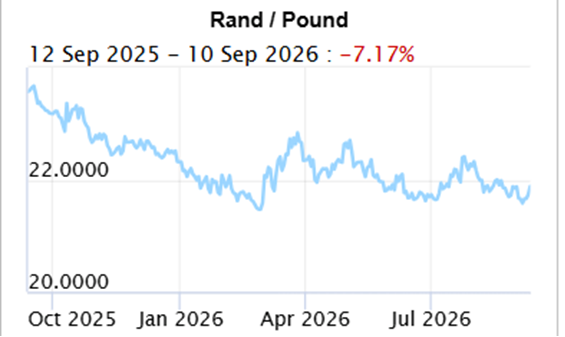
Rand/GBP: The rand was around R21.60 to R21.70 to the British pound, little changed from about R21.65 to R21.71 a week earlier. The Rand/Pound closed at R21.79 (R21.56, R21.79, R21.86, R21.88, R21.78, R22.31, R22.16, R21.86, R21.64, R21.64, R21.67, R21.80, R22.06, R21.80, R22.09, R22.21, R22.30, R22.56, R22.35, R22.02, R22.09, R22.77, R22.76, R22.35, R22.20, R21.48, R21.59, R21.78, R21,82, R22.11, R21.97, R22.13, …R22.57, R22.68, R22.74, R22.56,
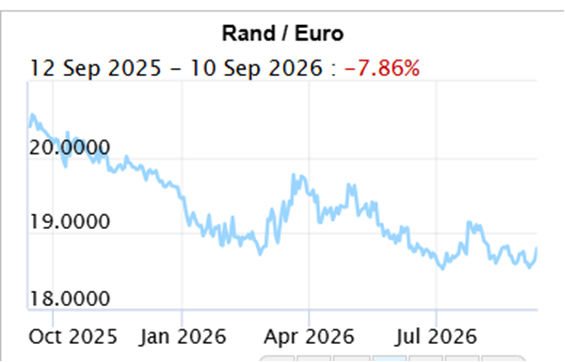
Rand/Euro: The rand was around R18.55 to R18.60 to the euro, little changed from about R18.55 to R18.58 a week earlier. The Rand/Euro closed the week at R18.68 (R18.52, R18.60, R18.72, R18.71, R18.66, R19.09, R18.84, R18.62, R18.52, R18.66,R18.89, R19.16, R19.08, R18.91, R19.11, R19.38, R19.29, R19.48, R19.37, R19.17, R19.24, R19.70, R19.77, R19.33, R19.23, R18.80, R18.87, R18.94, R18.93, R19.14, R19.04, R19.20)
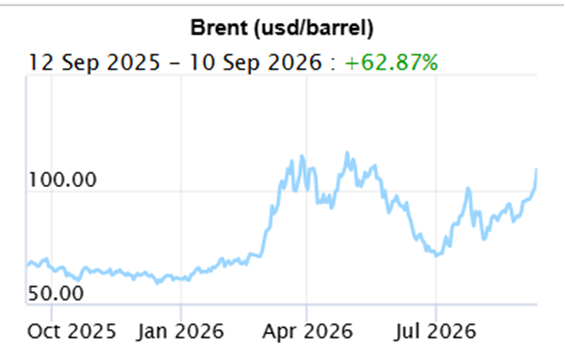
Brent crude: Brent crude rose further to around $105 to $107 a barrel intraday, up from about $95 a week earlier, as the conflict between the United States and Iran intensified.Brent Crude: Closed the week at $104.61($96.28, $88.29, $94.39, $88.52, $83.55, $87.93, $88.10, $76.01, $72.10, $71.99, $80.59, $87.33, $93.09, $91.12, $104,24, $109.26, $101.29, $108.83, $105.33, $90.38, $95.20, $107.88, $112.36, $103.14, $92.88, $73.19, $71.76, $67.75, $68,05, $69.32, $65.88, $63.34, …$63.71, $63.19, )
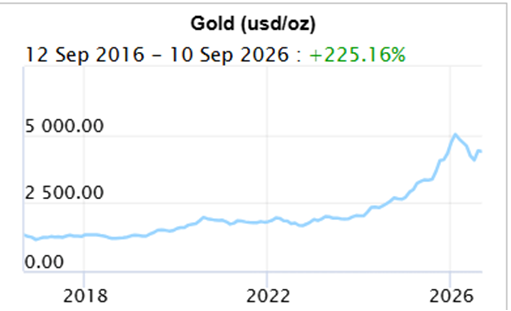
Gold eased to around $4,368 an ounce, down from about $4,469 to $4,478 a week earlier, as rising Federal Reserve rate-hike odds weighed on the metal. Gold closed at $4,347 ($4,432, $ 4,454, $4,607.35)
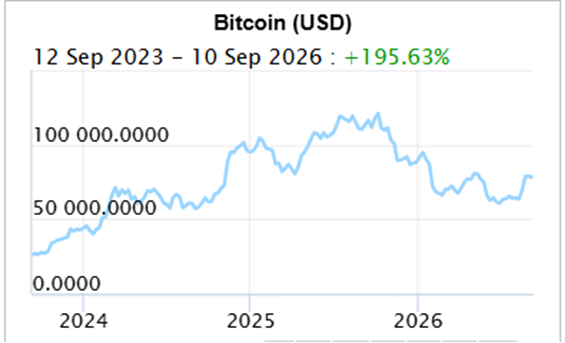
Bitcoin held around $77,000 to $78,000, little changed from a week earlier, as expectations of rate hikes continued to weigh on risk assets. Bitcoin closed at $76,582 ($79,776, $78,701, $76,532, $62,911, $64,921, $63,143, $64,718, $63,815, $62864, $60,063, $64,029, $64,131,$60,762, $73,788, $74,559, $77,879, $80,733, $78,204, $78,049.98, $75,519, $70,904, $68,691 , $68,586, $70,869, $67,310, $63,534, $68,04, $69,649, $68,553, $81,301, $89,295, $90,585,)
Articles and Blogs:
Investment series part 4(NEW)
Investment series part 3 (NEW)
Investment series part 1
Investment series part 2
Legacy Series Part 4
Legacy Series part 3
Legacy Series Part 2
Legacy Series Part 1
Holiday checklist
Next year – Action Plan
Next year – Vision, Mission etc
Medical Risk Mitigation
Next Year – Consolidation
Abdication or diversification?
Carbo-loading your retirement Spoiled for choice
Who needs a plan anyway
8 questions you need to ask about retirement
What to do when interest rates drop
How to survive volatility in your investments
What to do when interest rates drop
Difficult Financial Conversations
Financial Implications of Longevity
Kick Start Your Own Retirement Plan
You matter more than your kids in retirement
To catch a falling knife
Income at retirement
2025 Budget
Apportioning blame for your financial state
Tempering fear and greed
New Year’s resolutions over? Try a Wealth Bingo Card instead.
Wills and Estate Planning (comprehensive 3 in one post)
Pre-retirement – The make-or-break moments
Some unconventional thoughts on wealth and risk management
Wealth creation is a balancing act over time
Wealth traps waiting for unsuspecting entrepreneurs
Two Pot pension system demystified
Cobie Legrange and Dawn Ridler,
Rexsolom Invest, Licensed FSP 45521.
Email: cobie@rexsolom.co.za, dawn@rexsolom.co.za
Website: rexsolom.co.za, wealthecology.co.za