

If any of our readers out there don’t have our free RedFile Organisational template, let us know.
Too Busy? Got Better Things to Do? Read the Summary…
Trump Threatens EU Tariffs: Proposed Associate Membership
President Trump warned on 16 September that he could impose heavy tariffs on the EU, or cut off trade entirely, if he views the bloc’s proposal to bring Canada in as an “associate member” as a hostile act. The proposal, floated by Commission President von der Leyen with Canadian PM Mark Carney present, has no formal basis in EU treaties yet and would take years to ratify. The threat compounds an already deteriorating US-Canada relationship, following collapsed trade talks, 50% US tariffs on Canadian goods, and a new US procurement ban on Canadian goods. For now, this reads as rhetoric rather than policy, but it adds another layer of uncertainty for clients with European or Canadian trade exposure.
Treasuries Rally as Fed’s Hike Bolsters Inflation-Fighting Credibility:
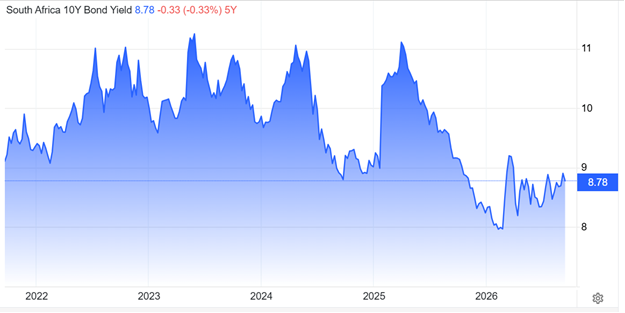
US Treasuries rallied on 17 September as markets read the Fed’s rate hike as confirmation of its inflation-fighting resolve, with the 10-year yield falling to 4.98% and the 2-year to 4.70%. The relief reflects certainty priced in rather than surprise: swaps markets are pricing in more hikes than the Fed itself has projected, and global bond yields hit a 19-year high on Middle East tensions and oil-driven inflation expectations. Elevated yields look more like a new normal than a temporary spike, and RSA yields (8.5% to 9%) remain notably more attractive than Western equivalents for income portfolios.
Concerns That US Visa Curbs May Target Pro-BEE Businesspeople:
US Secretary of State Rubio announced new visa restrictions on 15 September targeting individuals linked to “race-based discrimination” and uncompensated land seizures in South Africa. While framed around officials and lawmakers, business leaders, including Black Business Council CEO Kganki Matabane, warn the wording is broad enough to catch executives at BEE-compliant companies. This adds to an escalating US-South Africa dispute that already includes a 30% tariff, aid suspension, and questions over AGOA access. This remains a policy-level warning rather than a confirmed mass restriction, but travel and market access risk is rising for those linked to transformation policy.
The Federal Reserve Raises Rates:
The Fed lifted its benchmark rate by 25 basis points to 3.75% to 4.00% on 16 September, its first hike since 2023, in a unanimous 12 to 0 vote under new Chair Kevin Warsh. The move prioritises persistent inflation risk over growth concerns, with officials citing resilient demand, elevated energy prices, and ongoing AI infrastructure spending. The Fed’s own guidance points to at least one further hike this year, though this depends heavily on how the White House’s trade posture and the Middle East situation evolve, with markets now watching whether Warsh faces the same pressure from Trump that his predecessor did.

This Week’s Roundup
Brent crude settled at 104.82 US dollars a barrel on Thursday, close to last Friday’s 104.61 US dollar close but having spiked as high as 108.75 US dollars a barrel midweek, before slipping further to around 102.50 US dollars in early Friday trade. Gold slipped from about 4,390 US dollars an ounce last Friday to around 4,315 US dollars by Thursday, before rebounding sharply to around 4,434 US dollars in early Friday trade following the Bank of Japan’s rate hike. The rand weakened modestly over the week, moving from around R15.97 to the dollar on Monday to around R16.25 on Friday morning, having traded as weak as R16.33 on Tuesday before recovering some ground through midweek.
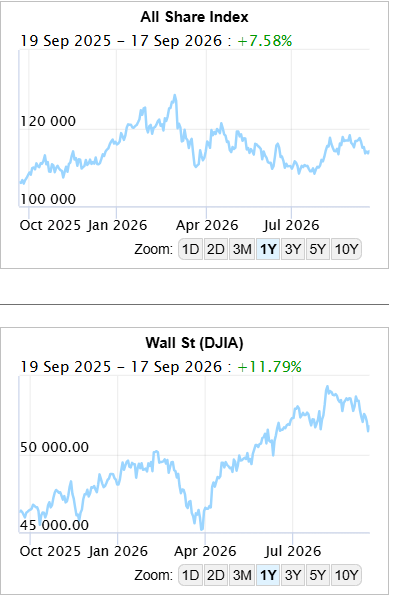
The JSE had a choppy week, with the All Share Index slipping to around 113,551 points on Wednesday 16 September, down about 0.4% on the day and off the 116,688 level seen two weeks earlier, as global rate jitters weighed on sentiment even though firmer gold and platinum prices gave mining counters some support.

Trump Threatens EU Tariffs Over Canada’s Proposed Associate Membership
A new front has opened in the US administration’s trade tensions with its allies. On Wednesday, 16 September 2026, President Trump warned he could hit the European Union with fresh tariffs, or cut off trade with the bloc entirely, if he judges a proposal to bring Canada closer into the EU’s orbit to be a “hostile act.”
What happened:
European Commission President Ursula von der Leyen used her annual State of the Union address in Strasbourg to invite Canada to become the EU’s first “associate member,” with Canadian Prime Minister Mark Carney in attendance. She framed the move as building on the EU-Canada free trade agreement (CETA) toward what she called an “Alliance for the Future,” aimed at creating a shared prosperity and security space between the two economies.
Asked about the proposal after landing in North Carolina, Trump did not hold back: “If they do that, if I think it’s at all a hostile act, I will put very serious tariffs or stop trading with Europe on many things.” He left the door open to a friendlier outcome, adding: “If it’s a good intention, that’s fine; if it’s a bad intention, we’ll put very heavy tariffs on Europe.” He separately dismissed the proposal itself as “laughable” and called Canada “a terrible trade partner.”
The European Commission pushed back on Thursday, with spokesman Olof Gill saying the proposed partnership was “not against anyone else,” echoing von der Leyen’s framing that the alliance is “for our common strength.”
Why it matters
Associate membership doesn’t currently exist as a formal category under EU treaties. Any such status would need to be created and ratified by member states, a process that could take years, and it remains unclear whether all EU countries would support it. In practical terms, this is a proposal, not a done deal, but Trump’s reaction shows how sensitive Washington is to Canada and the EU deepening ties as a hedge against US trade pressure.
The threat lands against an already deteriorating US-Canada relationship. Trade talks between the two countries collapsed last month, prompting Trump to impose 50% tariffs on roughly $20 billion of Canadian goods, with Canada retaliating in kind. On the same day as the EU remarks, Trump escalated further by signing a memorandum barring Canadian goods from US federal government procurement, a move the White House framed as retaliation for Canada’s “Buy Canadian” policy.
Notably, Trump had struck a more conciliatory tone on Canada only days earlier, saying over the weekend that he expected a deal “fairly soon,” without offering details on any resumption of formal talks. That makes Wednesday’s tariff threat something of a reversal, and it’s unclear what legal authority he would rely on to follow through.
The takeaway for investors:For now, this reads as rhetoric rather than an imminent policy shift; the EU has given no indication it will abandon the Canada proposal, and any formal associate membership arrangement is likely years away. But it adds another layer of uncertainty to an already volatile US trade posture toward its allies, alongside the ongoing US-Canada tariff fight. Clients with exposure to European or Canadian trade-sensitive sectors should treat this as another reason to expect continued policy noise, not a reason for immediate portfolio changes.
Treasuries Rally as Fed’s Hike Bolsters Inflation-Fighting Credibility
US government bonds found some relief on Thursday, 17 September 2026, as investors read the Federal Reserve’s rate hike a day earlier as a signal that the central bank is serious about bringing inflation back under control.
What happened:
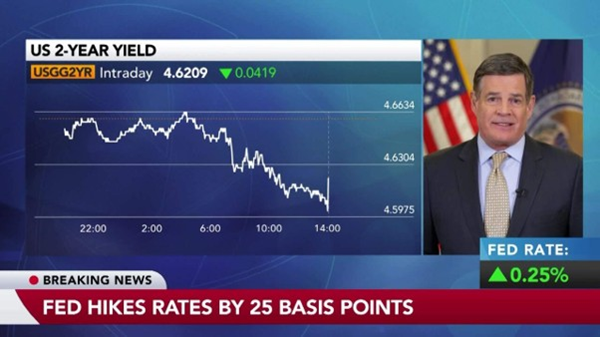
The 10-year Treasury yield fell four basis points to 4.98%, snapping an eight-day streak of rising yields and pulling back from a peak above 5% reached during Wednesday’s Fed decision. The 2-year yield, more sensitive to near-term policy moves, dropped three basis points to 4.70%, retreating from a fresh cycle high hit the day before.
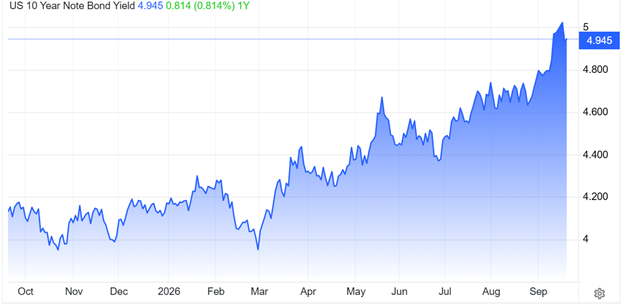
The move reflects relief rather than surprise: the quarter-point hike was fully priced in, and investors had been more worried about the alternative. The Fed had no choice but to give the market a hike or risk a much bigger bond market selloff. Analysts expect rates to stabilise at these elevated levels, noting markets are already pricing in more hikes than the Fed has projected, and that his desk would look to add duration opportunistically on that basis.
The inflation backdrop:
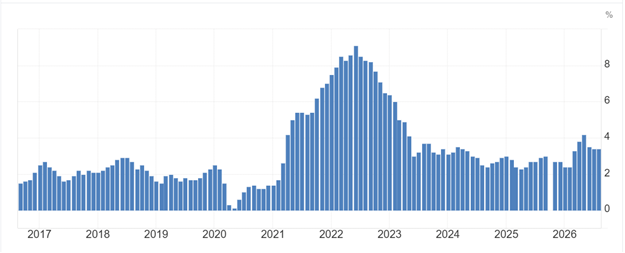
The Fed’s preferred inflation gauge stood at 3.7% in July, near its highest level since 2023 and well above the central bank’s 2% long-run target. Chairman Kevin Warsh reiterated that summer inflation data gave no indication underlying price pressures were easing. The Fed’s median policymaker projection points to one more hike before year-end, while swaps markets are pricing in three additional hikes by the middle of 2027, well beyond what officials themselves have signalled.
Not everyone expects the relief to last. For the bond market, this is likely to cast a long shadow rather than create a short-lived storm. The front end now has to price the possibility of further Fed tightening, while the long end is already wrestling with inflation, heavy issuance and fiscal concerns, meaning even when the initial volatility settles, the gravitational pull of higher yields may remain.
A global bond selloff:
The pressure on yields isn’t confined to the US. The average yield on global government bonds climbed to a 19-year high this week, driven by escalating tensions in the Middle East pushing oil prices higher and lifting inflation expectations worldwide. Reaction was mixed on Thursday: longer-dated bonds in Japan and Australia gained, while European debt lagged as markets caught up with Wednesday’s US selloff. Heavy long-dated issuance from France and Spain added to the pressure, and Germany’s 10-year yield rose two basis points to 3.52%. RSA 10-year yields have been volatile, but within a band of 8,5% -9%.
The takeaway for investors:
The relief in Treasuries reflects confidence that the Fed under Warsh is following through on its inflation mandate, not confirmation that the pressure on yields is over. With swaps pricing in more tightening than the Fed’s own projections, heavy sovereign issuance in Europe, and oil-driven inflation risk still in play globally, elevated yields look more like the new normal than a temporary spike. Fixed income positioning should account for continued volatility rather than an imminent return to lower rates. RSA yields are obviously much more appetising for income-generating portfolios than those in the West, but for the first time in a long time, Treasuries are creeping into offshore portfolios that used to be the domain of pure equity, especially for investors seeking less volatility.

Concerns That US Visa Curbs May Target Pro-BEE Businesspeople
South African business and labour leaders are warning that new US visa restrictions aimed at “race-based discrimination” could reach well beyond politicians and government officials, potentially catching any businessperson who has publicly backed economic transformation.
What happened
US Secretary of State Marco Rubio announced the new visa restriction policy on 15 September 2026, under Section 212(a)(3)(C) of the Immigration and Nationality Act. The policy targets foreign nationals the US considers “responsible for, or complicit in, the enactment or implementation of laws or policies that enable uncompensated land seizures, race-based discrimination, and/or the incitement of imminent violence against members of minority ethnic or racial groups in South Africa.” Rubio said the move follows what Washington sees as South Africa’s failure to adequately address concerns raised previously, and framed it as an extension of Trump’s executive order “Addressing Egregious Actions of the Republic of South Africa.”
US Ambassador to South Africa Brent Bozell described the restrictions as “only the first step in a series of escalatory measures,” warning that “the time for endless dialogue has run its course.”
Importantly, this is not a blanket travel ban. No individuals have been publicly named, restrictions apply case by case, and existing visa holders are not immediately affected. But the policy’s wording is broad enough that analysts, including South African journalist Nicholas Dawes, note it “looks broadly drawn enough to affect South African govt officials, judges, and politicians and their families, and maybe executives at BEE-compliant companies.”
Business leaders sound the alarm:
That last point is where local concern is now centred. Black Business Council CEO Kganki Matabane believes the restrictions could extend well past politicians to any businessperson who has publicly supported economic transformation. He expects US authorities to screen visa applicants from South Africa for a history of advocating for transformation policies before approving or denying their applications, a prospect that would put a far wider group of business leaders, executives, and BEE-compliant companies in the frame than the announcement’s language about officials and lawmakers might suggest.
Why Washington is targeting these policies:
The restrictions are the latest step in an escalating dispute that has been building for well over a year. The US has repeatedly criticised South Africa’s Broad-Based Black Economic Empowerment (B-BBEE) and Employment Equity frameworks as “race-based discriminatory policies,” alongside the Expropriation Act’s provisions on land seizure without compensation. Washington has tied its concerns specifically to the treatment of Afrikaners and other minority groups, a position that aligns with prior actions including the suspension of aid to South Africa, the withdrawal of the US ambassador, a boycott of the G20 summit in Johannesburg, and, in August, a 30% tariff on South African goods, the highest imposed on any sub-Saharan African country.
South Africa’s government has firmly rejected the characterisation. Pretoria’s foreign ministry said this week that the US measures rely on information from “fringe groups” that mischaracterise the country’s domestic policies, and has maintained that its transformation and land reform frameworks are legitimate tools to redress apartheid-era inequality rather than discrimination against minorities.
Why it matters for business:
Beyond the immediate travel implications for individuals, the broader risk is economic. The dispute now touches South Africa’s trade relationship with the US, its second-largest individual trading partner, and raises fresh questions over continued access to preferential arrangements such as AGOA. For businesses and executives associated with transformation initiatives, the practical concern is less about a mass enforcement action and more about uncertainty: without named individuals or clear published criteria, anyone with a public record of supporting B-BBEE or similar policies may now need to factor visa risk into decisions about US travel.
The takeaway for clients: This remains a policy-level warning rather than a confirmed mass restriction, and the US has been explicit that eligibility will be assessed case by case. But the direction of travel is clear: diplomatic and trade tension between Pretoria and Washington is deepening, and business leaders linked to transformation policy should treat continued US market access and travel as an area of genuine, rising uncertainty rather than a settled matter.
Author: Dawn Ridler

The Federal Reserve Raises Rates
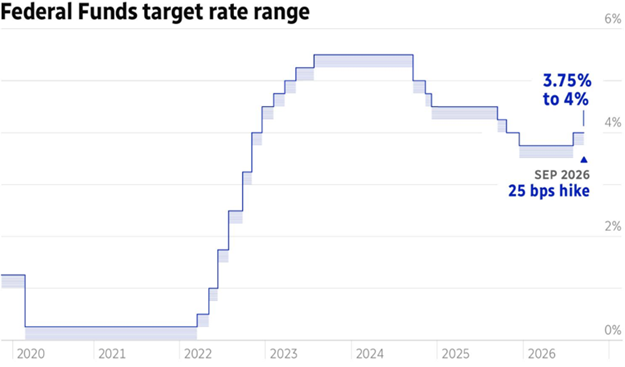
The US Federal Reserve has raised its benchmark interest rate by 25 bps to a target range of 3.75%–4.00%, its first increase since July 2023. The unanimous decision marks a significant shift in the policy outlook. The Fed is again prioritising the risk that inflation remains too high for too long, thus impacting growth.
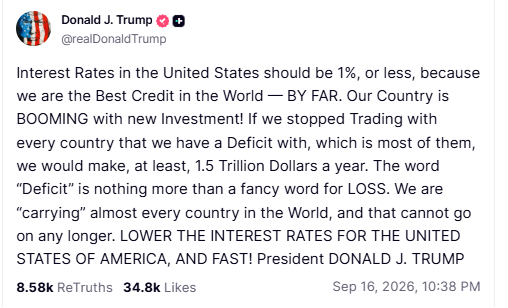
Last week the Federal Open Market Committee voted 12–0 to lift the federal funds target range from 3.50%–3.75% to 3.75%–4.00%, much to the dismay of the US President.
The Fed said that economic activity continues to expand at a solid pace, domestic spending remains resilient, labour market conditions have been broadly stable, and inflation remains elevated. It concluded that a modest rise in rates would support a more timely return of inflation to the 2% target. The Fed also raised the interest rate paid on reserve balances to 3.90% and the primary credit rate to 4.00%, effective 17 September.
The central issue is that inflation has not declined quickly or convincingly enough to meet the Fed’s 2% objective. Officials faced an uncomfortable combination of resilient domestic demand, elevated energy prices, geopolitical uncertainty and ongoing capital expenditure in sectors such as AI infrastructure.
The policy statement did not suggest that the economy is in recession or that labour markets are deteriorating sharply. Rather, it described an economy still capable of sustaining demand. This is a different policy environment from the 2020–22 period, when policymakers first responded to a pandemic shock and then to a sharp inflation surge. The current concern is not an inflation emergency, but the risk that inflation settles above target and forces an eventual, more disruptive policy response.
It is no secret that the war in Iran is driving the rate hike, and its on/off nature, with no true certainty, has led us to this point. Ironically, President Trump is probably the largest cheerleader for lower rates, but is the single biggest reason why they are not moving lower. Whereas he is not yet attacking the new Fed Chair, Kevin Warsh, there may come a time when he starts treating him similarly to how he treated the previous chair, J. Powell.
The policy tension between the White House and the Fed continues, even with someone new at the helm. Despite how you interpret economics, you can’t fight hard data, it seems.The question market participants will now ask is whether this is a sole rise in rates or if there will be more to follow. This very much depends on the actions by the White House. The US economy and markets can easily sustain themselves at current rates, but they are going to require a closer look at inflation expectations, as forward guidance on interest rates is going to be hard to get from Kevin Warsh.
Author: Cobie LeGrange
EXCHANGE RATES and other Indices:
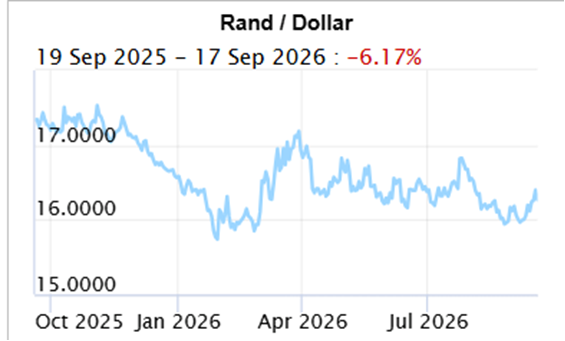
Rand/Dollar: The rand weakened modestly over the week, moving from around R15.97 to the dollar on Monday to around R16.25 on Friday morning, having traded as weak as R16.33 on Tuesday before recovering some ground through midweek The Rand/Dollar closed at R16.25 (R16.11, R15.95, R 16.09, R16.02, R16.17, R16.14, R16.55, R16.47, R16.31, R16.22, R16.40, R16.39, R16.27, R16.55, R16.23, R16.46, R16.68, R16.39, R16.63, R16.29, R16.41, R17.07, R17.06, R16.89, R16.55, R15.93, R16.01, R15.96, R16,03, R16.15, R16.10, R16.50, …R16.91, R17.13, R17.36, R17.13,16.52 )
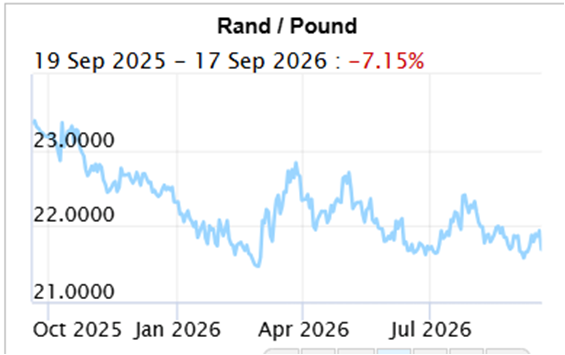
Rand/GBP: broadly flat over the week, easing from around R21.82 last Friday to around R21.72 on Friday morning as the Bank of England held rates. The Rand/Pound closed at R21.77 (R21.79, R21.56, R21.79, R21.86, R21.88, R21.78, R22.31, R22.16, R21.86, R21.64, R21.64, R21.67, R21.80, R22.06, R21.80, R22.09, R22.21, R22.30, R22.56, R22.35, R22.02, R22.09, R22.77, R22.76, R22.35, R22.20, R21.48, R21.59, R21.78, R21,82, R22.11, R21.97, R22.13, …R22.57, R22.68, R22.74, R22.56,
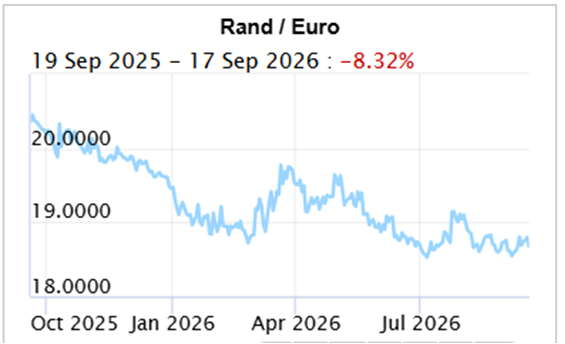
Rand/Euro: little change over the week, at around R18.68 on Friday morning versus around R18.72 last Friday. The Rand/Euro closed the week at R18.67 (R18.68, R18.52, R18.60, R18.72, R18.71, R18.66, R19.09, R18.84, R18.62, R18.52, R18.66,R18.89, R19.16, R19.08, R18.91, R19.11, R19.38, R19.29, R19.48, R19.37, R19.17, R19.24, R19.70, R19.77, R19.33, R19.23, R18.80, R18.87, R18.94, R18.93, R19.14, R19.04, R19.20)
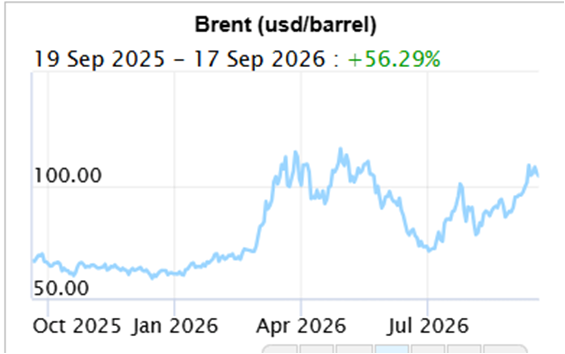
Brent crude: Brent crude settled at 104.82 US dollars a barrel on Thursday, close to last Friday’s 104.61 US dollar close but having spiked as high as 108.75 US dollars a barrel midweek, before slipping further to around 102.50 US dollars in early Friday trade. Brent Crude: Closed the week at $103.87 ($104.61, $96.28, $88.29, $94.39, $88.52, $83.55, $87.93, $88.10, $76.01, $72.10, $71.99, $80.59, $87.33, $93.09, $91.12, $104,24, $109.26, $101.29, $108.83, $105.33, $90.38, $95.20, $107.88, $112.36, $103.14, $92.88, $73.19, $71.76, $67.75, $68,05, $69.32, $65.88, $63.34, …$63.71, $63.19, )
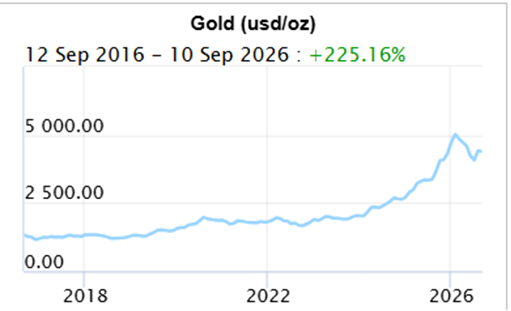
Gold slipped from about 4,390 US dollars an ounce last Friday to around 4,315 US dollars by Thursday, then rebounded sharply to around 4,434 US dollars in early Friday trade after the Bank of Japan’s rate hike.Gold: $4,379 ($ 4,454, $4,607.35)
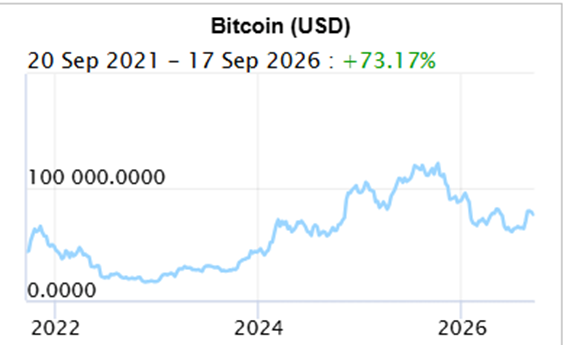
Bitcoin traded between around 75,000 and 79,500 US dollars over the week, dipping toward the lower end around the Fed’s rate decision on Wednesday before recovering to about 76,500 US dollars by Thursday and closing the week over $80K.Bitcoin closed at $80,354 ($76,582, $79,776, $78,701, $76,532, $62,911, $64,921, $63,143, $64,718, $63,815, $62864, $60,063, $64,029, $64,131,$60,762, $73,788, $74,559, $77,879, $80,733, $78,204, $78,049.98, $75,519, $70,904, $68,691 , $68,586, $70,869, $67,310, $63,534, $68,04, $69,649, $68,553, $81,301, $89,295, $90,585,)
Investment series part 4(NEW)
Investment series part 3 (NEW)
Investment series part 1
Investment series part 2
Legacy Series Part 4
Legacy Series part 3
Legacy Series Part 2
Legacy Series Part 1
Holiday checklist
Next year – Action Plan
Next year – Vision, Mission etc
Medical Risk Mitigation
Next Year – Consolidation
Abdication or diversification?
Carbo-loading your retirement Spoiled for choice
Who needs a plan anyway
8 questions you need to ask about retirement
What to do when interest rates drop
How to survive volatility in your investments
What to do when interest rates drop
Difficult Financial Conversations
Financial Implications of Longevity
Kick Start Your Own Retirement Plan
You matter more than your kids in retirement
To catch a falling knife
Income at retirement
2025 Budget
Apportioning blame for your financial state
Tempering fear and greed
New Year’s resolutions over? Try a Wealth Bingo Card instead.
Wills and Estate Planning (comprehensive 3 in one post)
Pre-retirement – The make-or-break moments
Some unconventional thoughts on wealth and risk management
Wealth creation is a balancing act over time
Wealth traps waiting for unsuspecting entrepreneurs
Two Pot pension system demystified
Cobie Legrange and Dawn Ridler,
Rexsolom Invest, Licensed FSP 45521.
Email: cobie@rexsolom.co.za, dawn@rexsolom.co.za
Website: rexsolom.co.za, wealthecology.co.za