

Too Busy? Got Better Things to Do? Read the Summary…
Bonds still sounding alarms, globally:
US government bond yields reached their highest levels in almost two decades. The 10-year hit its highest since 2007 and the 30-year its highest since 2004, after very strong PMI data, higher oil prices and two weakly supported Treasury auctions. Foreign central banks bought less at the auctions, which suggests the traditional buyers of US debt are stepping back just as supply keeps growing. The Fed has started hiking again and markets expect more, while the selloff has spread to Japan, the UK, Germany and Australia. In South Africa, the effects are showing up in the rand, local bond yields and the SARB’s second hike of the year. Rising yields partly reflect a strong US economy, and for long-term investors, cash and income yields are more attractive than they have been for years. The message is to stay with the plan rather than react to a two-day move.
Diesel, Hormuz and the Export Ban Debate:
Diesel is now the energy market’s real pressure point. Supply from the Middle East and Russia is constrained, and a US export ban is being discussed ahead of the midterms. Most analysts think a ban would backfire: refiners would cut output, gasoline and jet fuel would suffer, and allies would face even higher prices. Brent closed Thursday at $106.60 after Houthi missile attacks on Saudi Arabia, and the pipeline Saudi Arabia uses to bypass Hormuz is still recovering. South Africa imports most of its refined fuel, so motorists should prepare for another large increase on 7 October. Current projections point to record prices, which would feed into food prices and CPI.
Global bond selloff reaches Japan:
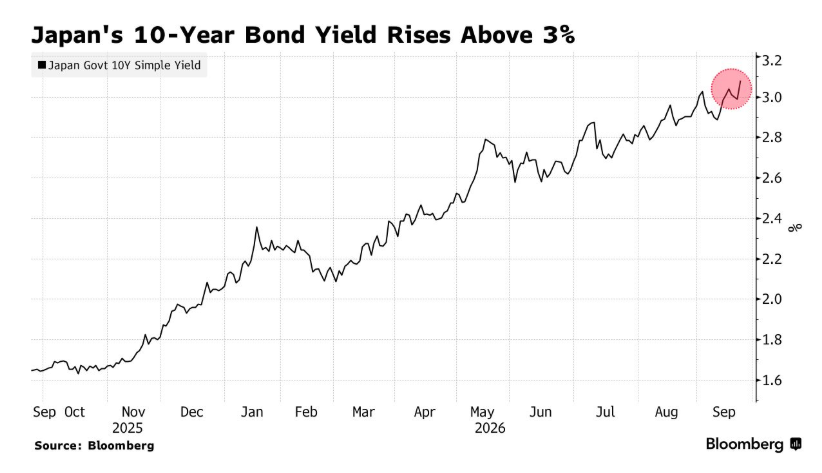
Japan’s 10-year government bond yield climbed to its highest level since 1996 and the 5-year hit a record high as Tokyo caught up with the US Treasury selloff after the Silver Week holiday. The Bank of Japan’s split 7-2 decision to raise rates to 1.25% raised concern that it is falling behind on inflation. Rising defence spending and record debt-servicing costs are adding to the strain. The yen slid towards 160 per dollar before recovering slightly. Japan is the largest foreign holder of US debt, so higher yields at home could draw Japanese capital back from global markets, including emerging markets like South Africa.
SA Repo Rate and valuations:
The SARB’s hike to 7.25% makes more sense when seen against a global rate cycle that is still rising, with the Fed, ECB and Bank of Japan all tightening recently. South Africa’s rate advantage over the US is much smaller than it was in 2012. With currency risk and geopolitical headwinds on top, the case for holding capital locally is harder to make. If US 10-year yields move towards 6%, bonds become a strong alternative to equities, which squeezes valuations. Slow-growing companies are most exposed, while fast-growing ones hold their premium only as long as the growth comes through.


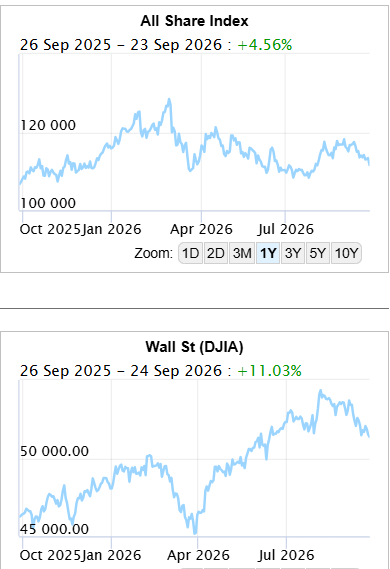
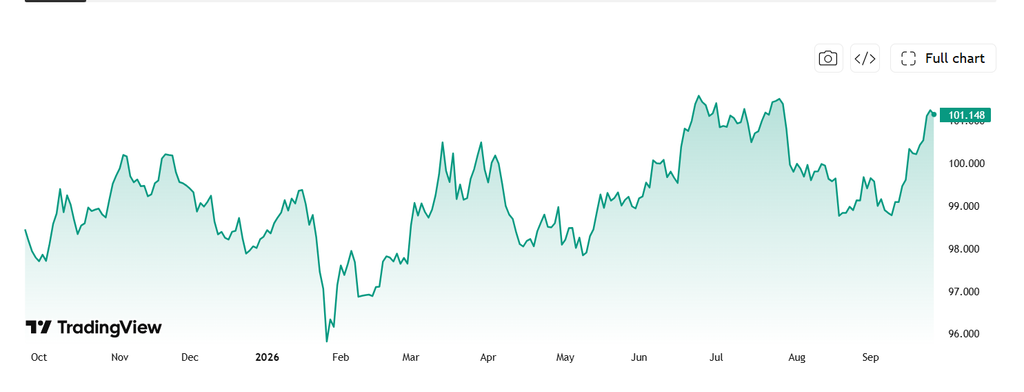
DXY CHART

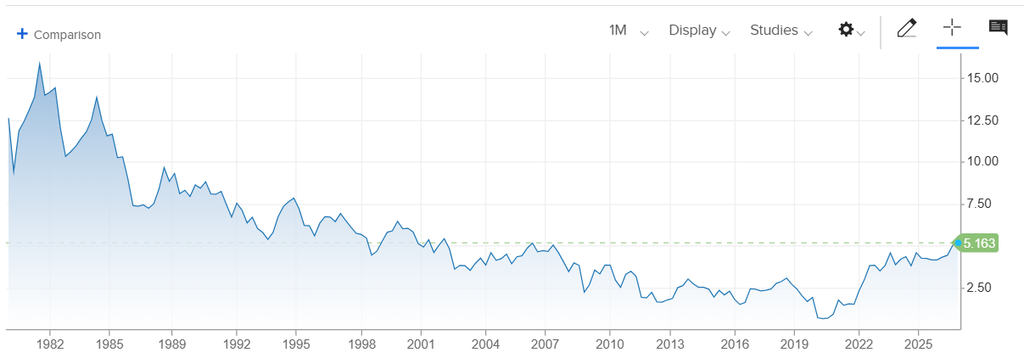
10-yr treasuries



Bonds still sounding alarms, globally
US government bond yields have climbed to their highest levels in almost two decades, and the move is spreading. Over Wednesday and Thursday last week, the US 10-year yield closed at 5.18%, its highest since 2007, while the 30-year reached its highest level since 2004. Strong economic data, a jump in oil prices and two poorly supported Treasury auctions did the damage. For South African investors, the ripple effects are already visible in the rand, local bond yields and a second SARB rate hike this year.
Two days that moved the market
The selloff started on Wednesday 23 September with rising oil prices. It gathered pace when S&P Global’s flash surveys showed US private-sector activity expanding at its fastest pace in more than five years, with price pressures building. It then accelerated again after a weak five-year Treasury auction.
The five-year yield traded above 5% for the first time since 2007, and the 10-year posted its biggest one-day rise since April 2025. On Thursday, the losses extended, with the 30-year climbing to its highest level since 2004.
Official US Treasury daily par yield curve, measured at about 3:30pm New York time (US Treasury). Intraday highs were higher: the five-year touched 5.03% on Wednesday and the 30-year came close to 5.5% on Thursday. This is the benchmark used in many US mortgages that is not going to make the citizens happy as the midterms close in.
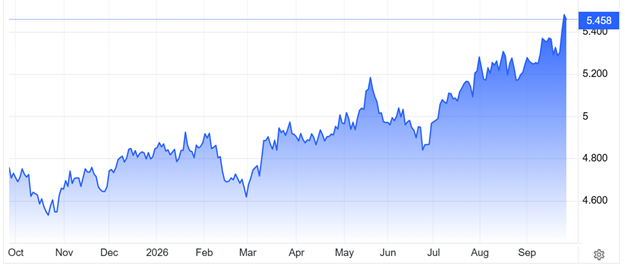
30-yr treasuries
Buyers are asking for more
The clearest warning came from the auctions, where the US government had to pay up to find buyers for its debt. The $70 billion five-year sale on Wednesday cleared at 5.033%, the highest auction yield since June 2006 and above the 5.002% the market expected going in.
The falling share taken by indirect bidders matters most. That group includes foreign central banks, and their pullback suggests the traditional buyers of US debt are stepping back just as supply keeps growing. This is probably a continued pull-back by other large countries from the role of the US as ‘global leader’. While nobody is suggesting that this is a deliberate policy by central banks, pundits know that not holding Treasuries, even selling them, is an effective way to ‘punish’ the USA’s anti-trade policies. US Treasury Secretary Scott Bessent has expanded buybacks of 20- and 30-year bonds since mid-August to cap long-term borrowing costs, but yields have kept rising regardless.
The Fed has turned
The US Federal Reserve raised rates on 16 September for the first time since July 2023, lifting its target range by 0.25% to 3.75% to 4.00%. The vote was unanimous, and Chair Kevin Warsh said inflation had been too high for too long.
More is expected. The Fed’s own projections show 16 of 18 officials expecting at least one more hike this year, with four pencilling in two. Having finally breken the no-rate-hike expectations from Trump with little reaction, perhaps another hike or two is more likely than not. After this week’s data, traders were pricing a better than 75% chance of another hike at the October meeting. Swaps imply around three more quarter-point hikes over the next year, which would take the Fed’s range to 4.75% to 5.00%.
The Fed’s inflation forecasts were also nudged up, to 3.7% for headline PCE and 3.4% for core this year.
Oil is the accelerant, and it is global
Brent crude closed Thursday at $106.60 a barrel, up 3.4% on the day and more than 17% higher in September. It briefly touched $108.23 after Houthi militants fired missiles at Saudi Arabia, including the Red Sea export hub of Yanbu. US and Iranian negotiators are talking on the sidelines of the UN General Assembly, but there is no deal to reopen the Strait of Hormuz yet.
Higher energy costs feed directly into inflation expectations, which is what bond investors fear most. The selloff is not a US-only story:
US mortgage rates have reached about 7%, roughly a percentage point above pre-war levels, showing how quickly bond moves reach households.
What it means for South Africa
The SARB raised the repo rate by 0.25% to 7.25% on Wednesday, its second hike this year, taking prime to 10.75% from 25 September. The decision was unanimous. August CPI rose only slightly to 4.4%, but Governor Lesetja Kganyago warned that the fuel shock has intensified and global rates are moving higher. Cobie goes into this in more detail below.
Keeping it in perspective
Rising yields are not only bad news. They reflect a US economy that is still strong: US nominal growth ran at around 8% in the second quarter, corporate profits remain healthy, and the Nasdaq closed at a record high as recently as Tuesday. Analysts note that as long as the move stays orderly, it is not overly dramatic.
The risk is that it stops being orderly. Higher yields raise government interest bills, lift mortgage and business borrowing costs, and put pressure on equity valuations that assumed cheaper money.
For long-term investors, a few points stand out:
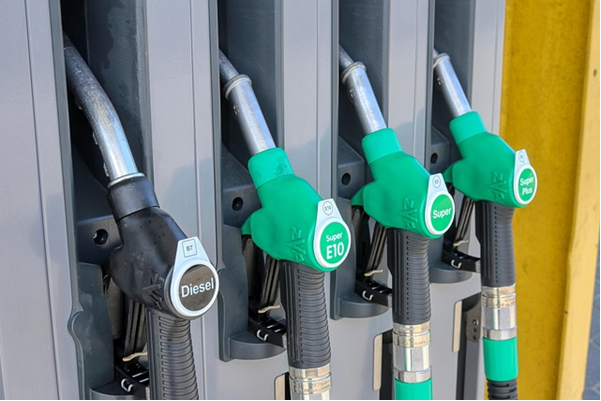
Diesel, Hormuz and the Export Ban Debate
This week showed that diesel is now the energy market’s real pressure point. US diesel futures fell 3.35% on Wednesday 23 September, to about $4.78 a gallon, on reports of a possible export ban. Brent crude went the other way, rising 3.9% that day and a further 3.4% on Thursday to close at $106.60 a barrel.
The gap between the two tells the story. Crude is still reaching markets, if slowly and expensively, around the Strait of Hormuz. Refined diesel is scarce because Middle East output, Russian exports and now possibly US exports are all constrained at once.
The export ban that may or may not happen
The White House has denied planning a flat ban, but the idea is not dead.
The political pressure behind the idea is real. The US average diesel price was $6.51 a gallon on Thursday, nearly $3 higher than a year ago, according to AAA. Farm-state Republicans, led by Iowa Senator Chuck Grassley, want relief before the November midterms.
US exports matter to the world. ULSD exports averaged about 1.27 million barrels a day last year and rose to about 1.57 million after the Iran war began. Exports in the week to 18 September dropped to 1.33 million barrels a day, which some traders hope eases the pressure for a ban.
Why a ban could backfire
Most analysts, including a former Trump energy secretary, think a ban would do more harm than good. The reasons are practical rather than ideological.
A ban might lower US prices briefly, but inventories would fill and force refiners to cut production.
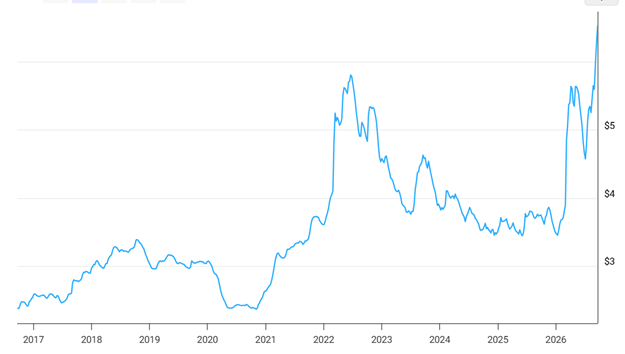
Diesel price average, USA
Thursday’s spike came when Yemen’s Houthis fired missiles at Saudi Arabia. Saudi forces intercepted six ballistic missiles aimed at Yanbu and Taif, and Brent briefly touched $108.23. Yanbu is the Red Sea terminal Saudi Arabia uses to bypass Hormuz.
That bypass was already fragile. Drone attacks shut the East-West Pipeline for over a week in mid-September. It restarted on Tuesday 22 September at a low rate. Reaching 40% of capacity would take days and a full recovery six to eight weeks. Before the attack, it carried about 4 million barrels a day, roughly 4% of global supply.
Diplomacy offers some hope. US and Iranian negotiators in New York are reportedly discussing a phased deal: Iran reopens Hormuz, the US lifts its naval blockade. A similar June memorandum collapsed within weeks. Iran’s President Pezeshkian told the UN that Hormuz stays shut while sanctions and the blockade remain.
What it means for South Africa
South Africa imports most of its refined fuel, so global diesel scarcity reaches our pumps directly. Motorists should prepare for another large increase on Wednesday 7 October.
Daily Central Energy Fund data points to under-recoveries across all grades. Projections reported on 23 September suggest increases approaching R3 a litre for petrol and some diesel grades. On those numbers, 50ppm diesel could exceed R33 a litre inland and petrol could near R30. Both would be records.
These are projections, not final prices. They move daily with international product prices and the rand, and published estimates earlier this month were closer to R2 a litre. The Department of Mineral and Petroleum Resources announces the official adjustment shortly before it takes effect.
The knock-on effects matter more than the pump price itself. Diesel drives freight, farming and mining costs, which feed into food prices and CPI. That makes the SARB’s inflation outlook harder, and the economy already contracted 0.2% in the second quarter.
What to watch
The diesel shortage is structural, so headlines about Washington will move prices without changing the underlying picture. US distillate stocks are about 13% below their five-year seasonal average, and Europe’s diesel prices stayed near records even after the White House denial.
Dates and events to look out for:

Global bond selloff reaches Japan
Japanese government bonds joined a deepening global selloff this week, as markets reopened after Japan’s three-day Silver Week holiday to find that the world had moved on without them. On Thursday 24th September the benchmark 10-year yield rose 10 basis points to 3.075%, its highest level since 1996, with the 5-year and 20-year yields climbing by similar amounts to 2.375% and 3.915%. The 5-year move is notable in its own right: it marked a record high for that maturity.
The trigger came from Washington.
The immediate catalyst was a sharp selloff in US Treasuries while Tokyo was closed. On Wednesday, the US 10-year yield jumped more than 13 basis points to 5.104%, a level not seen since July 2007, while the 30-year rose to 5.4%, its highest close since 2004. Two things caught markets off guard. S&P Global’s services PMI rose to 58.7 in September, a near five-year high, with manufacturing at 56.7, its strongest in over four years. A $70 billion 5-year Treasury auction then met lacklustre demand, and New York Fed President John Williams added that further tightening this year was likely.
This comes a week after the Federal Reserve raised rates for the first time since 2023, unanimously lifting the target range to 3.75% to 4.00%, with 16 of 18 officials seeing scope for at least one more hike this year. Markets now price a close to a 70% chance of another increase in October.
Oil remains central to the inflation story, with prices back above $105 a barrel as US and Iran talks show little progress. The effect is global: the average yield on Bloomberg’s Global Aggregate Treasuries index reached 3.99%, the highest since 2007.
Japan’s own central bank has not calmed nerves. The Bank of Japan raised its policy rate by 25 basis points to 1.25% on 18 September, the highest since 1995, but the decision was split 7-2. The two dissenters, are seen as reflationists appointed by Prime Minister Sanae Takaichi earlier this year. Markets had hoped for firmer guidance on the pace of future hikes. Instead, the dissents and the absence of any push for a larger 50 basis point move have raised concern that the BOJ is falling behind the curve on inflation. The new rate sits at the bottom of the BOJ’s estimated 1.1% to 2.5% neutral range, so policy is arguably only now ceasing to be stimulative.
Government finances are adding to the strain on longer-dated bonds. Japan is reportedly considering a defence spending target of 3.5% of GDP over 10 years, matching South Korea’s commitment, although a lower 3% target is also possible and officials say no figure has been decided. The wider numbers are sobering: the finance ministry expects debt-servicing costs to rise 17% to a record ¥36.64 trillion, assuming a 3.8% interest rate, with public debt above 200% of GDP.
A two-week slide took the yen back towards 160 per dollar, the level that has previously prompted official action. Strategists are divided. Some expect the threat of intervention alone to hold the line; others argue intervention is a blunt tool that will struggle without a more forceful monetary response. Japan’s solo interventions have historically faded when fundamentals were against them, so much depends on Washington. The US joined Japan in buying yen in July, when the currency jumped more than 1% from roughly 164 per dollar, and Treasury Secretary Scott Bessent has openly backed a stronger yen.
Friday brought some relief. The yen strengthened as much as 0.6% to 157.95 after Finance Minister Satsuki Katayama said President Trump shared concerns about the currency during a meeting with Takaichi in New York.
Why it matters for South African investors:Japan is the largest foreign holder of US government debt, and a world in which Japanese yields approach 3% gives Japanese institutions a reason to bring money home. (I am sure many of you rememebr the fallout from the Japanese Carry-trade crisis of August 2024). That matters for global bond markets, including emerging markets such as South Africa, which compete for the same pool of capital. Rising US yields and a firm dollar typically pressure the rand and local bond yields, and higher oil prices feed directly into South African fuel prices and inflation. For diversified portfolios, the lesson of this week is that bond markets, not equities, are currently setting the tone for global risk.
Author: Dawn Ridler

It’s telling how the interest rate environment has changed globally. In South Africa, the SARB last week hiked rates again to 7.25% p.a. I have seen some commentators strangely outraged by this. But whether one agrees or not with this is somewhat irrelevant when viewed in context with what is happening globally.
Global rates since 2021 have been going up even though the intention is for them to fall. South Africa has historically had higher rates to match our elevated inflation environment, but as inflation has crept into overseas markets, so too have their rates had to increase. The benefit a fixed income investor got in 2012 (SA:5% – US: 0.25%) by choosing to invest in the South African money market was much higher than what it is today (SA:7.25% – US: 4%). This makes the decision to place capital in South Africa a lot harder given the inherent currency risk against a backdrop of elevated geopolitical negativity against South Africa.
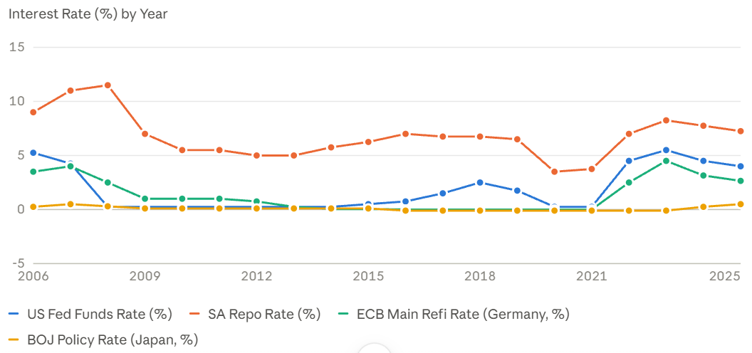
Even in Japan where rates have historically held at almost 0%, the interest rate has increased to 0.50%. So even though the SARB cited the escalating Middle East conflict and surging fuel prices as culprits, the need to be competitive from an interest rate perspective is equally important.
According to the MPC’s statement, the Middle East conflict has intensified since the committee’s last meeting, severely restricting oil flows through the Strait of Hormuz. Compounding the disruption, fighting in Yemen has interrupted Saudi Arabian oil exports, while the ongoing Russia/Ukraine war continues to damage refinery capacity and disrupt food exports through the Black Sea.
Kganyago described the combined effect as “a large, negative and persistent global supply shock” The statement notes that the European Central Bank, the Bank of Japan, and the US Federal Reserve have all raised rates recently, with the Fed hiking last week for the first time in three years.
Adding to the pressure, longer-term interest rates globally have also been climbing not only in the US but across the world, driven by global growth. If the current AI buildout is to be believed, there will be more growth to follow. US nominal GDP growth is trending higher and if it continues to rise it could rival the growth rates seen in the early 1980’s. This could very well imply that US 10-year yields could test the 6% level. As an example, currently South African 10-year yields are running at 8.9% vs US 10-year yields of 5%. Expect more upward pressure on local yields.
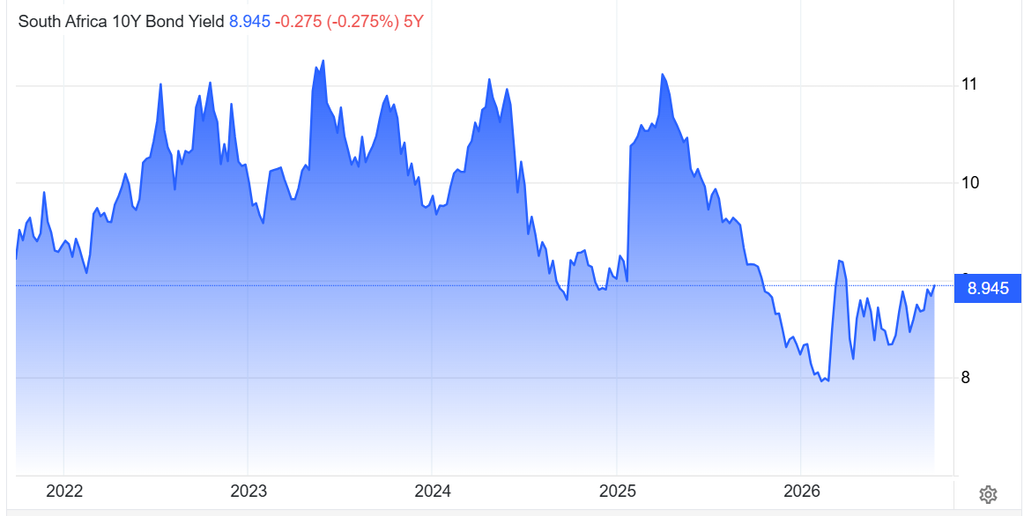
This upward pressure on yields will ultimately influence the multiple that equity investors are prepared to pay for shares.
US-10 year yields at 6% is a compelling alternative if the earnings yield for an equity is 2%. The 6% implies a forward P/E of 17x for an equity candidate and this may be the reason why we have seen large consumer companies selling down where growth is anaemic. Take PepsiCo as an example, which has been selling down for 5 years now. It’s share price, not surprisingly, is suggesting an earnings yield of 6%. Fast-growing equities should attract higher valuations but only if the growth continues to materialise. Failing that, slower-growing equities will take their cue from the bond market.
Author: Cobie LeGrange
EXCHANGE RATES and other Indices:
Rand/Dollar: weakened about 1% over the week, from around R16.26 at last Friday’s close to around R16.42 on Friday morning, having held between roughly R16.21 and R16.28 from Monday to early Wednesday before sliding past R16.40 on Wednesday on a firmer US dollar, its weakest level since early August. It has since improved and is now at 16.28. The Rand/Dollar closed at R16.28 (R16.25, R16.11, R15.95, R 16.09, R16.02, R16.17, R16.14, R16.55, R16.47, R16.31, R16.22, R16.40, R16.39, R16.27, R16.55, R16.23, R16.46, R16.68, R16.39, R16.63, R16.29, R16.41, R17.07, R17.06, R16.89, R16.55, R15.93, R16.01, R15.96, R16,03, R16.15, R16.10, R16.50, …R16.91, R17.13, R17.36, R17.13,16.52 )
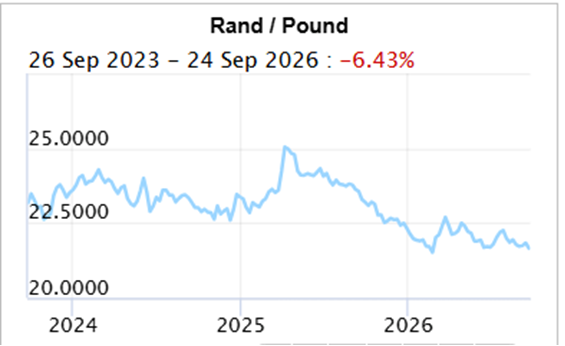
Rand/GBP: broadly flat, at around R21.72 to R21.75 on Thursday versus about R21.78 at last week’s close, with a low of about R21.67 on Tuesday, 22 September. As with the dollar, this improved over the weekend. The Rand/Pound closed at R21.57 (R21.77, R21.79, R21.56, R21.79, R21.86, R21.88, R21.78, R22.31, R22.16, R21.86, R21.64, R21.64, R21.67, R21.80, R22.06, R21.80, R22.09, R22.21, R22.30, R22.56, R22.35, R22.02, R22.09, R22.77, R22.76, R22.35, R22.20, R21.48, R21.59, R21.78, R21,82, R22.11, R21.97, R22.13, …R22.57, R22.68, R22.74, R22.56,
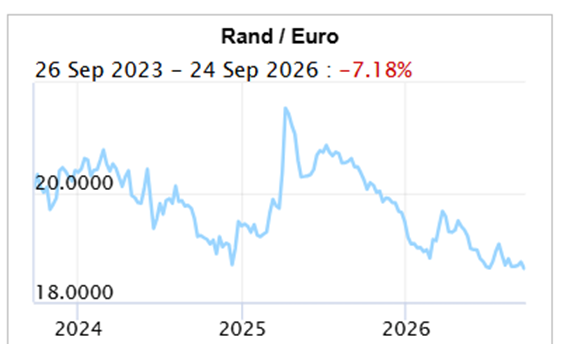
Rand/Euro: little change at around R18.67 on Friday morning, in line with last Friday’s level of about R18.67, having firmed to about R18.50 on Wednesday, 23 September, before giving that gain back. Volatility is the name of the game, and the rand/euro improved against all currencies over the weekend. The Rand/Euro closed the week at R18.55 (R18.67, R18.68, R18.52, R18.60, R18.72, R18.71, R18.66, R19.09, R18.84, R18.62, R18.52, R18.66,R18.89, R19.16, R19.08, R18.91, R19.11, R19.38, R19.29, R19.48, R19.37, R19.17, R19.24, R19.70, R19.77, R19.33, R19.23, R18.80, R18.87, R18.94, R18.93, R19.14, R19.04, R19.20)
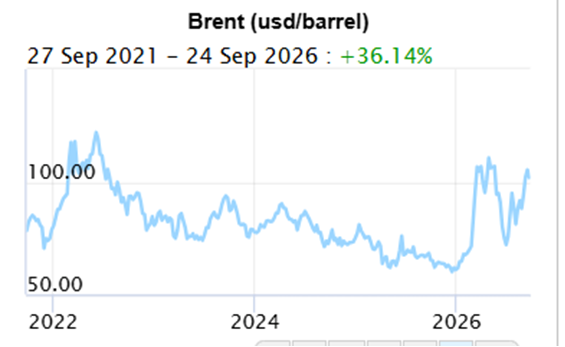
Brent crude dipped below 100 US dollars a barrel on Tuesday after Saudi Arabia restarted its East-West pipeline and US and Iran talks raised hopes of more Hormuz flows, then rebounded to settle at 106.60 US dollars on Thursday, up 3.4% on the day, and was trading near 105.70 US dollars on Friday morning and has since slipped.Brent Crude: Closed the week at $104.32 ($103.87, $104.61, $96.28, $88.29, $94.39, $88.52, $83.55, $87.93, $88.10, $76.01, $72.10, $71.99, $80.59, $87.33, $93.09, $91.12, $104,24, $109.26, $101.29, $108.83, $105.33, $90.38, $95.20, $107.88, $112.36, $103.14, $92.88, $73.19, $71.76, $67.75, $68,05, $69.32, $65.88, $63.34, …$63.71, $63.19, )
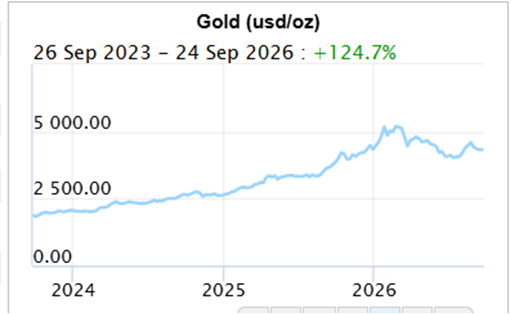
Gold fell over the week, from around 4,360 to 4,370 US dollars an ounce early in the week to about 4,262 US dollars on Thursday, its lowest since 17 September, after a 1.6% drop on Wednesday as surging Treasury yields and a firmer dollar weighed on it, and was near 4,257 US dollars on Friday morning, since recovering slightly.Gold: $4,285 ($4,379, $ 4,454, $4,607.35)
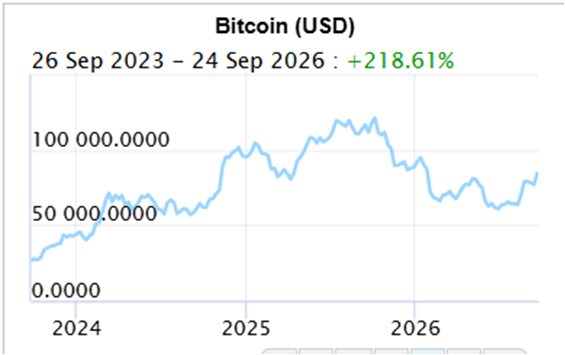
Bitcoin rallied to about 87,400 US dollars on Monday 21 September, its highest level since January, as US spot bitcoin ETFs took in almost 1 billion US dollars in a single day (their largest daily inflow of 2026) and short positions were squeezed, before easing back to around 84,000 US dollars by Thursday and Friday morningand easing off a tad over the weekend.Bitcoin closed at $83,725 ($80,354, $76,582, $79,776, $78,701, $76,532, $62,911, $64,921, $63,143, $64,718, $63,815, $62864, $60,063, $64,029, $64,131,$60,762, $73,788, $74,559, $77,879, $80,733, $78,204, $78,049.98, $75,519, $70,904, $68,691 , $68,586, $70,869, $67,310, $63,534, $68,04, $69,649, $68,553, $81,301, $89,295, $90,585,)
Articles and Blogs:
Investment series part 6 (NEW)
Investment series part 5 (NEW)
Investment series part 4
Investment series part 3
Investment series part 1
Investment series part 2
Legacy Series Part 4
Legacy Series part 3
Legacy Series Part 2
Legacy Series Part 1
Holiday checklist
Next year – Action Plan
Next year – Vision, Mission etc
Medical Risk Mitigation
Next Year – Consolidation
Abdication or diversification?
Carbo-loading your retirement Spoiled for choice
Who needs a plan anyway
8 questions you need to ask about retirement
What to do when interest rates drop
How to survive volatility in your investments
What to do when interest rates drop
Difficult Financial Conversations
Financial Implications of Longevity
Kick Start Your Own Retirement Plan
You matter more than your kids in retirement
To catch a falling knife
Income at retirement
2025 Budget
Apportioning blame for your financial state
Tempering fear and greed
New Year’s resolutions over? Try a Wealth Bingo Card instead.
Wills and Estate Planning (comprehensive 3 in one post)
Pre-retirement – The make-or-break moments
Some unconventional thoughts on wealth and risk management
Wealth creation is a balancing act over time
Wealth traps waiting for unsuspecting entrepreneurs
Two Pot pension system demystified
Cobie Legrange and Dawn Ridler,
Rexsolom Invest, Licensed FSP 45521.
Email: cobie@rexsolom.co.za, dawn@rexsolom.co.za
Website: rexsolom.co.za, wealthecology.co.za